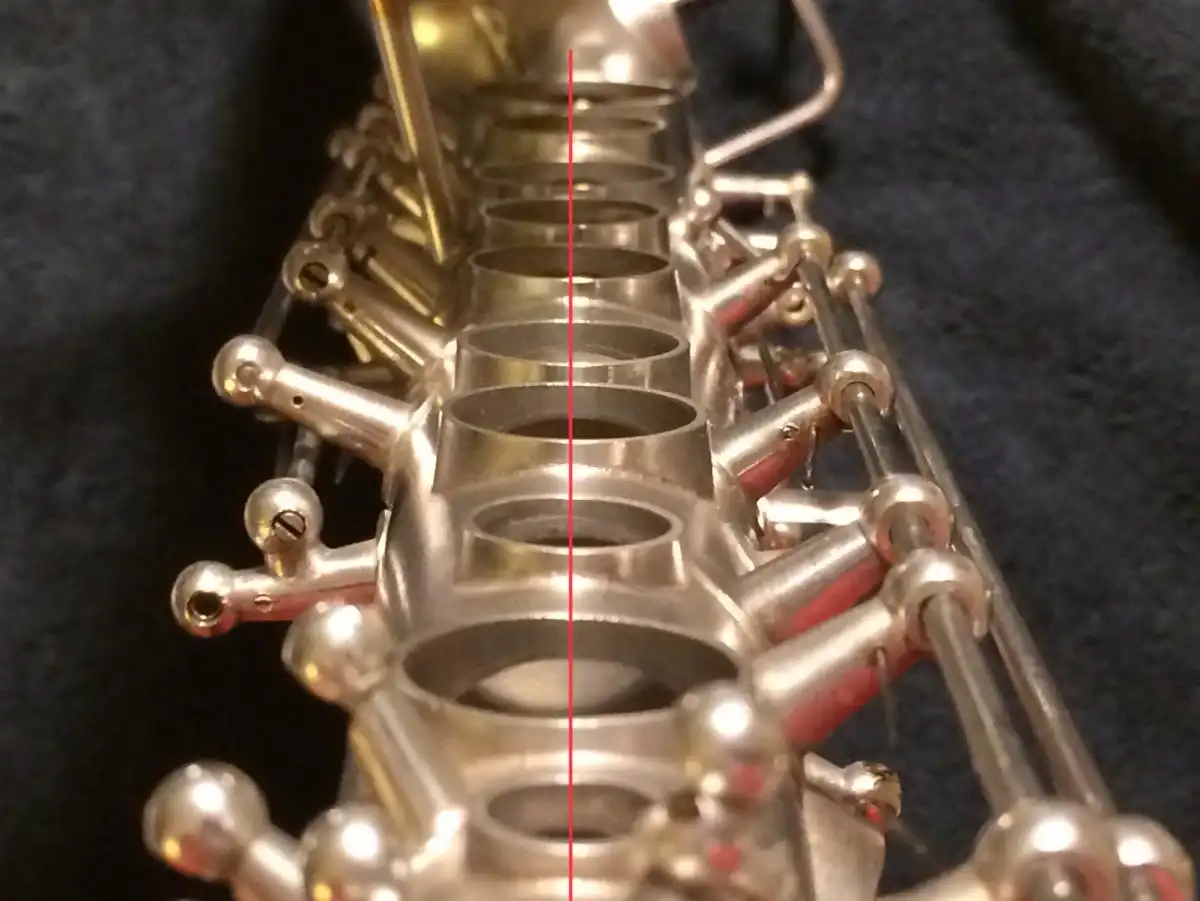
Tech/maintenance Talking of tone hole files...

A metal saw, bench grinder and scrap metal are your friend. I’ve had more successes than epic failures. Make whatever you need. Use it gently.
ACF5A24F-FC3A-414A-A4BD-8336A05FC95D.webp
9281882F-FC13-4411-8A84-F3882C9AE2F2.webp
CE07CEBE-644D-46D5-8197-D73300D8CCFA.webp


Some of the old ones with soldered tone holes have pretty stout chimneys.
The ones with drawn tone holes usually have a crown at the thin centerline. I think this is what everyone is trying to describe. The typical high area.
600A7893-2E18-4335-AB68-1DEF61BEAD02.webp
 
The ones with drawn tone holes usually have a crown at the thin centerline. I think this is what everyone is trying to describe. The typical high area
I’m no tech, but surely if there is something that is a high area then the best thing is to make it lower. That can’t be difficult.

But if there is a low area, then it needs to be higher. That seems to be more tricky IMO.

So filing could deal with a high area but should not be used to such an extent to level it down to a low area
 
I’m no tech, but surely if there is something that is a high area then the best thing is to make it lower. That can’t be difficult.

But if there is a low area, then it needs to be higher. That seems to be more tricky IMO.

So filing could deal with a high area but should not be used to such an extent to level it down to a low area
Each unit is completely different. It’s a judgment call. Often it’s hard to knock something down. given the location it’s easy to raise a little. I try to pick the route that’s the least intrusive. Same as Steve. Always thinking about long-term life of the instrument. It’s a shame to trash one that’s already lived 100 years with good care.
None of this is extremely difficult. Yes a bit of a learning curve. Mostly finesse in tool choice / use. I don’t think you would trim the roses with a chainsaw. Could get ugly.
 
What you have here is metal deflection in the facing operation. "Metal memory" ain't happening, not in a ductile material like 26000 brass, not when you are talking about temps like 40-50C max, which is WAY lower than any stress relieving temp.

But if you look at PS's picture of the toneholes all in a row, and imagine you're in the factory facing off those chimneys with a dull cutter, the force exerted downward by the cutter is going to be well resisted at the "sides" of the chimneys (away from the red line) because the tube wall's nearly vertical there. It's going to be weakly resisted at the top and bottom (along the red line) because the tube wall's being placed in bending stress here, plus on the main stack it's just the little bridge between tone holes that's resisting that deflection. When you remove the cutting reaction force, then, and the material springs back, the top surfaces of the chimneys won't be flat; they'll be higher along the red line.

The fact that cutters wear with use, and are resharpened with varying degrees of success, and the semi-manual nature of this process that I've seen in old films (it looked like they basically use a drill press and the operator feeds the tool by hand so the amount of force and rate of feed are variable) helps to explain why the degree of unflatness varies from one instrument to the next. Keeping the cutters properly sharp and changing them or sharpening them, on a proper sharpening fixture, is the way to prevent this, but of course it's a little late to go back 80 years and enforce proper tool management in a factory of the past.

The thing about any kind of lapping process is that if the lap can rock back and forth (as in, a tone hole with two high spots) you can lap and lap and lap and end up taking as much or more from the low spots and actually make the problem worse. You really need to know what you're doing before you start grinding and filing on your horn.
 
What I really needed was a range of sacrificial shims to insert either side of the high points, as pictured by @PigSquealer above.

If the high points were, say 1mm above the low rim either side...
Screenshot 2022-05-10 at 13.53.31.png

... I could insert a 0.5mm shim each side for the rotary sanding disc to bear on if it tipped one side or another. This would stop the low rim from being damaged whilst wearing away the peak. The shims might be made of steel to lessen abrasion, although this would wear the sanding surface more quickly, cause extra friction, and cause more frequent replacement of the sanding material. The 0.5mm shims would be replaced by 0.25mm shims, 0.1mm shims until the peak has all but gone. Then all shims removed for a final skim to level.

Or... how about a 'U' section shim which is inverted and fitted over the TH rim and moulded to its curve as it's fitted. This would aid its retention whilst filing and reduce friction, although it would still need some kind of external clamping ring right around it and the TH to stop it moving.

Screenshot 2022-05-10 at 14.22.46.png


For a single high point, the U shim would go all the way around the TH apart from where the high point starts and ends, a 3/4 circle perhaps.

Anyhow... the idea of protecting low areas whilst removing high points with a rotary file seems to be the way to stop the file tipping onto the area of least resistance.

Anyone still with me...?

Having said all that, I was only very slightly off with my "flat the peak first" trial.
I will think further on this rim protection idea... might not get anywhere though.

 
My understanding from what was said above, the process as used by Buescher in the old days was good, unless the tools were worn in which case the extra pressure required to flatten would cause the distortion of the tube and hence the inaccurate flattening occurred.

So if that's the case sure the best option is to use the right tool in good fettle, as opposed to making up something to compensate for less than adequate machinery maintenance.

toneholes.webp
 
My experience making toneholes perfectly flat using both mechanical means--lifting and tapping, and judicious filing with circular diamond grit files has taught me that toneholes behave differently from one horn to the next and even on the same horn depending upon the locations. This means that it is an ongoing learning process regardless of how much one has done in the past.

I find that tapping down the high spot(s) using a plastic mallet and an oak or delrin dowel very often turns into "chasing" new high spots as the previous ones are lowered. When there are 3 or more high spots remaining, the height of those spots can be then determined by using a .001" feeler gauge in the low spots that show light coming through. If there is just the smallest amount of "drag" felt when pulling the feeler in the low areas, I feel comfortable using the rotary file to remove the remaining high places producing a flat surface.

Something I have learned from discussions with the Music Medic techs is that the instant that the file contacts the entire circumference evenly having brought down the high areas, there is a perceptively different "feel" and the cutting is much less "aggressive" due to the increased surface cutting area. When I sense that change is when I reverse the brass disc and check the tonehole for flatness. Occasionally when it is very close to perfect, burnishing the top of the tonehole using the brass disc takes it the rest of the way. In my experience using the diamond grit files, no further finishing is necessary other than removing any burrs created by the filing.

For those who have an interest in the history of tonehole filing, I have attached an article written by George Jameson that was re-printed by permission in the NAPBIRT bi-monthly magazine called the "TechniCom".
 

Attachments

Last edited:
My experience making toneholes perfectly flat using both mechanical means--lifting and tapping, and judicious filing with circular diamond grit files has taught me that toneholes behave differently from one horn to the next and even on the same horn depending upon the locations. This means that it is an ongoing learning process regardless of how much one has done in the past.
...

I would add that it's important that the final checks/adjustments for flatness are done in the playing position.
This is essential for the low Bb/B toneholes at the very least. You can spend as long as you like getting the toneholes flat while the horn is horizontal - but as soon as you stand it upright you're looking at at least half a thou of deformaration (unless it's a Martin). Low C# tends to be reasonably stable. low C can be iffy, low Eb doesn't matter that much - but you can still see stress warps from low D upwards. G and A are the two you really need to keep an eye on.
 
My experience making toneholes perfectly flat using both mechanical means--lifting and tapping, and judicious filing with circular diamond grit files has taught me that toneholes behave differently from one horn to the next and even on the same horn depending upon the locations. This means that it is an ongoing learning process regardless of how much one has done in the past.

I find that tapping down the high spot(s) using a plastic mallet and an oak or delrin dowel very often turns into "chasing" new high spots as the previous ones are lowered. When there are 3 or more high spots remaining, the height of those spots can be then determined by using a .001" feeler gauge in the low spots that show light coming through. If there is just the smallest amount of "drag" felt when pulling the feeler in the low areas, I feel comfortable using the rotary file to remove the remaining high places producing a flat surface.

Something I have learned from discussions with the Music Medic techs is that the instant that the file contacts the entire circumference evenly having brought down the high areas, there is a perceptively different "feel" and the cutting is much less "aggressive" due to the increased surface cutting area. When I sense that change is when I reverse the brass disc and check the tonehole for flatness. Occasionally when it is very close to perfect, burnishing the top of the tonehole using the brass disc takes it the rest of the way. In my experience using the diamond grit files, no further finishing is necessary other than removing any burrs created by the filing.

For those who have an interest in the history of tonehole filing, I have attached an article written by George Jameson that was re-printed by permission in the NAPBIRT bi-monthly magazine called the "TechniCom".
Interesting article I had not read that one. No doubt pillow pads made a big difference. Thanks for the post !
 
I would add that it's important that the final checks/adjustments for flatness are done in the playing position.
Based on your remark I changed my method 0f installing my synthetic pads. The silicon contact area with the tone hole is now solidified with the saxophone in the playing position.

I noticed that the pads on the bell needed more corrections, Your observation could be the reason for that. It will take some time to see if it really reduces the amount of corrections.
 
I'm sure it will help.

Another thing to watch out for with the bell keys is flex in the keys. Even with the flattest tonehole and the most perfectly seated pad, it sometimes goes that a small leak pops up at the 2 o'clock position (where the outside centre of the pad is 12 o'clock) . When this happens you have to add a bit of 'bias' to the pad to account for the flex - just as is sometimes necessary on the left side of the Aux.F pad to accommodate the tension introduced by the Bis Bb/G# adjusters.
 
Ads are not displayed to logged in members. Yay!
For what it's worth I have a set of rotary tonehole files which I made shortly after leaving college. Hand driven -not by a drill. I rarely ever use them and prefer to tap down high spots and raise low spots using similar tools and methods to Stephen H.
I have seen tone holes filed down so much that I have had to resort to soldering in inserts - which isn't ideal either but it saved the saxes from the scrap heap.
 
I am working on an alternative method. I heat my home made polyester/silicone pads and bend them to the shape of the tortured tone hole. It gives a good result.
So you are torturing your pads to match the imperfect tone holes. In other words, creating imperfect pads to create an imperfect horn in every way!?

I get the idea, but I don't like the trend...

Why not fix what's wrong in the first place?

That's, skewed, ain't it?
 
If you took the wavy pad/tone hole theory to extremes you'd find as the angles increased there would be friction lifting the pad away due to the convex pad edge getting "stuck" in the convex tone hole "V" shaped edge, or vice versa.

My experiment with silicone sheet, both solid and foam, quickly ruled it out as a pad material as it tended to want to stick to the tone hole, especially when wet. This may be due to its skin which was very slick.

I've not tried silicone sealant (wouldn't work for my pads) which must behave differently for @Woodpad to continue to use it.
 
So you are torturing your pads to match the imperfect tone holes. In other words, creating imperfect pads to create an imperfect horn in every way!?

I get the idea, but I don't like the trend...

Why not fix what's wrong in the first place?

That's, skewed, ain't it?
I agree with the idea that you have to fix the things that are wrong first. The first problem is that
pads wear faster than tone holes.

It is bad practice to torture parts with slow wear to fit them to parts with fast wear. So I want to fix that.
 
I've thought about the 'which one's wrong, the tonehole or the pad?'
a little- because, on most of the baris I work on,
it's pretty obvious that the makers of the instruments (King, Beauginer, US Selmer, Buescher, so far)
didn't get the tone holes very flat, by modern standards. A few tenths of a mm was pretty good, put
soft pads on it, and send it.
So just like over- restoring a 60's automobile that left the factory with
pretty mediocre bodywork, slapdash assembly and parts already failing-
how good SHOULD the toneholes be?
How do you 'fix' something that was never really exact to start with?
Was that 'perfect vintage sound' a result of the way the horn was made, or despite it?

I'm not sure there's ever an answer- me, I look at the original horn, its current condition, what we're going
to use it for, and then do what seems right to me. Because, at the end of the day, I'm my own worst critic.

t
 

Similar threads... or are they? Maybe not but they could be worth reading anyway 😀

Popular Discussions on the Café

Latest Song of the Month

Forum statistics

Topics
31,925
Messages
565,071
Members
7,965
Latest member
Rockin-Baz
Back
Top Bottom