Playing the saxophone Key transposition from Eb instrument to Bb instrument

Learn a scale. Play a simple song in the same key.

Do you notice there are fewer wrong notes to guess from?

Read the last many threads from musicians trying to support you. There is enough information to keep you going for years - if you care to use it.

Enjoy the path.
 
Learn a scale. Play a simple song in the same key.

Do you notice there are fewer wrong notes to guess from?

Read the last many threads from musicians trying to support you. There is enough information to keep you going for years - if you care to use it.

Enjoy the path.
Thanks @Dr G ....I am really grateful for all the support here....all ideas and advice will be used....my plan is to choose a song Jambalaya was the last one, its works well the carpenters version. Buy the score and transpose myself this is good for dot reading and scales, play to the original song re tempo and rhythm, learn the scale, fill in the instrumentals by ear..I think this encapsulates most of the advice here.....this covers the playing side and I am trying to run learning theory alongside it...Again with thanks to everyone who contributed..
 
Ads are not displayed to logged in members. Yay!
If you're serious about learning the circle, there are only 3 things to memorize, "G", "GCF" and the word "BEAD". This gives you the circle in the 4ths direction, which is the most useful way. "GCF" is on the top, then clockwise to "BEAD" (all flats), then Gb at the very bottom, then "BEAD" again (naturals).

Unlike the good doctor, I think knowing the circle is necessary for learning your scales and key signatures.

When I was a kid in school, by the end of our first year of band class, we were expected to have memorized all our major scales. I hated practicing them, so I got so I could play them all in under a minute. Jay Metcalf (bettersax.com on youtube) does all of his in 30 seconds, but he does one scale ascending and a different one descending, so it's only have as many notes. Either way is a great exercise and a way to keep them under your fingers and in your brain forever without taking hardly any practice time at all.
Hi thanks @lydian...I am going to look into the circle in my literature....but does it matter if I start on the C as having no sharps or flats and work clockwise to F#...then back to F (Dm) and then BEAD..Is remembering it the important thing....is there a formula for what sharps are in each key sig.....Thanks again for all the support Eddie
 
Yes, there is a lot of theory you don't need right now. But you do a LOT of transposing, so the construction of the major scale and knowledge of all key signatures is inescapable, hence the circle of 5ths is required. If you didn't transpose written music and only played by ear, I'd agree you could skip the theory. But that's not the case with you. You rely heavily on written music and written transposition. The easier path would be by ear, if you're willing to try it.
I'm definitely willing to try it...I use transposing and scores to read music and try to understand scores...I'm getting fed up playing alone and if I want to play with others I have to learn music its a need... what I want to do is play.. 🙂........The next part of my cunning plan is to fill in the instrumental parts by ear....at least i can play the rest of the song which keeps me happy...I also have to learn the relevant scale which helps the theory side...All advice and support from everyone gratefully received and not ignored....
 
I think Colin is referring to the names of keys as you look at the circle of 5ths, not the notes contained within the actual scales. Probably best not to dwell on this at this point.

Yet another tip.

As you learn your scales practice them starting on a different note. Stay within the scale you are learning e.g. if C,D,E,F,G,A,B,C is your basic scale, play it right up and down the instrument, then, when you are comfortable with it, start on D - D,E,F,G,A,B,C,D, then start on E etc all up and down the instrument ending on the starting note. After you have this down try playing notes 1,3 and 5 of the scale starting on all the notes of the scale, up and down, so (1) C, (3) E, (5) G, then, starting on D - D,F,A. Do the same with all notes in the scale. You are just skipping a note in the scale. Take it slow to begin with and you will find that you quickly get familiar with this. If you do this you will really start to know the scale. The time you spend on this will repay itself 100 fold.
 
Last edited:
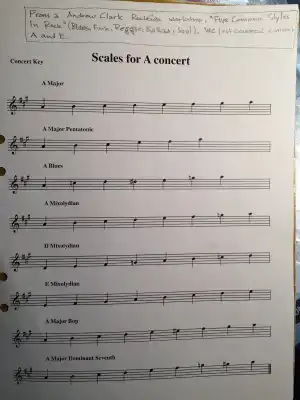
To know the major scales is good. But to know the other scales is also good. What scales fits best to song you're right now learning/playing? Maybe the D mixolydian scale shouldn't be on this page? But it made sense when we heard it on the workshop. Scales in A, so you have to transpose to other keys. When I write down things, it's easier for me to learn/remember.

skalor i A.JPG
 
Hi thanks @lydian...I am going to look into the circle in my literature....but does it matter if I start on the C as having no sharps or flats and work clockwise to F#...then back to F (Dm) and then BEAD..Is remembering it the important thing....is there a formula for what sharps are in each key sig.....Thanks again for all the support Eddie
Yes there is a formula which will be clear to you when you study the circle. There’s no point to n describing it here when the picture is so much clearer.
 
losing this already I thought F had a flattened
He said keys with no sharps or flats in their NAME. The name of F is just the letter F. The name of Eb is the letter E and the b symbol. In other words there is a flat in the name Eb. Again, obvious when you look at the circle but confusing when it’s described in words. Get a picture of the circle and study it.

I bet you already know the circle and don’t realize it. For example, how would you know what sharps are in the key of B if you didn’t already know the sequence F# C# G# D# A# which is in the circle?

Just as much as multiplication tables are fundamental to maths, the circle is fundamental to keys. Every reading musician must memorize this fundamental thing. Thinking of it as a circle works for most people, but if a line or sequence works better for you, then think of it that way. It’s just a way to organize and relate keys to one another in a way that’s easy to remember and understand. Since it is just 5ths (or 4ths in the opposite direction), it's sufficient to be able to find the next note a 5th away, i.e., F to C is a 5th, C to G is a 5th, G to D is a 5th and so on. Memorizing these (picturing the circle in your mind) lets you skip the step of walking up the scale to the 5th, which would be analogous to counting when doing addition rather than relying on memorization of simple sums.
 
Last edited:
losing this already I thought F had a flattened
Eddie didn't you say a little while back you had a teacher, if so what's he/she teaching you, scales, chords should have been on the top of the teachers list, you have had a lot of help from posts above but what lydian said learn you circle so that it is second nature and learn your scales from memory so that they are under the fingers.
 
I never learned to play all major scales up and down. I just couldn't understand the use of doing this. I learned how to use the scales later.
Kind of what im doing i guess...good for muscle memory and playin by ear i guess..at least if you know the key sig and scale snd ha
Teacher: Hi Eddie. So, now, what syllabus have you been following
eb424: well, there's this thread, and that thread and some others. A bit confusing...
Trachers teaching syncopation and rhythm his own syllubus.. hes played pro
for 40 years... im too old for grades, dont like jazz., cant read dots quickly enough but enough to transpose..guess im following my own syllubus really...taking from theory what i need to have fun....or just to play with others...there has to more than one way of learning..
 
Eddie didn't you say a little while back you had a teacher, if so what's he/she teaching you, scales, chords should have been on the top of the teachers list, you have had a lot of help from posts above but what lydian said learn you circle so that it is second nature and learn your scales from memory so that they are under the fingers.
I am doing...all my posts say i play scales....
 
I am doing...all my posts say i play scales....
When you play a given scale, how do you know what sharps or flats are in it? Do you look it up in a table somewhere, or do you already have some system to remember? Or do you always just read the scale from the page that already has the correct key signature? If you saw a particular key signature, say 4 flats for example, would you know what key that was, and if so, how?

You're right that there are many ways to learn, but the information that ends up in your brain is the same no matter which path you took. I'm just wondering how you manage scales and keys right now using whatever learning method worked for you.

When I was a kid, I first learned all my scales by ear. If the new scale I was learning sounded like the other scale I already knew, then I had it right. I had no idea about keys or flats and sharps. That worked fine until I started reading music in different keys. At that point I had to learn how to tell what key signatures meant and which notes were supposed to be flat or sharp. Without some sort of system, i.e., the circle of 5ths, it would have been extremely difficult for me to memorize that amount of information. I'm just curious how you do it and what learning method has worked best for you.

The way I identify keys is look at the last sharp and raise it one semitone or look at the next to last flat. For example, if the last sharp is D#, one semitone up is E, and that's the key (E). If the next to last flat is Eb (and the last flat is Ab), then the key is Eb. If the key is known, but the key signature is not, then I use the above rules in reverse plus the circle to fill in the blanks. So for the sharps in B, going down a semitone to A#, tells me the final sharp. Going around the circle, I start at F# then C# G# D# and know to stop at A#. For flats, taking Db as an example, I know Db is the next to last flat. I start going around the circle from Bb then Eb Ab Db then add the next flat after that, Gb. Sounds complicated, but I've not come across a simpler way to do it. If I didn't teach my students this as soon as they started learning the different keys, no matter how young or old they were, I'd have failed as a teacher. Any musician who reads music is going to be lost if they don't understand keys.
 
Last edited:
Eddie didn't you say a little while back you had a teacher, if so what's he/she teaching you, scales, chords should have been on the top of the teachers list, you have had a lot of help from posts above but what lydian said learn you circle so that it is second nature and learn your scales from memory so that they are under the fingers.
I do @jazzdoh....we don't focus to much on scales to much more syncopation...I had a teacher and thats all we did I didn't go back after a few lessons...£ 40 to learn something I could do by myself indoors didn't really seem like value for money......to get me in context I have been playing around 5 years....I started on a book called blowout sax....the book doesn't focus on the traditional way of learning music...this suited me fine I was 50 with arthritis and COPD and I wasn't sure how long my health would allow me to play...playing was what I wanted to do and this seemed a fast track simple way of doing it, written notes and backing track...I remembered notation from school so I could buy scores and use this approach on any tune.....All I do is transpose and write the note circling it if its high...At the time I was playing once or twice with a mate and it was fun...I then met a pro player and he came for a blowout and used the same method...We play the whole song he's done some good if unexpected songs all of which I liked...Fantastic playing with people...Then my first mate moved away and I was playing alone over the hall, not so much fun.....Time is difficult with a small council house full of adults I play either at the church hall or in my caravan...neither are ideal..... I am replying to this post now as I started work at 8.30 am yesterday and got in at midnight...another issue time but I still manage 10-15 hours a week playing time..its what I love doing..The above method requires some basic theory....I know you can play any song in any key....but why would you...I play to the original track and use the words as my rhythm..and am doing ok for the time I have dediated which I believe should be measured in hours and not years...you could have played an hour a week for twenty years...20 years sounds a long time...I am learning on an as required basis and can manage to play Bobby Mc Gee but there's no technique it is pretty good pitch wise but technique is my next on my agenda to give my songs some emotion....also to play the instrumentals by ear (sorry can't remember the proper word) but at least I am playing quite well whilst learning and this is the important thing for me....I love learning and the theory side will catch up with my playing ability...which is ok for where I am...If I didn't mark the scores with note names I would never be able to play the songs I enjoy playing and would have given up by now...I'll keep practicing playing by dots but songs like Bobby McGee would be out of reach, I don't know if I'll ever be fast enough note reading wise to play it but will persevere so as I can play with others...
 
When you play a given scale, how do you know what sharps or flats are in it? Do you look it up in a table somewhere, or do you already have some system to remember? Or do you always just read the scale from the page that already has the correct key signature? If you saw a particular key signature, say 4 flats for example, would you know what key that was, and if so, how?

You're right that there are many ways to learn, but the information that ends up in your brain is the same no matter which path you took. I'm just wondering how you manage scales and keys right now using whatever learning method worked for you.

When I was a kid, I first learned all my scales by ear. If the new scale I was learning sounded like the other scale I already knew, then I had it right. I had no idea about keys or flats and sharps. That worked fine until I started reading music in different keys. At that point I had to learn how to tell what key signatures meant and which notes were supposed to be flat or sharp. Without some sort of system, i.e., the circle of 5ths, it would have been extremely difficult for me to memorize that amount of information. I'm just curious how you do it and what learning method has worked best for you.

The way I identify keys is look at the last sharp and raise it one semitone or look at the next to last flat. For example, if the last sharp is D#, one semitone up is E, and that's the key (E). If the next to last flat is Eb (and the last flat is Ab), then the key is Eb. If the key is known, but the key signature is not, then I use the above rules in reverse plus the circle to fill in the blanks. So for the sharps in B, going down a semitone to A#, tells me the final sharp. Going around the circle, I start at F# then C# G# D# and know to stop at A#. For flats, taking Db as an example, I know Db is the next to last flat. I start going around the circle from Bb then Eb Ab Db then add the next flat after that, Gb. Sounds complicated, but I've not come across a simpler way to do it. If I didn't teach my students this as soon as they started learning the different keys, no matter how young or old they were, I'd have failed as a teacher. Any musician who reads music is going to be lost if they don't understand keys.

Hi @lydian please refer to my reply to @jazzdoh for a bit of background on how I currently play..also a genuine thanks for all the support...in reply to @mizmar s post

"Teacher: Hi Eddie. So, now, what syllabus have you been following
eb424: well, there's this thread, and that thread and some others. A bit confusing..."

I have never been asked what syllabus I am following...A good teacher would assess your skillset, ask what your goals are and formulate a way of getting you there....as far as I can see there is only one "syllabus" for music and one method of assessment that is the "Grades" not suitable for everyone so everyone me included......I would also like to say that I try to use the threads to get over specific issues I have with the theory side it's not a syllabus..E.G.. my thread Jambalay initially asked if anyone knew what key Jambalay by the carpenters was in....it was G major....but the thread brought up a lot of other issues some good and relevant and some not so much like which is the best version and playing by ear...which is all part of my plan....This thread was started because I misunderstood a quote regarding transposition from an Eb to a Bb instrument which was irrelevant and I took the quote out of context and here we are talking Chords and the circle of fiths which technically should be another post... 🙂 I would like to say that when I answer questions on here I try to do it from my knowledge rather than look up answers on the internet, this can sometimes make me look a bit thicker than I really am...i refer to @Colin the Bears post on the circle of fifths regarding the Key Signature F again it's context and I think I had said I started with C for cool as there were no # or flats in the scale...I am starting to understand the value of discourse.....in answer to your questions

"When you play a given scale, how do you know what sharps or flats are in it? Do you look it up in a table somewhere, or do you already have some system to remember? Or do you always just read the scale from the page that already has the correct key signature? If you saw a particular key signature, say 4 flats for example, would you know what key that was, and if so, how?"

All of my songs to date have been on the # side of the circle...I need to study this more in depth but came up with the acronym above re Gorrillas starting at C which I now has no #or Bs...it was noted by Mr Bear that I had it slightly wrong as said I try to do it from memory...I work from C through to F# or Gb Cool Gorillas Do Aerobics Evenings (do prefer and will use Energetically as suggested) Bare (for) Fun so I know C has no #s or Bs G 1 D2 A3 etc...need a format for working out what #s and Bs but will study the circle it is important for me...As said all of my songs have been on the #side so I have looked through my music for a b number...I play when I'm 64 and have been playing in the wrong key...originally it was C# or Db I would normally transpose from C# but will go from Db to Eb to bring in the other side of the circle..I appreciate what you told me to remember regarding this above but was trying to answer your question on how if you asked me re sharps it would have been easier to answer....

"You're right that there are many ways to learn, but the information that ends up in your brain is the same no matter which path you took. I'm just wondering how you manage scales and keys right now using whatever learning method worked for you."

I manage in context to the piece of music I want to learn....I am going to say this I know I shouldn't and am sitting here arguing with myself (internally thankfully 🙂 )....I don't see the point of learning and practicing scales independently...there i've said it... This doesn't mean I don't see the value of scales I just prefer learning in context...My warm up routine is playing the snippets in the orange book and the accompanying scale (8 or so with arpeggio)... then playing my songs and the accompanying scales...again I shouldn't say it (internal blah blah blah) but I use the songs as long notes and don't practice these independently....Bobby Mc Gee and 2 outta 3 ain't bad really push my lung capacity....

"When I was a kid, I first learned all my scales by ear. If the new scale I was learning sounded like the other scale I already knew, then I had it right. I had no idea about keys or flats and sharps. That worked fine until I started reading music in different keys. At that point I had to learn how to tell what key signatures meant and which notes were supposed to be flat or sharp. Without some sort of system, i.e., the circle of 5ths, it would have been extremely difficult for me to memorize that amount of information. I'm just curious how you do it and what learning method has worked best for you".

I really wish I had learnt as a kid I probably would have followed the traditional format....I cant read dots quickly enough yet to play the music I want to play....I will persevere not because I want to or see a need but I want to play with others...Every teacher I have ever had has said don't mark the score with the notes but I have to at the moment...Hopefully with practice I may be able to but I don't see a need..The pro player I blowout with sometimes uses the same method as me and it works but again he gigs and plays alone and has enough experience to play by ear... which is one of my goals and will come with time...I am learning what is important to me and the circle, key sigs, scales, intervals are cropping up all the time so need to be learnt...The acronym above has helped on the # side of the circle I still have the b side to learn and hopefully when I'm 64 will help..this is what I end up with ( see below)... so I no the key and notes in the scale this will be used to learn improv and technique in the instrumental bits (next part of the plan)..

Great advice on the last point.....I will take note....
 
Last edited:

Popular Discussions on the Café

Latest Song of the Month

Forum statistics

Topics
31,937
Messages
565,384
Members
7,968
Latest member
teoman
Back
Top Bottom