Playing the saxophone Getting my head out of the game.

What are some of the reasons, when reading music, you are unable to play with feeling/expression?
Certainly that I'm focusing on correctness.

Can you play this tune,
Just now my flute homework is Akher Aywa Al-Sayfiyah - Fairuz! Always good for "lots of feeling/expression" etc...
... Just a matter of not forgetting that and having the confidence to play like that as well as correctly.
 
Your title for this thread says it all. Analysis worked to see the problem! However making music is not engineering. It's art that engages in telling stories, giving emotions, and letting ourselves feel the musical intentions of others... or ourselves.

Rhythm is felt in the body. If you're dancing do you consciously think of every step your feet make? Are you counting the rhythm to make sure each step is precisely on the beat?

When you started singing I thought you'd "get it", however if it's still a matter of reading and trying to be precise, then that exercise didn't work. Hopefully you are enjoying it. Being inside and part of the sound of a singing group can be cathartic.

Sounds to me like you're understanding that it's about getting out of the analytical head space and into your body. It's a case of developing the same subconscious mode you use when dancing.

When one is a beginner and being taught you're simply trying to get the mechanical basics. You should be well past that and it sounds like you're ready to "let go" of the analytical mode (you can bring that back later).

Think of a very simple piece of music you like. Sing it several times with eyes closed and consider giving it a different emotion/feeling with each sing. Change the harmonic structure (major - minor). Change the rhythm. The object is to connect feeling/emotion to the music in each instance. Do not think of the key, the intervals or any other construct. Hear it, sing it. Believe in what you are doing.

This can also be accomplished on any instrument (minus the words) if you have the mechanical basics. You may stumble in finding your way, but with a few tries can get there. I'd recommend trying this for a while without reading any music. Reading is definitely a good skill, however it is an eye to hands pathway that bypasses first hearing what you play. For now, I'd also avoid playing jazz and concentrate on melodic music. Jazz can lean too far towards being "intellectual" and keep you in that analytical space.

If you're serious about this, then it's a matter of trying to rewire your brain for music to come from you rather than outside of you and always filtered through an intellectual mechanical process. It's a different path that requires a completely different approach. It will take time.

If nothing different is attempted... you're intelligent... so know the answer.
 
When you started singing I thought you'd "get it", however if it's still a matter of reading and trying to be precise,
The singing isn't with sheet music.
Indeed, I didn't even try to check my tuning till now - a year later.
then it's a matter of trying to rewire your brain
Well, playing music requires a substantial rewiring - quite a challenge late in life presenting challenges more experienced players don't appreciate.
As I've concluded above; now that rewiring (well, additional wiring) is well under way, it's attitude that needs tweaking...
 
Last edited:
The singing isn't with street music.
Indeed, I didn't even try to check my tuning till now - a year later.

Well, playing music requires a substantial rewiring - quite a challenge late in life presenting challenges more experienced players don't appreciate.
As I've concluded above; now that rewiring (well, additional wiring) is well under way, it's attitude that needs tweaking...
Just apply the same determination you've demonstrated towards a new destination. Internalizing music and then having it come from you remains the key. This can be relatively simple. Sing along (or try to) with whatever you're hearing on the radio. Whistle, hum, do whatever links you to what you are hearing. The advanced step for this is to hear and sing a harmony or counterpoint. That's your hearing a creative line that you execute. These are also possible when playing an instrument, however it requires a lot of familiarity with that instrument to the point of it being your voice.

There was a Youtube example (that I unfortunately didn't copy down) which is an excellent exercise. It was a player hearing an electronically generated series of notes (usually not more than ten notes), which were to be immediately repeated by the player. There is no key, no melody, and no time to analyze anything. You hear it and you play it. That's developing a pathway of ears to fingers instead of eyes to fingers. It completely engages developing that pathway. From there if you can hear music or have musical ideas that can be expressed on your instrument.

Age is a factor, however I'd like to think that I'm getting better at the above whenever I play. At 79 years old I am getting better and will probably continue to do so until the fingers succumb to arthritis, or the brain turns to mush.

We experience you as an intelligent and determined individual, and you don't seem to have problems with your brain or fingers. Being fluently multilingual is also an advantage that many of us don't have. Music is just another language... and that's the guiding principle of the very successful Suzuki school of music. There should be nothing stopping you unless you are looking for excuses.
 
There was a Youtube example (that I unfortunately didn't copy down) which is an excellent exercise. It was a player hearing an electronically generated series of notes (usually not more than ten notes), which were to be immediately repeated by the player. There is no key, no melody, and no time to analyze anything. You hear it and you play it.

As a side note there is a very nice ear trainer website that has this exercise, Online Ear Training with Intervals, Melodies, Jazz Chord Progressions | IWasDoingAllRight, click on 'Melodies'. Note there are a lot of options to fine-tune the presentation as well.
 
"What are some of the reasons, when reading music, you are unable to play with feeling/expression?
Can you play this tune, adagio, with lots of feeling/expression, even extending or shortening, the note values as you wish, maybe on the first or second time? Why?"

It's usually played with a 9/8 feel over a faster underlying beat, which gives better fluency regarding the stretching of certain notes, and with more legato. And, the tempo retards at the end.
 
There are lots of aspects of "ear training" programs that can be good. The one mentioned above has several exercises that aim to sync one's ear to playing their instrument. However there are others exercises that (IMHO) do the opposite in being academic by nature and would have the player "translating" in order to (supposedly) play by ear.

Recognition of intervals chords, etc. and naming them is more than OK, especially if you have limited musical experience. However it is a very different topic which does nothing to assist a player in syncing one's ear to their instrument. Singing, and playing simple tunes by ear, as well as repeating phrases immediately (without analysis) opens a mental pathway between ear and fingers. Eventually one should be able to develop the ability to hear and play harmonies, counterpoint and play whatever they can hear.

Exercises that encourage identifying (naming) the structural components of a melody in order to play = translation. Again, OK information, however it does nothing to sync your ear and fingers. It's a completely different and academic exercise.

The direct path is how one can best sync their ear to their instrument. Hear each note in the melody and play it. Do you need to know what a 7th is to sing it? No, you just need to hear it in your head! The same is true for playing by ear. You do not need perfect pitch to do this, but it does require a sense of "relative pitch". If you can sing a simple melody by starting off with a random start note and get it right, then you have a good sense of relative pitch. This works just as well with playing an instrument, however it takes a lot more time/work to get your fingers in sync.

The program above should have divided itself so that the academic/theoretical portion is not considered a part of learning to play by ear. It is valuable information, however infers that it is somehow a requirement. It plays no part in developing an ear to hands mental pathway.
 
That's exactly right.

Although part of the raison d'etre was to generate a deeper enjoyment of jazz/music. And that's worked a bit.


Maybe playing with others would help. I am in a Choir now and its ok.
But, I'm not sure a leopard changes spots.
FWIW, 'playing with others' has been for most of my sax-playing years the only reason that I've enjoyed playing sax. It's also the only reason that I ever practice at home; what I absolutely need to practice to keep playing in bands.

Things were different (up until my late 40's) when I still played folk/classical) guitar. I always played alone (at home) but I always enjoyed 'the challenges' and the 'progress' in learning new (Baroque/Renaissance or more modern 'classical) guitar pieces.

For a couple of years, I enjoyed 'the challenges' and the 'progress' in learning to play sax (practicing at home) too.
I had a 4-year 'break' between playing (classical) sax in a local 'Wind Orchestra' and being invited to join a local 'Big Band' in a different location. I've now been playing (very amateur!) tenor sax for some 30 years in different Big Bands. Like many amateur sax players, with many 'ups and downs' in terms of motivation.

There have been many periods in which I've thought "I'm not a good sax player, I have no motivation to practice or improve, so what's the point?' Somehow, I've managed to just 'hang in there' at these low points. And to my delight, I've also regularly become inspired and energized to (again) improve my sax playing. Mostly through posts (with links) on the cafe. But also through insightful tips by MD's of my bands.

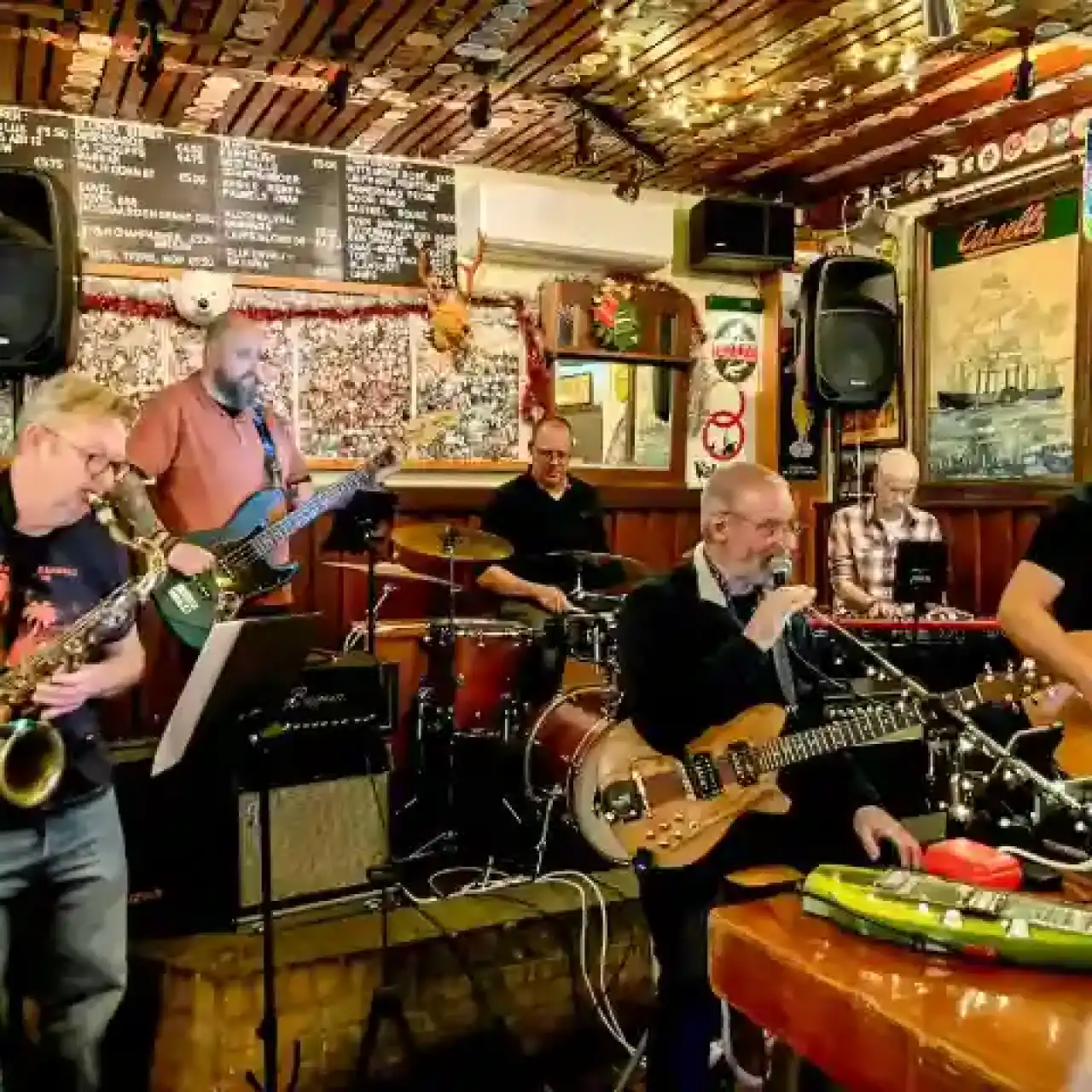
A year ago (aged 69) I joined a 'Blues/Rock/Pop' band. Our 'music' has no notes, just a 'song sheet' with chords. So as a sax player. I was completely free to play any 'fills' and 'solos' how and wherever I wanted on any songs that I felt 'appropriate'. Six months later, a trumpet player (who I knew) also joined the band. So (together) we're now the 'horn section'. Which meant that we now had to 'synchronize' with each other. This has gone amazingly well!

The point I want to make is that - without any 'notes' - both the trumpet player and I often just have to follow the song text, 'feel' the rhythm and both 'set in' at exactly the same time. And play both our parts (by feeling the rhythm in synchronization).

So please consider 'playing with others' as source of inspiration, enjoyment and motivation.

Mike

PS. There are many sax players who just love playing sax (and improving their sax playing). Just for its own sake and for their personal enjoyment. I've never been one of these. Since 'playing with others' is my main motivation for playing sax, if that became no longer possible, I would just give up playing sax. And maybe take up a different musical instrument.

 
.Ive found that it really helps if you love the song
I and I am about to embark an a reggae odyssey
Well, that's basic; Red Red Wine, Kingston Town and Food for Thought under the fingers, give or take iReal; on sax, penny whistle and reed flute. Not complex tunes, nice to get in this groove... Side-by-side with other stuff; but it is refreshing. Feeling better. Redemption Song next.
 

Social

New! Social Feeds

Look out for the navigation icon:

Follow CafeSaxophone

Latest Song of the Month

Trending

Forum statistics

Topics
32,057
Messages
578,232
Members
8,127
Latest member
PJ2116
Back
Top Bottom