Accessories The buzz oversized neck screw

Back to the drawing bord. The present accepted theory is like: that as long as the brass is too thick to work as a membrame the thickness of the wall doesn't matter, only the shape.

Three possible theorie based on the same number of wormholes in this theory:

1 the weight changes the shape of the tube.

2 the ununiform weight distribution makes the material work as a membrane at a much thicker wall as with a uniform weight distrbution.

3 the weight affects the micro leaks in the tennon.

But as it is not my cup of tea I just go work on my pads.
 
Worms are not meant to live in cans; open the cans, free the worms. If they're maggots they might already have turned into flies, saw it happen once and I'm scarred for life.
 
Back to the drawing bord. The present accepted theory is like: that as long as the brass is too thick to work as a membrame the thickness of the wall doesn't matter, only the shape.

Three possible theorie based on the same number of wormholes in this theory:

1 the weight changes the shape of the tube.

2 the ununiform weight distribution makes the material work as a membrane at a much thicker wall as with a uniform weight distrbution.

3 the weight affects the micro leaks in the tennon.

But as it is not my cup of tea I just go work on my pads.
It doesn't matter if any of these are correct, it doesn't do anything anyway.
 
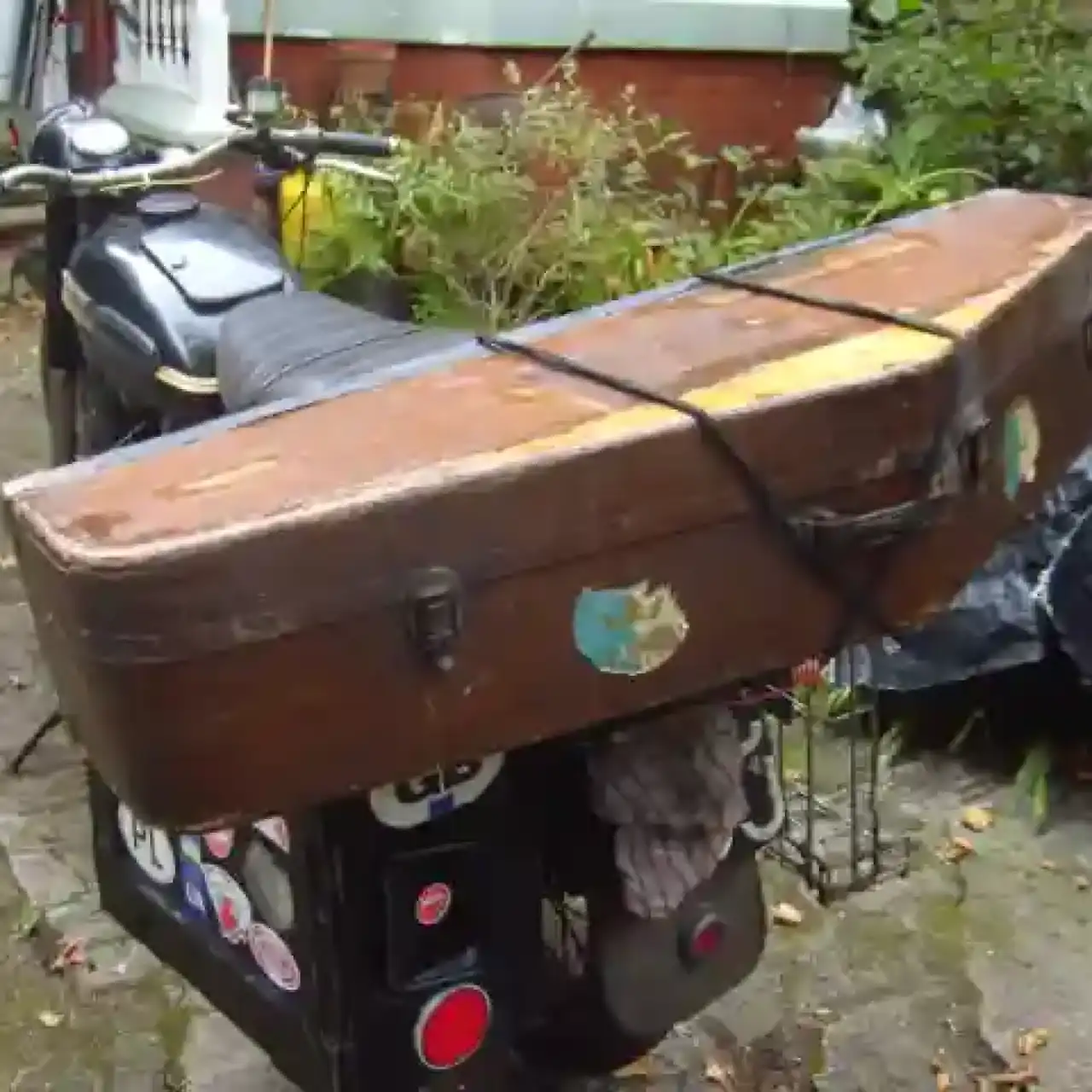
Couldn't help but notice the boom mike to capture the chug of the engine exhaust, very well done, goes to show that with some imagination, one can turn a steady beat into music.

I mentioned this before in another thread, but someone's car burglar alarm went off in the Walgreen's Drugstore parking lot while I was playing A Capela Christmas caroles on my bari sax near a Salvation Army donation kettle on stand to raising money for their social services operations.

Got a chuckle out of a friend nearby when I started playing Jingle Bells in tune with the bleeping car horn, until it timed out or owner reset it.

Never a dull moment. πŸ˜‰
 
I think those tractors are rare and a collector's item now but they were very good in their day.
I had a -56 Bolinder-Munktell 230 "Viktor" made in Eskilstuna, Sweden. 2 cyl, 2.24 L diesel engine. These tracors have high efficiency. A modern, and 60 years younger, computer tractor have better efficiency. Viktor went out of production in 1961. They needed more horsepower and they lost efficiency ..... . I had a Farmall H tractor as well. Kersone (started on gasoline). High octane fuel .... . The sound of the Farmall made me more nervous compared to the sound from the Viktor. I think the big and heavy (mass) weight flywheel is the secret. Create stabile frequencies. Like my heavy Rovner mouthpieces ..... .
 
Try no neck screw if the tenon is snug :clapping:
Hello, John. This is not pointed at you. This is in defence of my methodology on how I treat my sax.

There is one sax I have that has this snug problem. It is my 1990's Le Blanc 7133T Vito tenor. At times I have put a very light wipe of cork grease, which makes it fit and the tenon screw tightens it down nicely without binding or overtightening.

I know this goes cross grain with some traditionalists who will swear by doing such is a way to enter dust and dirt, cause overtightening the screw to cause thread stress and strippage, and ad nauseum. (One will wear out the threads on that screw quickly if there is no lubricant on the screw threads.)

No, for one, that joint is only briefly exposed to the environment when mounting the neck. When removed, the end plug that protects the octave pin is replaced when storing in the case. Case inside is a relatively dust-free environment.

Also it is very easy to clean off with a paper towel or rag. And, it doesn't turn while I'm playing because of a little lubricant.

And at times I have put a very light wipe of cork grease on a tenon screw threads, so it acts like it is lubricated. I don't carry key oil in my case for obvious reasons.

To both of these measures, I may have to do it once say every 6 months.

(Ever have a squeaky door hinge on a car? I take the oil or automatic transmission oil dip stick, put a drop on the hinges. Works until I get more time to further lubricate it in my home garage. Saves me buying new door hinge pins.)

(Or, car is a quart low on oil. So I put the only oil I have on hand, because I am out in the middle of nowhere with a quart of automatic transmission fluid. Engine will stay lubricated until I get home, where I can change it. A lack of oil can permanently damage an engine, requiring expensive rebuilding or replacing.)


And again, it is easily reversed with no harm done. And, they are with my personal instruments, which I have latitude into how I treat. And, similar to a motorcyclist never criticises another's ride but shows due respect, neither do I comment on another's sax or how they treat it, unless they are asking for opinions.

There are a lot more creative ways to destroy a sax than a simple wipe of cork grease. A simple wipe of cork grease on that squeaky tenon screw will help preserve the softer brass threads without damage. YMMV.

It is a part of my playing safe sax. :banana:
 
Hello, John. This is not pointed at you.
Hey Hostler, no problem. There are many ways of dealing with the tenon fit and you have good points. My statement was regarding all of the new neck screws that are on the market, and I have purchased several brands over the years and used them.

I recently tested one of the "buzz" screws while holding a note and found (on my saxes) that tightening the screw while sustaining the note tended to slightly muffle the sound. Nothing major at all but just a very small amount. Probably in my mind but no screw seems to work better for me.

Again, probably in my mind or ears πŸ˜‰
 
That's interesting. I don't believe they do anything so the case that the screw might make things worse never occurred to me. Assuming you think it will make it better then the opposite is also likely.
 
Will advise the Rock band, that own and rehearse in the building, that they are also a Saxophone enhancement facility.

IMG_4425.webp
 
There are two sections to the socket. The part airtight where the tenon fits and the part that grips to stop it twisting. If the socket screw needs lubrication to get enough purchase to lock it steady, then it needs attention imo and probably isn't airtight where it needs to be. Over tightening can deform the socket, making things worse.

Lubrication enables more torque to be applied and will stress the screw, promoting premature failure. Brass isn't steel. Comparisons to ICE lubrication are misguided imo.
 
Hey Hostler, no problem. There are many ways of dealing with the tenon fit and you have good points. My statement was regarding all of the new neck screws that are on the market, and I have purchased several brands over the years and used them.

I recently tested one of the "buzz" screws while holding a note and found (on my saxes) that tightening the screw while sustaining the note tended to slightly muffle the sound. Nothing major at all but just a very small amount. Probably in my mind but no screw seems to work better for me.

Again, probably in my mind or ears πŸ˜‰
Maybe not. The extra purchase on a large handled screw facilitates more torque. This extra pressure may be deforming the socket, causing a leak, which may be the cause of the muffled sound.
 

Similar threads... or are they? Maybe not but they could be worth reading anyway πŸ˜€

Social

New! Social Feeds

Look out for the navigation icon:

Follow CafeSaxophone

Latest Song of the Month

Trending

Forum statistics

Topics
32,058
Messages
578,293
Members
8,127
Latest member
PJ2116
Back
Top Bottom