

• New!

    Try our new Social Feeds, look out for the navigation icon: . You can now set default social feed view in your account preferences.

Saxophones Selmer Supreme alto (quick look)

Stephen Howard

Well-Known Member
Messages
4,008
Location
UK
Had a client bring two Selmer altos in yesterday - a Ref.54 for a service and a brand new solid silver Supreme.
First time I've had my hands on one.
It only came in for a quick tweak - so no time to run up a proper review, but I did notice a couple of things.

First up - the client brought it in because there was a problem when moving from low B to low Bb; a break in the transition.
This turned out to be a badly adjusted link between the low B and the low C#. In fact it wasn't really adjusted at all - so that when his finger rolled down onto the Bb touchpiece and just caught the C# touchpiece on the way, the C# would open about 3mm. That's plenty enough to knock out the low B.

And there was this:
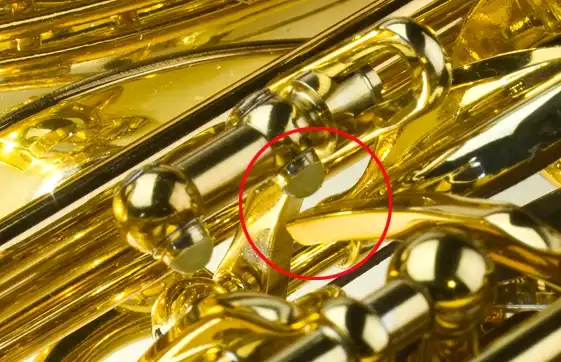
Selmer Supreme Bb adjuster.webp


This is the Bis Bb/G# adjuster bar. Take a look at that gap between the Bis Bb arm and the adjuster above it. In horn terms it's miles away.
The adjuster is actually set right in terms of its ability to close the Bis Bb - so you can't screw the adjuster in to take up the play. What this means is that the lower stack is set substantially higher than the upper.

I had a quick peek at the toneholes. Selmer are traditionally pretty good at getting the toneholes level, but I was rather disappointed with the low C on this horn:
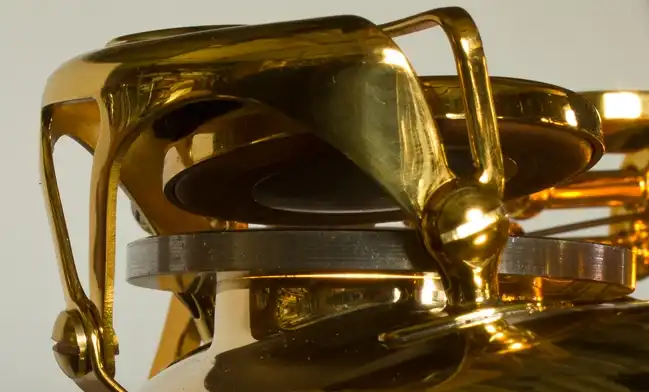
Selmer Supreme low C tonehole.webp


I compared it with the Ref.54 - which still wasn't perfect but was rather flatter.

So, not a great start for the Supreme. It comes in at an eye-watering price, and for that kind of money I want all the boxes ticked...and then some. So I'd expect the out-of-box setup to be spot on and rather more precision when it comes to the toneholes. Y'know, a bit like a top-end Yani.

And then I had a blow on the Supreme.
I was expecting a 'Woah!' moment - and I got one...but not the one I wanted.
It prompted me to go back and forth between the Supreme and the Ref.54. The Ref is exactly what you'd expect from a Selmer. Nicely balanced, a 'big' sound with that characteristic Selmer mid-range oomph, slightly resistant but nonetheless punchy - with a wide spread of sound.

The Supreme felt very closed in, like it was keeping the sound huddled around itself. And where was the punch and clarity?
It had a sort of Paul Desmond thing going on...that sort of laid back, soft kind of approach. That's fine...if you can turn it on and off at will but it kind of comes stamped into the horn.
That really surprised me because it's dramatically different from the Ref - so-much-so that I had to put a light down the Supreme to see if there was a problem with one of the pads (nothing major...slight leak on the A, which didn't change the tone when corrected).

I can't say it's a conclusive impression because it's just that horn - but even accounting for variations between seemingly identical horns it seems a bit extreme.

I'm hoping the client is going to book the Supreme in for a proper setup once I've serviced the Ref - at which point I can do a proper run-down on it and see what's what.
 
Thanks for your honest reporting of first review. Your first picture of Bis is a bit blurry. Looks like a good bit of gap?? A double action scenario in G#/bis? Is there no F# / bis cam adjustment 😳 ! !

Honestly I’m not surprised at the low C chimney level pictured . Even at this value point. Yeah $$$£££. Those who look and seek/ value upscale goods…..
I can only assume that this is a production tolerance. Tone hole, to key cup, to pad forgiveness.
That being mass produced engineered metal production, with finishing fit to other engineered natural hand made materials . The pads.
Still with a company exceeding more than two weeks of solid experience. The current presented value. I’m disappointed flat out.
The brand has always been about being the best. About being quality…. No issues.

Looking forward to meeting the representatives of Selmer in person in January.
 
Thanks for your honest reporting of first review. Your first picture of Bis is a bit blurry. Looks like a good bit of gap?? A double action scenario in G#/bis? Is there no F# / bis cam adjustment 😳 ! !

Honestly I’m not surprised at the low C chimney level pictured . Even at this value point. Yeah $$$£££. Those who look and seek/ value upscale goods…..
I can only assume that this is a production tolerance. Tone hole, to key cup, to pad forgiveness.
That being mass produced engineered metal production, with finishing fit to other engineered natural hand made materials . The pads.
Still with a company exceeding more than two weeks of solid experience. The current presented value. I’m disappointed flat out.
The brand has always been about being the best. About being quality…. No issues.

Looking forward to meeting the representatives of Selmer in person in January.
Yep, a good bit of a gap - 3-4mm.
I can't discount the possibility that the retailer did a set-up, but as it's Thomann I think it highly unlikely.

Selmer's production tolerance is usually better than that. Toneholes are the one area where they do pretty well - and for a premium product I would have expected no compromises.
But yeah, the pad will accommodate that much distortion...for a certain length of time - but it shouldn't have to.

For me the biggest 'Hmmm' came from the playtest. I'm not really a fan of the Selmer sound, but I've certainly played enough of them to know what they ought to sound like, and how to get the best out of them.
I always default to my "If you had to buy one" strategy - and in this instance I'd have bought the Ref.54.
 
I have read on the Thomann site that instruments go through their workshop to be inspected and set up before shipping.
I had a look but couldn't see anything related to a setup - but if it's the case that they do then it leaves two possibilities: either Selmer's setup procedure is pants...or Thomann's repairers haven't got a clue what they're doing. I suspect the latter.
Neither is good news for the punter.
 
Thomann's repairers haven't got a clue what they're doing.
I imagine they are probably OK at finding glaring issues on the cheaper horns and making it playable for at least a few weeks so maybe the bar is quite low and this one, with all its faults is still above that bar. But you are right this should be spot on from the factory. Just check for no transit damage.

Huh.
 
I’ve played 3 Supremes so far and they have all been ok but not even close to being worthy of the price tag.

And the VC owners are imo despicable so there’s zero chance I’d ever buy one

So many great horns out there already.
 
I enjoy reading these "no bars hold" truthful hands on assessments. They help others considering buying to know what they will need to do to bring their intruments up to performance standards.

Back in the early 1970's, I saw that with a new crop of Buffet Crampon R-13 Grenadilla wood clarinets we received with the 264th Army Band, Honolulu, Hawaii. I tried a few, their tuning straight from the factory left a lot to be desired. I retained the used one I was issued which serviced played better in tune.

When my pro model Yamaha YAS-61 alto was nicked in 1999, I made up for it by buying a used recently serviced Selmer Bundy II for $140 US on eBay several years later. I wasn't willing to spend the high cost of the Yamaha pro model. After, 5 - 8 years, bought a used Antigua Winds alto for around $400. It was the seller's wife's college sax. I found the Antigua played as well as my 61. Last year I had it serviced by Tarpley Music, Lubbock, TX.

A month or two ago a pro mentioned (don't recall name off-hand) that he buys used saxes and has them serviced at a cost far less than new, given the recent escallation in prices. They play as well as new.

So, with a decent playing sax and mouthpiece, one can focus on their musicianship, continue to roll out good music.
 
The thing that gets me, is that it's JUST NOT THAT DIFFICULT to make a saxophone mechanically correct top to bottom. Yamaha and Yanagisawa get (by all accounts) a lot closer with their basic instruments, than a lot of hotsy-totsy makers that charge a whole lot more. The thing's a pretty simple mechanical device when all's said and done, and it's been mechanically pretty much the same thing for 100 years now. It REALLY shouldn't be that here in 2026, people can't figure out how to make the top of a drawn tube square and flat, or not have mechanical slop in the joints, on a $7000 piece of kit.

It's my understanding that there's still a thriving but rarely talked about business going on, in buying new Selmers from the factory, stripping them down, fixing everything that's wrong, and putting them back together and reselling them at a tidy profit. It's just CRAZY that this is needed.
 
I imagine they are probably OK at finding glaring issues on the cheaper horns and making it playable for at least a few weeks so maybe the bar is quite low and this one, with all its faults is still above that bar. But you are right this should be spot on from the factory. Just check for no transit damage.

Huh.
That's a little patronising. My Thomann 580 alto was perfect out of the box and is sill going strong years on. My Startone Baritone was the same and still going strong. It only needed a little extra cork to suit my preferences.

Also let's not conjoin Selmer Paris and Selmer USA.
 
The thing that gets me, is that it's JUST NOT THAT DIFFICULT to make a saxophone mechanically correct top to bottom.
Well, it’s obviously a little more tricky or ergo they just can’t be arsed. That’s not to say that they shouldn’t be better after all these years and for that money.
 
That's a little patronising. My Thomann 580 alto was perfect out of the box and is sill going strong years
Yes it did sound like that but I didn’t mean to be patronising. A lot of horns, including cheap and intermediate are very good out of the box these days. If a factory is making them for Thomann they will have very good QC or else they will lose that contract. Hence I meant that any work at Thomann may be quite minimal and there should not be an awful lot to do, if anything. I could be be very wrong but I’m sure a company like that will not want to be spending a lot of money on fixing stuff so they will expect horns to not need a lot of work whether from China, Taiwan or France.
 
Well, it’s obviously a little more tricky or ergo they just can’t be arsed. That’s not to say that they shouldn’t be better after all these years and for that money.
They can't be arsed. That's the absolute bottom line - because people pay me to go the extra mile.

But here's the thing. It costs waaaaay more to have me sort out the build issues after the event than have someone at the factory do it. And I guess they have a team of accountants looking at the bottom line and shaking their fingers.
But how much extra would you pay for a horn that was *absolutely guaranteed* to be bang on right out of the box? £100? £200?
If I'm asked to set that Supreme up - no holds barred - it's gonna cost around £250, and most of that will be for time spent tearing it down and putting it back together again. What I can do, mechanically, for £250 can be done in the factory for less than £100.

So I'm going to carry on calling them out - and maybe, just maybe, someone will think "Hey, what if we build it the best we can?"
As of this point in time it's Yanagisawa who carry that flag - but they can still do better. And they ought to - because what's coming out of China at the mid-range price point is eyebrow-raising. And it's not stopping.

I don't have to like the way a horn plays and sounds - but I do have to like the way it was built and the price that's asked for it.
Get those two things right and you'll always get a thumbs up from me.
Does it matter? Maybe...maybe not - but it's my belief that there has to be someone out there to say "Not good enough"...because there are a hell of a lot of people out there who'll say "It's great"...if you pay them enough. And there are even more who simply wouldn't know if corners had been cut.
 
Here’s why, in my opinion. The upper level management and owners do not care if the instruments are any good or not. They only care if they sell enough of them to make a tidy profit and keep the company growing. This attitude carries down to the actual people who make the instruments. Those people may in fact care if the instruments are any good, but they sense the pressure to produce more and thus cut corners.

In smaller companies, it’s likely that the owners care about the things they are making, or the services they are providing. But once companies grow beyond a certain point, the mantra “growth is the goal” creeps in, and when that happens quality slinks out.

A striking example of this is the current kerfuffle with Fender Stratocaster guitars. There are many small makers who create what are essentially clones of this iconic instrument. Fender is now threatening the makers and distributors of these guitars, in Europe, because of a recent court case that held that Fender had a valid copyright on the shape and form factor of these guitars. The problem is, most working guitarists prefer the boutique brands because they are better instruments. Fender resorted to lawsuits instead of just fixing the problem at the source - namely, make better guitars. But doing that would cut into profits.

Instrument making is unique because of the personal involvement of the purchaser. Saxophones, guitars, indeed all musical instruments, are not commodity items. It may just be that the best way to create these kinds of things is by small companies dedicated to making the very best ones they can. This model does not fit neatly into the current economic climate.
 

Similar threads... or are they? Maybe not but they could be worth reading anyway 😀

Trending

Latest Song of the Month

Forum statistics

Topics
32,250
Messages
575,666
Members
8,078
Latest member
Keaton Norfleet
Back
Top Bottom

