



Saxophones Couturier-Lyon&Healy-Holton

turf3

Well-Known Member
Messages
2,946
Location
Earth
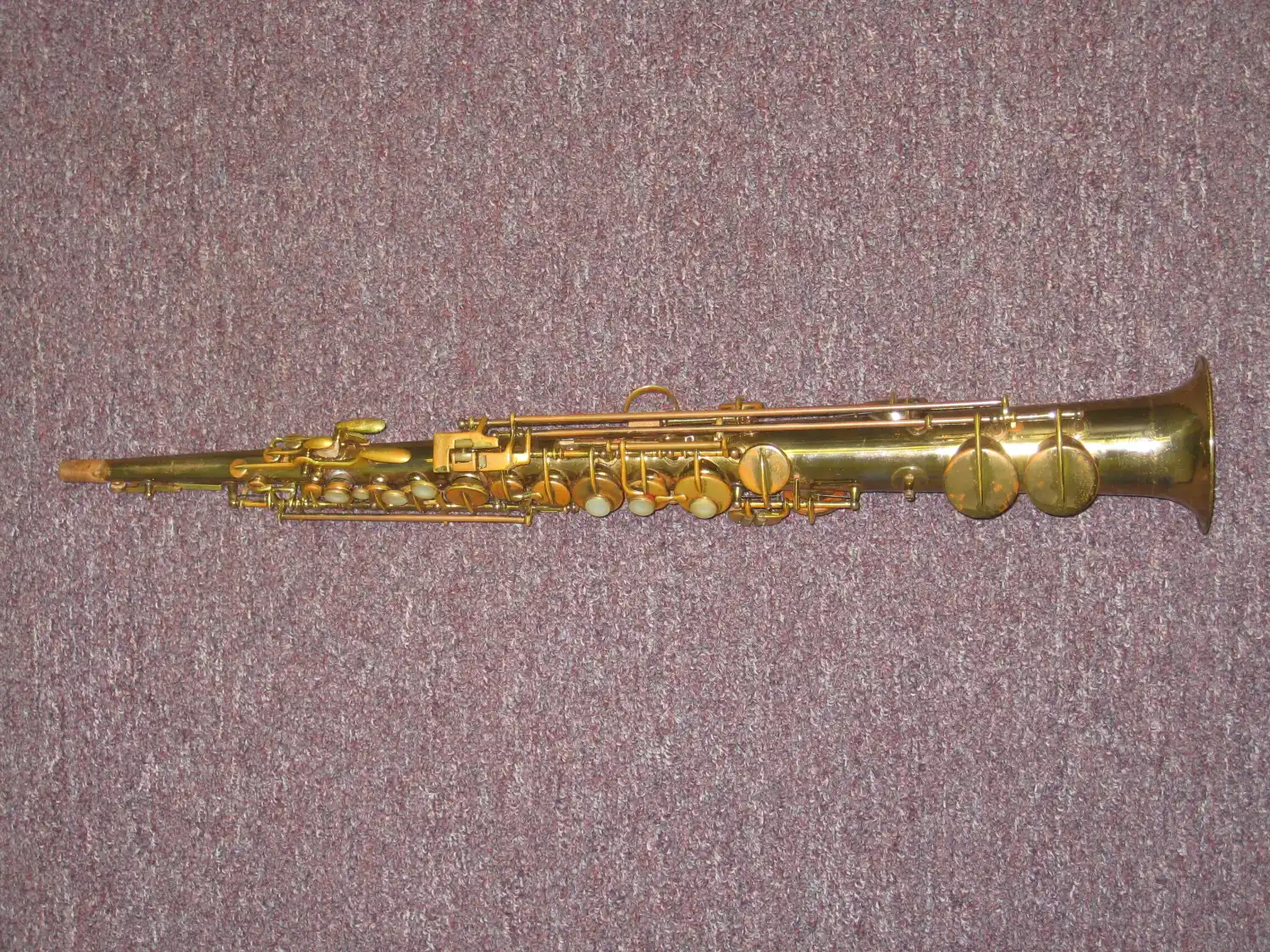
So, in the C melody discussion, and elsewhere, was discussion of the Couturier-Lyon & Healy - Holton path and the related products. I alluded at the time to my Couturier-design Holton Collegiate soprano, so here it is. I have many photos so will probably have to break this into several posts.

Overall view
1793111399041.webp


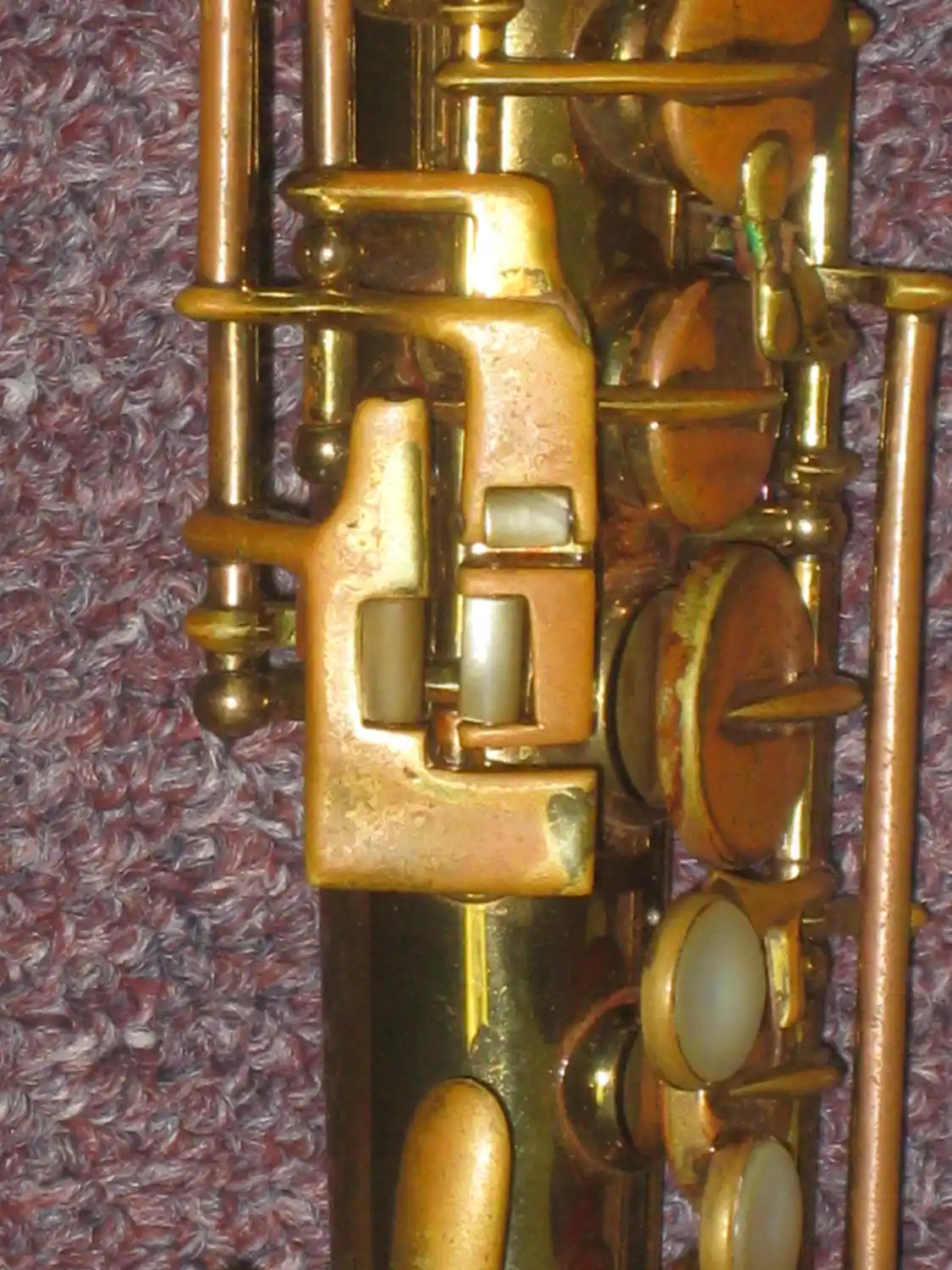
Here is the distinctive LH table, with integrated C# and G#.
IMG_4681.webp
 
Here is the badge. Reads (very difficult to see in the photo) "COLLEGIATE" then underneath "Made By Frank Holton & Co. Elkhorn Wis"

IMG_4685.webp


The keywork is delicate and rather frail. Note for example the rather flimsy bridge below. Also the very small C/Eb keys, the very small side keys.

1793111995793.webp
 
Distinctive shape of octave key touch. Linked LH palm keys - D# key lifts D key, F key lifts D# key and through it the D key, Note also the long slender shape of the palm keytouches, at a time when most US saxophones had round bulbous ones. The dreaded thumb ring is shown. The piece of cork was my attempt to make it bearable to hold and play. SN is shown (again, hard to read because the horn's been buffed to within an inch of its life).

1793112343571.webp


I believe the SN is 201833.

The case I reckon is a replacement, but if it's an original Couturier/L&H, that'd be cool. I know it's not a Holton case. Also note the pivot screw. Very crudely made. The basic design is same/similar to Holton pivot screws. I have a Holton sax at home but have not done a direct comparison of the screws. Did Couturier use the same design? Or when Holton took them over did they move to using Holton small hardware? That would certainly be a cost savings, I'd think.

1793112740717.webp


I will also point out that all the rods and hinge tubes are very much smaller in diameter than my Buescher or genuine Holton sopranos. The whole thing gives a feeling of general flimsiness.

The tone is rather nice, intonation is pretty good. The horn's in pretty rough condition and I haven't played it in probably 10 years, so it may not be very playable by now.
 
Never seen anything quite like this one. Funky LH palm key setup. I like it.
The bevels are different than L&H made. So maybe Holton made the change ? Every Couturier/ Lyon & Healy I’ve seen bevels looking like this below.
1793164517995.webp


The pivot pin screw you pictured is of Holton style but most likely DIY made. The threaded portion is 100% equal to the post size. The pin area @ 1/4” long . They are 1/2”, 2-56 fillister head. Couturier / L&H used points.

If the case interior is gold it’s post war. Red or baby blue pre war. I’m thinking post war 1950’s from the latches and handle.

Your 201833 may be the oldest Collegiate on record. The number is consistent with others made at the LaPorte factory.
1793163143791.webp


Holton used different numbering at the time.
1793162929473.webp
 
I looked last night at my genuine Holton and the pivot screws are different. Same principle, but different execution. I'll take a couple pictures today. I'll also get a couple photos of tonehole bevels. My Holton C, I thought it had more or less straight toneholes without a bevel (although soldered), but it seems last night that there is a small rounded bevel. Neither the Collegiate soprano nor the Holton C has those clearly chamfered toneholes as in the silver plate horn you show above.
 
OK, some of what I wrote above is wrong on closer investigation.

First of all, it looks like my Collegiate does have the clearly chamfered bevels on the tone holes, or it did, before someone went wild with the buffing wheel. In the first photo below (the brass finished horn) you can see the tonehole on the left, which is down in the mechanism where you couldn't wail away on it with a buffing wheel, still shows a fairly sharp chamfer, and the one on the right is all rounded off.

By contrast, my Holton C (the silver plate one) has nearly straight tone holes. If you look closely you can see they're slightly tapered toward the open end. I show the badge of it just to show that this is what I would consider "all Holton".

1793197913215.webp


As to pivot screws, the two together are from my 1923 Holton C (the silver plate one), and the three together are from the COLLEGIATE. They all look the same design to me; so my earlier claim that the Holton screws were different is not accurate. They're all REALLY crude - far cruder than similar hardware would be on a Buescher or Martin or Conn of the timeframe. I have seen other weird stuff with the Holton horns, like on side keys where you can drive the screw pretty much clear through the post. If you look closely you can see one of the screws from the Collegiate didn't even get threaded all the way - that one pokes way out of the post, with just enough thread and pin to hold the parts together.

The case you see is what I got the COLLEGIATE in. I'd call the lining faded red.

1793198238712.webp
 
Here's a listing from Getasax, branded L&H, which is visually identical to mine branded "COLLEGIATE made by Frank Holton" except for the plating. (Of course we can't see the pivot screws of the Getasax L&H, but everywhere I look, the visible mechanism looks exactly identical.)

1793198454562.webp
 
I never really much cared about the Coutrurier/LH-Holton thing, even though I am a huge Holton aficionado....but I guess my simple question would be this:

Are you guys saying than ANY COLLEGIATE PRIOR to around serial 30,000 was actually a Cout/LH and not made at Holton ?

I have never really understood the fascination with this....the soprano shown reads "made by Holton" with a 20, xxx serial.

So what is the basis of ascribing it to a different factory ? Or am I asking the wrong Q ?

(a favor, please....make your answer the 'drive-by' version, not a novella. The reason I never much bothered with this subject was because of those plodding thread reads on SaxRegimeOnTheWeb.....)
 
I don't know if "ANY" is accurate.

What it looks like to me is that Couturier, a very short-lived company, sold their factory and designs to Lyon & Healy who kept making the same design in the same factory, then they sold the factory and designs to Holton who kept making the same design in the same factory for a bit, labeled "COLLEGIATE". I haven't seen any comment on whether there are "COLLEGIATE" saxophones before this little fandango that were made elsewhere.

The thing is, the construction and design of these L&H and COLLEGIATE saxophones with the one piece C#/G# appears to be identical to that of the Couturier saxophones. I have owned a Holton Bb soprano of this period and it was DEFINITELY a differerent instrument than my COLLEGIATE.

So we're kinda trying to figure out where the transitions occurred. To me it's the same kind of thing as two Selmer saxophones, one an Omega made in Elkhart and one from Paris; they're distinct design and manufacture although both branded "Selmer". Of course this corporate kerfuffle we're talking about here is 100 years ago and far fewer instruments exist and the number of people who actually care is rather small, compared to Selmer Paris.
 
Exactly. I know MINE is. It's of course possible that certain minor details of hardware got changed here and there to come from the Holton source. For example PS indicated that Couturier used a different design of pivot screw in earlier production, than the design that's on my COLLEGIATE - which appears to use the same pivot screws as my standard Holton.

To me the significant point is that there were products with "Frank Holton" on, that were derived almost 100% from Couturier (whatever "derived" means - it might well have been the exact same people using the exact same machinery in the exact same factory, or it might have been less than that) - being produced at the same times as products with "Frank Holton" on, using Holton-original designs. The former were labeled "COLLEGIATE". Is this 100%, that all "COLLEGIATE" marked horns during this period, were Couturier in origin? I dunno. PS seems to be the resident expert on the Couturier/L&H/Holton evolution. It's significant to ME personally only in that I used to own a pure-Holton Bb soprano, now I own a Couturier/Holton soprano, and a pure-Holton C soprano, and they're quite different.
 
Oh, one more thing, you said "any Collegiate before SN 30,000" - but it seems clear that some of these Collegiates used Couturier SNs, which are in the 200,000 range (I guess they probably started numbering at 200,000?). So if one were to try to date my horn #201833 from a Holton SN chart, it would be way out of whack.

You might ask "why the heck do you even care?" which is a valid question. I guess it's because all my other instruments (except one) are immediately evident what they are - the Conns from the 40s, the Buescher and Holton from the 20s, the Martin from the 30s, the recent production flutes. The only other one that's a bit odd is trying to figure out when my Beaugnier Noblet bass sax was made. It seems to date from the 1960s or so, surely VERY late production for bass saxophones not named "Selmer" - but the serial number charts are not helpful, they all run out long before mine, and then only resume with Yamavitos.
 
I never really much cared about the Coutrurier/LH-Holton thing, even though I am a huge Holton aficionado....but I guess my simple question would be this:

Are you guys saying than ANY COLLEGIATE PRIOR to around serial 30,000 was actually a Cout/LH and not made at Holton ?

I have never really understood the fascination with this....the soprano shown reads "made by Holton" with a 20, xxx serial.

So what is the basis of ascribing it to a different factory ? Or am I asking the wrong Q ?

(a favor, please....make your answer the 'drive-by' version, not a novella. The reason I never much bothered with this subject was because of those plodding thread reads on SaxRegimeOnTheWeb.....)
Here’s the short version.
Frank Holton product made at LaPorta was American Beaufort and Collegiate. The start origin of Collegiate.
Different tooling than Holton-Elkhorn.
This was less than one year 1928-29
The SN# will be 201xxx and up on Collegiate not five digits. Beaufort SN’s I don’t know.
Simultaneously Holton was making SOP’s at Elkhorn. SN# 30,000-36,000.
 
Here's a listing from Getasax, branded L&H, which is visually identical to mine branded "COLLEGIATE made by Frank Holton" except for the plating. (Of course we can't see the pivot screws of the Getasax L&H, but everywhere I look, the visible mechanism looks exactly identical.)

View attachment 38201
Yes they are from the same tooling.
Early 1927 L&H restarted serial numbers @ 200,000. The Blackamore engraving started in 1927 and continued until Holton acquired the factory.
1793215736096.webp
 
OK, some of what I wrote above is wrong on closer investigation.

First of all, it looks like my Collegiate does have the clearly chamfered bevels on the tone holes, or it did, before someone went wild with the buffing wheel. In the first photo below (the brass finished horn) you can see the tonehole on the left, which is down in the mechanism where you couldn't wail away on it with a buffing wheel, still shows a fairly sharp chamfer, and the one on the right is all rounded off.

By contrast, my Holton C (the silver plate one) has nearly straight tone holes. If you look closely you can see they're slightly tapered toward the open end. I show the badge of it just to show that this is what I would consider "all Holton".

View attachment 38199
Buffed 🤯 !
That’s a record for buffing😬 Yep, yours is of the Couturier-L&H-Holton make / build.

As to pivot screws, the two together are from my 1923 Holton C (the silver plate one), and the three together are from the COLLEGIATE. They all look the same design to me; so my earlier claim that the Holton screws were different is not accurate. They're all REALLY crude - far cruder than similar hardware would be on a Buescher or Martin or Conn of the timeframe. I have seen other weird stuff with the Holton horns, like on side keys where you can drive the screw pretty much clear through the post. If you look closely you can see one of the screws from the Collegiate didn't even get threaded all the way - that one pokes way out of the post, with just enough thread and pin to hold the parts together.
Those screws you have are odd. Only four threads. Below has 5. The point on right is Couturier/ L&H.
1793218364693.webp

1793218399849.webp

X
1793218330442.webp


The case you see is what I got the COLLEGIATE in. I'd call the lining faded red.

View attachment 38200
Your case looks like post war 50’s and not really faded.
Below is mid 30’s. No handle, corner reinforcement, different latches.
1793219019816.webp

Case badge from above sample.
1793219217741.webp
 
Exactly. I know MINE is. It's of course possible that certain minor details of hardware got changed here and there to come from the Holton source. For example PS indicated that Couturier used a different design of pivot screw in earlier production, than the design that's on my COLLEGIATE - which appears to use the same pivot screws as my standard Holton.

To me the significant point is that there were products with "Frank Holton" on, that were derived almost 100% from Couturier (whatever "derived" means - it might well have been the exact same people using the exact same machinery in the exact same factory, or it might have been less than that) - being produced at the same times as products with "Frank Holton" on, using Holton-original designs. The former were labeled "COLLEGIATE". Is this 100%, that all "COLLEGIATE" marked horns during this period, were Couturier in origin? I dunno. PS seems to be the resident expert on the Couturier/L&H/Holton evolution. It's significant to ME personally only in that I used to own a pure-Holton Bb soprano, now I own a Couturier/Holton soprano, and a pure-Holton C soprano, and they're quite different.
What you have is an early Collegiate.
Made in LaPorte Indiana after March 1928.
The factory facility was built by E.A. Couturier 1920.

E.A Couturier company went into receivership in Fall of 1923.
Highest recorded Couturier SN# 13395.
Lyon & Healy bought and took control in early 1924. The “Couturier Model” / Lyon & Healy Makers seems to run until 1926 & SN# 17,000 depending on S,A,C,T. Likely ending @ SN# 20000/ 1926

SN#’s restart @ 200,000 1927 after some design changes.
@ 203,278 March 1928 the company transferred to Holton.

Your SN# 201833 was likely partially made under L&H ownership. Finished by Holton.
 
Buffed 🤯 !
That’s a record for buffing😬 Yep, yours is of the Couturier-L&H-Holton make / build.


Those screws you have are odd. Only four threads. Below has 5. The point on right is Couturier/ L&H.
View attachment 38206
View attachment 38207
X
Your pivot screws look like quality parts, well made. Mine look very poorly made. There's a lot of variation amongst them, the length of the pin, the way one of them the threads aren't even up to the underside of the screw head, the pins look almost like they were cut off with end nippers.

If I didn't know better I'd assume some kind of aftermarket pivot screws made by Joe Schmo in his back garden shed; but I bought these two horns almost 20 years apart, one in Texas and one in Florida.

It's also an interesting speculation when the Holton pivot screws replaced the Couturier pointy ones. Actually, the COLLEGIATE mechanism isn't particularly sloppy. I wonder if they already had the keys made up and just drilled out the ends. There aren't really all that many pivot screws. Even quite long keys have hinge rods on this horn.

The drummer I bought the COLLEGIATE from said that the sax player in a band he used to be in, would load the horn with a Roman candle and shoot it out at the audience while playing. I guess the finish might have been kinda rough, before Buffy McBuff-Face the Lacquer Slayer got hold of the horn.

As for the case, I'm gonna declare it an aftermarket replacement and not think any more about it. (There is no brand indication on it of any sort, nor brad holes or a faded rectangle where one might once have been.)
 
Your pivot screws look like quality parts, well made. Mine look very poorly made. There's a lot of variation amongst them, the length of the pin, the way one of them the threads aren't even up to the underside of the screw head, the pins look almost like they were cut off with end nippers.
My pictured samples are NOS.
If yours have been cut short they were likely bent at some time. Techs that only loosen one end and skew the part out bend the opposite end. Causes big bind. They straighten what they can and cut short to salvage themselves.
If I didn't know better I'd assume some kind of aftermarket pivot screws made by Joe Schmo in his back garden shed; but I bought these two horns almost 20 years apart, one in Texas and one in Florida.
100 years later who knows ?
It's also an interesting speculation when the Holton pivot screws replaced the Couturier pointy ones. Actually, the COLLEGIATE mechanism isn't particularly sloppy. I wonder if they already had the keys made up and just drilled out the ends. There aren't really all that many pivot screws. Even quite long keys have hinge rods on this horn.
I wouldn’t be surprised if production ran out of points and changed over.
The drummer I bought the COLLEGIATE from said that the sax player in a band he used to be in, would load the horn with a Roman candle and shoot it out at the audience while playing. I guess the finish might have been kinda rough, before Buffy McBuff-Face the Lacquer Slayer got hold of the horn.
🤣🤣🤣
As for the case, I'm gonna declare it an aftermarket replacement and not think any more about it. (There is no brand indication on it of any sort, nor brad holes or a faded rectangle where one might once have been.)
Agreed.
 

New! Social Feeds

Look out for the navigation icon:

Follow CafeSaxophone

Trending

Latest Song of the Month

Forum statistics

Topics
32,008
Messages
576,629
Members
8,106
Latest member
gmaric22
Back
Top Bottom