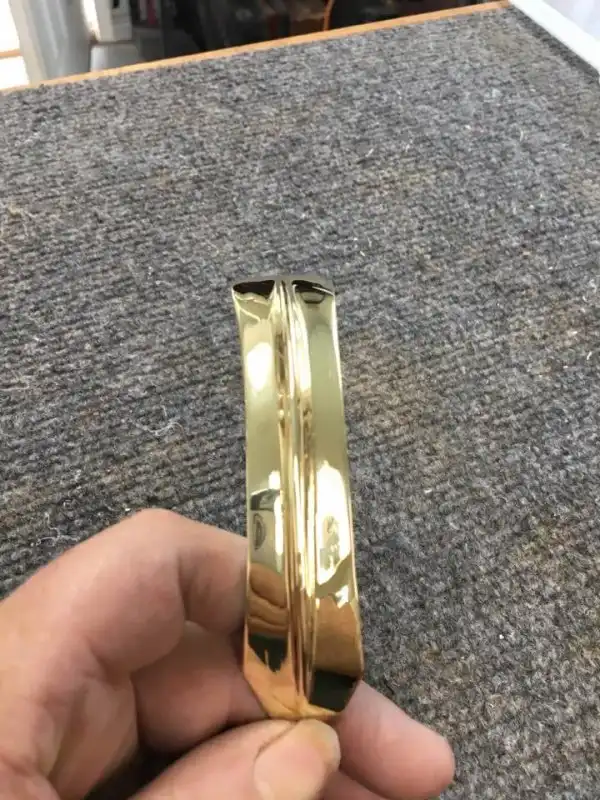
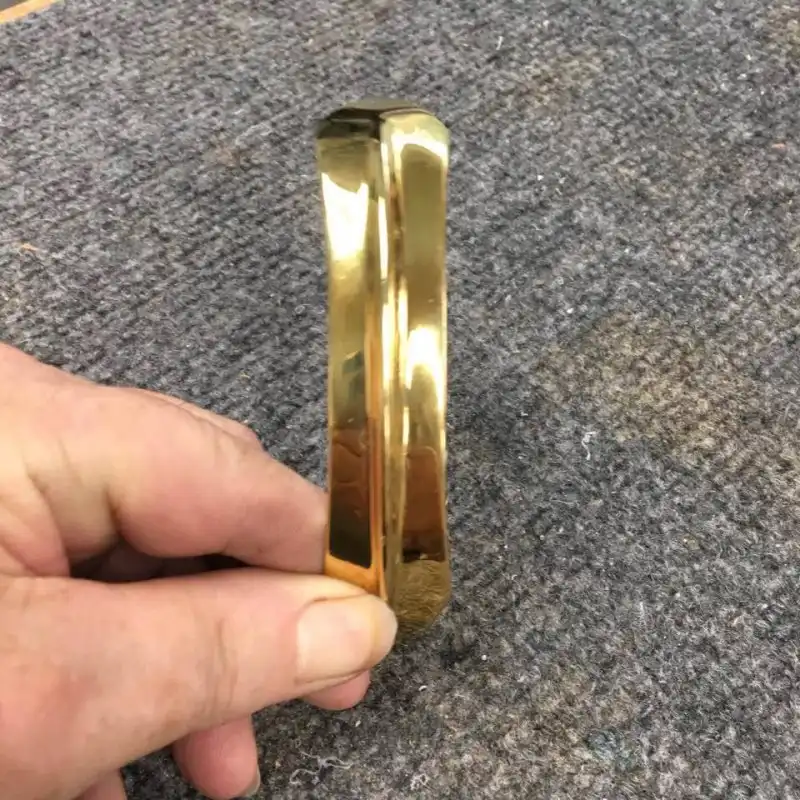
You've stumbled upon what's known as a 'hot process patination'.
You can achieve a wide range of patinas on brass depending on what chemicals you use, and whether they're applied cold or hot.
In this case the (few) impurities in the water coupled with those that were washed off the brass have resulted in a very weak patination solution. A similar process is to place the brass in an oven with a dish containing a predetermined solution of chemicals - which subsequently evaporate and form a 'tarnishing gas'.
Vinegar is a cheap and safe patinator - and if you have a lump of brass spare, and you don't mind filling the house/workshop with the smell of a chip shop, it's a good way to see just how much the appearance of brass can be changed.
The problem with such techniques is that they're often impractical. That lovely patina you've achieved will be shot to pieces when the time comes to solder the part to the horn...and if you want to get the finish back you'll be facing the prospect of trying to get the whole horn into a pot of boiling water.
They're also somewhat unpredictable - and if you're trying to match an existing patina it usually ends up being a completely frustrating exercise in trial and error.
Cold process patinators are rather more useful for spot colouring, though it's still very much an inexact art...and when it goes wrong it tends to go horribly wrong.
I've had some good results using a heat-and-quench method, whereby the part is heated with the gas torch and then quenched with a rag soaked in a solution of various liquids (black tea, engine oil, dilute household cleaners, rusty water etc.). The big advantage of this method is that it allows you to blend the new patina in with the existing.
If you're lucky.




 acebook
 (bottom of page)