
• New!

    Try our new Social Feeds, look out for the navigation icon: . You can now set default social feed view in your account preferences.

Tech/maintenance 1946 The Martin Tenor - an overhaul thread

@kamak , as a suggestion write on face of each pad indicating the key cup position. On a ledger write down this position and the thickness as removed best as possible.
Clean, flatten and round the key cups. Then measure the cups ID. This being at a cross in multiple directions. Average the needed diameter and record needed OD size.
Round up or down ??? Better snug than loose. You can’t expdand a small one.

Most pad suppliers furnish pads in .5mm increments. Not all have thickness options…
Martins are notorious for needing thin pads. Like 3.8mm / .150” Most available are 4.0-5.0mm / .160-.197
Pads with plain rivets will sound just fine. Likely what it left the factory with.
Pad maker choice gets interesting. Music Medic Pro pads are good choice if all the action is perfect. Tone holes leveled and you want a heavy impression. The fabrication of the Pro Pads is less forgiving. Including the back are solid pressed hard. No range to iron back to reduce thickness. Setting an impression with a RTH or Martin bevel you will find challenging.
Option that’s more user friendly. The MM SF grade. This is 4.0mm/.160 pad. The wrap pleats on back can be ironed to .150. They take impressions setting easier.
Thanks! That's what I did when you helped with my L&H C-Melody! Worked great. Kept an Excel sheet with all the measurements, then ordered from MM.

I was planning to do MM SF with flat metal resos.

Why is is an impression challenging with the Martin bevel?
 
Pads with plain rivets will sound just fine. Likely what it left (factory with.
I have oversized Resotechs, sterling silver or brass, on my Martin Committee saxes. I think the sound became more contempoary with bigger reflectors,/resonators/tone boosters. I play blues and rock so I need more volume/piercing sound. Martin Committee tonehols are not with bevelded tone holes rims.
 
I have oversized Resotechs, sterling silver or brass, on my Martin Committee saxes. I think the sound became more contempoary with bigger reflectors,/resonators/tone boosters. I play blues and rock so I need more volume/piercing sound.
In general i use boosters that are 10mm smaller that tone hole ID. IE, a 30mm tone hole has a 20mm booster size. This provides 5mm clearance all the way around. Going oversized the whole assembly needs good review. You don’t want any boosters hitting the sockets. I have consistently achieved quality results without boosters. This being achieved by filling the back of pads with shellac. Stiff and solid the sound waves reflect differently. IMHO boosters do change the sound. Resotechs are similar in shape to Selmer dome. Both metal and reusable unlike plastic.

“6. CONCLUSION
The covers have a measurable effect on the acoustical characteristics of the saxophone. Their main role is to stiffen
the pad, so that the cover should in fact be called “stiffener”.
For those interested in not derailing the thread here. I stored more information about boosters/reflectors /resonators here on post #24.
Martin Committee tonehols are not with bevelded tone holes rims.
That is correct. The sockets are more conical-curved shape with a broad rim face. But what the heck the proper name is ?? I do not know ? Just like the other Martin bevel with a concave shaped bevel.
 
Small leak but still secure & solid can be sealed with flowing in some superglue.
I mentioned in another thread my latest glue discovery is CT1 that may also work as a quickfix bodge for leaky soldered tone holes. I managed to repair an old Indonesian lost wax figurine which was too chunky for my soldering iron and failed with superglue and epoxy but CT1 was perfect as it is super sticky but also remains very flexible. Sticks like **** even wet or dirty surfaces.
 
In general i use boosters that are 10mm smaller that tone hole ID. IE, a 30mm tone hole has a 20mm booster size. This provides 5mm clearance all the way around. Going oversized the whole assembly needs good review. ...
And pad/cup size doesn't always correlate to tonehole size, so pay attention in measuring. You're likely to find one or two pad cups that are way larger than the tonehole - those obviously need smaller boosters.
 
Took a quick jaunt today and found an STM 7* today that came with a Francois Louis ligature for a very good deal. Its sooo good. Cannot wait til the Committee is done to try it on it. Using a Java Green 2.5 on it.
11751.webp

11752.webp
 
For readers that don’t know. There’s a few key cups much larger than tone hole. Reason. An easy fix to hold / mount the pearl touch in needed position.

This below YAS-23 showing Bb with small booster. Note the large diameter pad & cup to hold the pearl.
The two circled on left showing the cup is off center to tone hole.
1786734251282.webp
 
Last edited:
I have oversized resotech reflectors on committe saxes. I like them because .....

..... can be used over and over. A small screw and a washer on back holds the reflector.
..... oversized reflectors gives me a slightly bigger sound. Committees saxes are built to have low key-heights.
..... a big reflector helps up to keep the pad flat.
..... brass and sterling silver resotechs helps to avoid plating corrosion on the reflectors.
..... the details are important to me. A HC Committee sax with solid sterling silver keys must have sterling silver reflectors. On a "The Martin" sax brass reflectors is the way to go. I hesitated when I picked reflectors to my Magna tenor. All key cups on my Magna are brass (some keys are solid sterling silver) so I decided to install brass reflectors.
 
A HC Committee sax with solid sterling silver keys must have sterling silver reflectors. On a "The Martin" sax brass reflectors is the way to go. I hesitated when I picked reflectors to my Magna tenor. All key cups on my Magna are brass (some keys are solid sterling silver)
I may be wrong but I think the Comm l & ll had solid nickel keywork not solid silver, and Comm lll had solid brass ?
Regardless your choice of booster metal & color to match the keywork is definitely pleasing. I like any boosters that are reusable. Not many quality options. MM flat metal are stainless and natural color only. Their domes are available in silver or gold. All three secured by rivets. A pain to reuse but doable. The MM smooth dome are one time use and silver only.
1786783441447.webp
1786783607423.webp
1786784245367.webp
 
FWIW brown plastic domes do work just fine. Yes they make the horn play a bit brighter. They don’t look entirely stupid ugly.
Benefits,
They are waterproof, long lasting and don’t corrode.
Relatively easy to install.
Some have push-in barbed rivet to secure. Others by hot melting the stem into a secure mushroom type closeure. Tool required.
Properly installed and properly set in key cups they don’t come loose or buzz. (Aka loose booster).
They don’t leak often. (Yes leaks through the center hole and backside of pad can happen. Through the leather too).

Drawbacks,
On a Martin if the pad thickness needs to be reduced by hot ironing the back of pad. (pads acquired by maker as assembled with booster installed). Ironing can be challenging for a DIY / hobby person with limited experience. Anticipating or realizing a learning curve is real. Experience is just that.
Depending on the maker of plastic domes the heat forgiveness varies greatly. PVC or ABS ? Is the back of dome solid or hollow ? Is the DIY using an open flame setting pads or hot air device? One fart of an oops on heating cup and you have a warped booster with plastic boosters.
Lastly, the heat range of HMG (hot melt glue) or shellac and quantity used affects outcomes.
Some can be back filled and others you better not… Depends on the pad build materials. Synthetic felt (aka foam rubber) or woven wool felt. Pressed wool felt etc. Thick or thin cardboard backing? Real or faux leather ? (FYI both work).
A plastic dome can have a epic failure from any of the reasons above. Still success can be achieved with good review. Study !
I find most DIY hobbyists and of good quality playing ability are simple minded. Cheerful pleasing results on first attempts. Refining later as understanding progresses on the mechanical side is achieved.
All said, a quality made pad with a simple plain old rivet is very forgiving to install. Size in diameter and thickness understanding for a good start is more important than boosters IMHO. Work the fit and sealing first. Pad protrusion, the effects of fulcrum math.
Learn performance traits later.
1786785662842.webp
 
On my 208XXX (1959) Magna tenor the palm keys. side keys, C/Eb cluster, G#,C#,B, Bb cluster finger touches are solid nickerl silver. All key cups are brass? I "cleaned" the keycups very well ....
Here is a goldplated Magna. What a horn!
If Matt says it solid nickel silver it must be .....

View: https://youtu.be/iwE00zPOXTM?si=UQUiarEPHnaAyfZy
Metal alloys are another full study. Matt is correct in stating a nickel silver. It’s a type of alloy. Not of solid silver or sterling silver. Hopefully your translator is not adding confusion to each of us.
That Magna is to drool over😍. Uncommon to us common folk. Lucky Matt. If you win the lottery…..

1939-1945 are years that deserve respect. The war years. Craftsman trying to make products and the harsh reality around them. Materials shortages and…nuff said. Sad times globally.
I have another Comm ll. A 1942(picture below). This like yours stated. This appears to also have a mixed key build of different materials. The barrels and touches appear to be different than the key cups. Just like you’ve stated. Honestly I never noticed this before.
Good eye !!
If possible can you compare the picture below to any you know and please comment ?. Say late ‘39 to ‘46 ?
This thread is becoming an important study of late Comm ll to early Comm lll transition. However small it seems. History is learned in small doses. Maybe @Stocker sees something different and new here ?
It’s all small stuff but FUN 🤪
1786791588036.webp


Honestly I’m challenged to see our OP’s (@kamak ) pictures clearly enough to support what we are each seeing. I see what you see.
He is still in the cleaning and preparing phase. Dirt and oxidation is hiding a good obversion to make comment. His horn best I can tell is a 1945 first year post war.
 
Metal alloys are another full study. Matt is correct in stating a nickel silver. It’s a type of alloy. Not of solid silver or sterling silver. Hopefully your translator is not adding confusion to each of us.
That Magna is to drool over😍. Uncommon to us common folk. Lucky Matt. If you win the lottery…..

1939-1945 are years that deserve respect. The war years. Craftsman trying to make products and the harsh reality around them. Materials shortages and…nuff said. Sad times globally.
I have another Comm ll. A 1942(picture below). This like yours stated. This appears to also have a mixed key build of different materials. The barrels and touches appear to be different than the key cups. Just like you’ve stated. Honestly I never noticed this before.
Good eye !!
If possible can you compare the picture below to any you know and please comment ?. Say late ‘39 to ‘46 ?
This thread is becoming an important study of late Comm ll to early Comm lll transition. However small it seems. History is learned in small doses. Maybe @Stocker sees something different and new here ?
My 1933 Imperial tenor is the same - cupronickel* keytouches, rods, and arms, with brass keycups. (However, it was relacquered so I don't know if it was originally lacquered or silver plated.)

Cupronickel is used in the keywork for reasons of wear and durability; the only benefit to cupronickel keycups I can think of would be for aesthetics on a lacquered horn. I believe at least some Handcraft Committees and Committee IIs were made that way - not sure if Imperials were. (And the Imperial design was constantly evolving anyway.)

I like the brass keycups - it gives an impression of them being more a part of the body tube than of the keywork, which is an interesting effect.

The Magna above is the same - cupronickel keys with brass keycups, originally lacquered throughout. This was one of the features that set the Magna apart from the Committee III.

*For long-term clarity: here this refers to what's known as nickel silver, German silver, Liberty silver, maillechort, nickel brass - among other things it's been called through the decades.
 
Metal alloys are another full study. Matt is correct in stating a nickel silver. It’s a type of alloy. Not of solid silver or sterling silver. Hopefully your translator is not adding confusion to each of us.
That Magna is to drool over😍. Uncommon to us common folk. Lucky Matt. If you win the lottery…..

1939-1945 are years that deserve respect. The war years. Craftsman trying to make products and the harsh reality around them. Materials shortages and…nuff said. Sad times globally.
I have another Comm ll. A 1942(picture below). This like yours stated. This appears to also have a mixed key build of different materials. The barrels and touches appear to be different than the key cups. Just like you’ve stated. Honestly I never noticed this before.
Good eye !!
If possible can you compare the picture below to any you know and please comment ?. Say late ‘39 to ‘46 ?
This thread is becoming an important study of late Comm ll to early Comm lll transition. However small it seems. History is learned in small doses. Maybe @Stocker sees something different and new here ?
It’s all small stuff but FUN 🤪
View attachment 36530

Honestly I’m challenged to see our OP’s (@kamak ) pictures clearly enough to support what we are each seeing. I see what you see.
He is still in the cleaning and preparing phase. Dirt and oxidation is hiding a good obversion to make comment. His horn best I can tell is a 1945 first year post war.
Serial # based on 'themartinstory' puts it around 1946, but I know/have heard that isn't a perfect chart. Is there a better one to go off of?

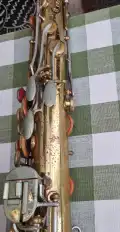
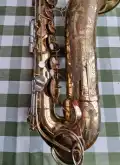
Keys are not nickel/silver like my Handcraft tenor, but rather are brass colored, so I am not sure the best way to confirm all of this for the sake of this thread and future people's needs.
 
Serial # based on 'themartinstory' puts it around 1946, but I know/have heard that isn't a perfect chart. Is there a better one to go off of?

Keys are not nickel/silver like my Handcraft tenor, but rather are brass colored, so I am not sure the best way to confirm all of this for the sake of this thread and future people's needs.
Dating and model details are IMHO ongoing research. I feel the noted replies on this thread are consistent with known research & range. The material possibilities @Stocker posted make sense. Martins made with whatever the alloy, are amongst the toughest keywork to straighten. Until someone actually takes a bit to a laboratory and tests the material….. there’s no proof.
Dating are +/- a year or two on just about every American maker. Some generated by sales records. When goods left the factory warehouse. Others by combining sales lists, dated catalogues / advertising , live sample details and archive pictures.
 

Similar threads... or are they? Maybe not but they could be worth reading anyway 😀

Trending

Latest Song of the Month

Forum statistics

Topics
32,254
Messages
575,788
Members
8,081
Latest member
DataPath
Back
Top Bottom