
 (bottom of page)




CafeSaxophone Forum
 Introduction
This is something I have been working on since I retired from teaching in 2002. It is a summary of techniques that proved successful in teaching beginning students. My emphasis from the beginning was on tone production. My reasoning was if students liked how they sound, they would practice more and enjoy playing music. If their parents liked how they sound they would be more likely to support their student and the music program as a whole. The ability to enjoy music through performance is one of the greatest gifts that life has to offer. Passing that gift on to others can be a rewarding experience but it carries with it the very important responsibility to give each student the very best possible chance of success according to his or her abilities. The purpose of this article on teaching beginning saxophone students is to share the knowledge gained through a lifetime of study and experience in helping beginning players navigate through their first hands on experience with the amazing instrument we call the saxophone.This is a first draft, and I welcome any suggestions or comments. But please remember I am a "sensitive musician" so be kind with what you have to say. 😉
The Equipment
Checking the Equipment
The best of instruction will bound to fail if the saxophone, mouthpiece, and reed are faulty. The instructor should first play the student’s instrument using the instructor’s own mouthpiece to insure everything is working properly. Should it become necessary to play test the student’s mouthpiece and reed as well, a spray bottle of mouthpiece disinfectant and paper towels should be on hand to disinfect the mouthpiece and reed. Washing the mouthpiece and reed in a sink using an anti-bacterial soap is another effective way to prevent the spread of germs.The Instrument
There are many brands of saxophones available nowadays that are suitable for beginning instruction. The Yamaha YAS-23 has been the standard for many years. The instructor should rely upon his/her experience in advising the parents about which makes and models are suitable for a starting player. Whatever brand of saxophone is chosen it should be free from defects and leaking pads.The Mouthpiece
The mouthpiece is a crucial factor in determining initial success with tone production. The Yamaha 4C for many years has set the standard for an effective and consistent plastic student mouthpiece. The Hite Premier and Fobes Debut are other plastic student mouthpieces that are reasonably priced and are currently highly recommended. A word of caution is needed with regard to “no name” mouthpieces and those supplied with Chinese saxophones. These have a well deserved reputation for being low quality and unsuitable. If there is any doubt, the mouthpiece should be play tested by the instructor before proceeding with the instruction.The Reed
There are many good brands of reeds on the market today. A beginning player is not yet in a position to appreciate the nuanced differences in the high end more expensive cuts of reeds. For the mouthpieces previously recommended a Rico #2 is a very good choice for a student’s first experience. After a week or two when the embouchure muscles are more developed, most students can be moved up to a Rico #2 1⁄2. Never start a studentwith a #1 or #1 1⁄2 reed. All that will accomplish is to acclimate the student to sounding like a “kazoo”, and will keep the embouchure muscles from developing the strength and muscle tone required to produce a characteristic sound.
The Ligature
Most student mouthpieces come with an adequate ligature. Just make sure it is not broken, and that the screws are inserted in the correct side. Also check to insure the ligature is the correct circumference for the mouthpiece. The screws should be adjusted so that they are just “snug” with the front screw slightly less “snug” than the rear screw.Assembling the Instrument
The Mouthpiece and Reed
The teacher can demonstrate how to apply cork grease and how to “twist” and push the mouthpiece onto the cork to the desired position about halfway onto the cork, and then demonstrate how the ligature goes onto the mouthpiece. To put the reed onto the mouthpiece a good technique is to have the index finger push up on the ligature at the top of the mouthpiece while the other hand holding the reed by the sides carefully inserts the reed under the ligature. The index finger then allows the ligature to drop in place and the screws are gently tightened enough to hold the ligature at the correct height. Then using the two thumbs on the sides of the reed, the reed is wiggled up, down, left or right to straighten it on the table of the mouth piece and so one can see a thin thread of black when looking straight at the mouthpiece. Once the reed is in place the screws are then tightened to be “snug”.The Neck
The teacher should first demonstrate how to rotate the neck slightly back and forth while inserting it into the receiver, and then how to line up the brace on the underside of the neck with the post that extends from the saxophone to operate the neck octave. Like the ligature screws, the neck tightening screw should just be snug. Both the neck tenon and the receiver should be clean prior to assembly. Windex or rubbing alcohol on a soft cotton cloth are effective for this purpose. Lubricants of any kind should not be used since they attract and hold small particles than can score the surface.Posture
The Head
The head should be held straight and erect as if balancing a cup of water on top. This is an important consideration in order to establish good posture and the correct angle of the mouthpiece in the mouth.The Back and Feet
Good breathing habits depend upon good posture. Good posture is established and reinforced by having the student sit on the front half of the chair with both feet flat on the floor. Once the student is sitting up straight, ask the student to become an inch taller in the chair to eliminate any remaining slouch in the spine.
The Chest and Ribcage
In order to make room for the lungs to expand, the ribcage should be held high. Have the student imagine he or she is a puppet suspended from a string attached to the sternum.The Shoulders
A common habit of young players is to tense and raise the shoulders as they play. This not only can cause tightening of the neck and throat muscles, but often creates tightness in the arms, hands, and fingers as well. A good way to teach the concept is to have the student imagine the shoulders and arms hanging like a tablecloth hangs from a table. Learning from the beginning to keep the ribcage high and the shoulders relaxed will go a long way in preventing other poor playing habits later on.
Breathing
Inhaling
Once the correct posture has been established, good breathing habits will fall quickly into place. With the rib cage as high as it can be, have the student place both hands with the fingers and thumbs outstretched on the sides of the abdomen right above the belt line. Instruct the student to fill up with air in 8 counts while pushing their hands outward like inflating a big inner tube. Once full, have the student blow the air out taking 8 counts to get empty while pushing in with the hands like squeezing a big tube of toothpaste to get the last bit out. Make sure the chest or shoulders do not raise while doing this exercise. The chest shouldn’t raise because it is already as high as it can be. The shoulders can’t raise because they are relaxed and hanging. If necessary go back and review these concepts before going on.Pressurizing the Air
It is not uncommon for band teachers to tell their students to play with “breath support”. It is probably the way they were taught themselves. The problem is that very often the students are given little or no instruction as to what exactly the term “breath support” actually means. Using the term ”pressurized” air helps to dispel the mystery and confusion and helps the student understand exactly what the instructor is referring to. An effective method to teach “breath support” is to give the student a half sheet of copy paper to hold with one finger at the top against a mirror or window the appropriate height for the student. The next instruction is to let go of the paper and blow at the same time trying to hold the paper against the glass for as long as possible on one breath of air. After several trials, tell the student that the way the abdominal muscles felt while doing that exercise is what you mean when you say play with “breath support” or “pressurized air”.Expending the Air
Another important concept in addition to learning to take the air in properly is to learn to expend the air in a controlled manner. To teach this concept go back to the inhale for 8 counts exercise and repeat that again a few times. Remember to get full in 8 counts, and to use up all the air in 8 counts. Next do that exercise breathing in for 4 counts and going to empty in 8. Then inhale for 2 counts and empty in 8, and lastly get full in 1 count and empty in 8.The Embouchure
Forming the Embouchure
The embouchure contained in all of the standard method books and taught by the majority of teachers is based upon shaping the lips to form an airtight seal around the mouthpiece and reed. This embouchure is described in detail in “The Art of Saxophone Playing” by Larry Teal and is sometimes referred to as “the Teal wheel”.To teach this embouchure have the student say “EE” and pull the corners of the mouth outward stretching the lips at the same time. Then have the student say “OO” (like too) and push the corners in with a separate set of muscles. The embouchure is formed by first stretching the corners out using the “EE” muscles and then while the “EE” muscles are still pulling, push the corners back in using the “OO” muscles. This results in a “tug of war” which is a “tie” between these two sets of muscles and has the effect of stretching the bottom lip thin and tight, and also making the chin flat and point downward. If one were to stop here it would be a textbook clarinet embouchure (which does not work very well on the saxophone). To transform this to the saxophone embouchure one simply lets the “OO” muscles win the tug of war. The “EE” muscles don’t give in completely, but the “OO” muscles predominate. This has the effect of loosening and softening the lower lip to act as more of a “cushion” for the reed, and to round the chin slightly. It is important to note that the chin still has the feeling of pulling down and away from the reed which means that it is not “bunched” excessively.
Placement of the top teeth on the mouthpiece
By far the best explanation has been given by Bruce Pearson, the author of the Standard of Excellence Band Method. First you take an index card and carefully place it between the reed and the mouthpiece, moving it up to where the reed and mouthpiece join. Then you take a pencil and make a small mark on the sides of the mouthpiece where the edge of the card stops. Finally draw a line across the top of the mouthpiece connecting these two lines. It is on this line that the top teeth should go. On the alto mouthpiece it is approximately 5/8" back from the tip of the mouthpiece. On the tenor mouthpiece it is back approximately 3/4". It is recommended that a soft rubber patch be placed over this mark and that an indentation in the rubber be made with the thumb where the top teeth are to be placed. The student then is instructed to find that groove with his top teeth when inserting the mouthpiece into the mouth.The Lower Lip
When forming the saxophone embouchure the partially relaxed lower lip for most people goes slightly over the bottom teeth. When the mouthpiece and reed are inserted into the mouth to play, the reed pushes a bit more of the bottom lip back over the teeth to provide a cushion for the reed. Because there is such a variation in the thickness of student’s lower lips it is not always useful to talk about the “red portion” of the lip. The clearest instruction is to tell the student that on the clarinet the “least possible amount of lower lip covers the lower teeth”. On the saxophone you use “a bit more” than on clarinet. The concept to get across is that the lower lip forms a “cushion” for the reed to sit on that is above the lower teeth but is supported by the muscles around the mouth.Angle of the Mouthpiece
One of the most important concepts to teach saxophone players right from the beginning is the correct angle of the mouthpiece. Unlike the clarinet mouthpiece which tips down about 45 degrees, the saxophone mouthpiece goes straight into the mouth or very slightly downward. This sometimes overlooked fundamental is closely related to the student’s posture, instrument holding position, and the length of the neckstrap. To teach the correct angle, first have the student sit with the back straight on the front half of the chair with both feet on the floor and the head erect. Next set the neckstrap approximately where it should go, push the bell of the sax forward so that the body of the sax is to the side of the knee. Then allowing the neckstrap to support the entire weight of the instrument, balance the saxophone using the two thumbs. Still using the thumbs tilt the saxophone back as if to play and without moving the head see where the tip of the mouthpiece touches. If it touches the nose, the neckstrap is too short. If it touches the throat, the neckstrap is too loose. The neckstrap length should be adjusted so that with the head straight, the tip of the mouthpiece touches the curved area right above the player’s chin. Once this length is set, then the student lowers the head very slightly to place the mouthpiece in the mouth.Tone Production
Preliminary Exercise
For the student’s first experience at tone production, it is often helpful to first replicate how it feels to “blow” the saxophone using just the thumb. Have the student insert the thumb straight into the mouth about 1" while pressing down gently with the top teeth and letting the thumbnail push the lower lip back just enough to cover the teeth. Then have the student form the “EE - OO” embouchure and blow as if holding the paper against the glass. It is acceptable to have the air “hiss” out the corners of the mouth which shows proper air pressure.The Mouthpiece and Reed
Once the student is accustomed to how the mouthpiece feels in the mouth and blowing against some resistance the next step is to produce a good tone on the “tone producer” which consists of just the mouthpiece and neck.
The “Tone Producer”
Using the posture, breathing, and embouchure techniques described above have the student place the mouthpiece into the mouth and blow to make the initial sound. Check that the top teeth are pressing down lightly on the top of the mouthpiece and the corners of the mouth are snug to prevent air from leaking. For alto sax, set a tuner to sound Ab concert and have the student try to match that pitch. Common issues are not tightening the embouchure enough to bring the tone up to pitch, and not using sufficient air volume or pressure to produce a tone that sounds full and vibrant. The teacher should encourage the student to blow as hard as he/she can to make the “tone producer” sound as big and full as possible. Most problems with tone quality and intonation can be traced back to failure to blow enough air. The teacher may have to demonstrate using his/her own instrument the sound that the student should try to match. Even after the student moves to the full instrument, it is useful to periodically warm up on the “tone producer” to check the “input pitch” going into the saxophone that is related to the tightness of the embouchure.The Saxophone
When the student can sustain a full, well controlled tone for 15 or more seconds on the “tone producer” it is time to go to the full saxophone.Review the posture and breathing techniques previously discussed and then have the student adjust the neck strap to the proper length. Next show the student where the thumbs and the fingers go on the upper and lower stack keys, and then how to finger the note F with the octave key. Instruct the student to blow exactly the same way that produced a full tone on the “tone producer”. If all works as planned, the student’s first note on the saxophone will be an Ab concert with a big and beautiful sound—especially for a beginner. All that is left will be to recreate that “concept of tone” on different notes.
[future chapters will include teaching good holding and hand position, and tips to teach articulation]
17 Replies
·
10156 views

Saxophones Wireless mic and reverb effects
Been playing a year now and looking at getting a wireless clip on mic. The Isolo Choice mic comes with mic, transmitter and receiver WITH effects like echo and reverb. Thinking of getting one but concerned will it be ok in the UK it ships from Taiwan. Assuming the 9v power supply can be used in UK. It’s the effects I am after. Anyone in UK bought one they are £425. Thanks . Chris.
49 Replies
·
10104 views
I'm considering purchasing an effect that allows me to simulate a horn section a bit for LIVE use. So far I've been using the Roland Aerephone AE10, which isn't bad, but I'd like to try it with my tenor sax so I can switch from clean sax to horn section-like effects. I was thinking about a Zoom A2.1 or a Roctary Poly Octave, but I don't have any experience. I'd use it with my Xvive wireless microphone.
6 Replies
·
155 views

Mouthpieces Jody jazz DV Chicago tenor.
Anyone using one on tenor? What are your impressions and thoughts? Cheers!
9 Replies
·
246 views
Saxophone beginners If you had to do it all again
Evening all.
I'm returning to playing the sax after nearly 25 years, used to play alto (played in various bands, gigs in pubs, clubs, fesitvals, weddings & wakes, recorded some albums). I've only gone and bought myself a tenor off of ebay by accident and i'm planning to do some practice, mostly so I can get some half decent sounding brass parts down on my computer based deep house noodling.
When i started learning (early 90s) I taught myself, never had a lesson and subsequently developed a load of bad habits. These days there's something called youtube and it's full ofAI slop tutorials for people to learn off so I've had a look around.
I'm planning on focussing on my embechoure first (long notes, stupid face exercises), intonation then finger placement (always moved my fingers too much and hit the pads too hard).
So my question is, if you had to do it all again - how would you go about it, what would you concentrate on?
Coke Escovado - I wouldn't change a thing
I'm returning to playing the sax after nearly 25 years, used to play alto (played in various bands, gigs in pubs, clubs, fesitvals, weddings & wakes, recorded some albums). I've only gone and bought myself a tenor off of ebay by accident and i'm planning to do some practice, mostly so I can get some half decent sounding brass parts down on my computer based deep house noodling.
When i started learning (early 90s) I taught myself, never had a lesson and subsequently developed a load of bad habits. These days there's something called youtube and it's full of
I'm planning on focussing on my embechoure first (long notes, stupid face exercises), intonation then finger placement (always moved my fingers too much and hit the pads too hard).
So my question is, if you had to do it all again - how would you go about it, what would you concentrate on?
Coke Escovado - I wouldn't change a thing
25 Replies
·
2569 views

Miscellaneous Is AI taking over!
I just made this with AI today (inspired by my daughters recent wedding) and was totally mind blown... The song itself, band, singer and sax solos were just too good... There's no future for humans in music if this is just the early stages!
Walk her to forever
Walk her to forever
611 Replies
·
22888 views


Apparently, at a Richard Thompson gig a girl asked him to "play that song about the Water Bed". "I don't do a song about a water bed" he replied. "Yes you do, the one the goes Let me ride on your water bed one more time".
View: https://youtu.be/gw1ZDzBoUf8?si=yah5OyWiRWCpzq_T
Have you got any other examples ?
Rhys
Have you got any other examples ?
Rhys
48 Replies
·
2810 views

Miscellaneous Any Cafe members in the Curitiba / BR region?
I'll be traveling to Curitiba / Campo Largo in October and I was just wondering if there are any familiar faces in the area.
😉
😉
2 Replies
·
46 views
Mouthpiece/Lig FS for sale - Phil-tone Isotope tenor mouthpiece, 8*
for sale - a rare beast, the Phil-tone Isotope. This has been discontinued for a while, it was a collaboration between Phil-tone and Theo Wanne -beautifully made piece as you'd expect. Comes with the original wooden box. Big step baffle so unsurprisingly leans towards the bright side with a clean, modern sound, but I found it to be capable of a bit more warmth and versatility than a guardala for example.
Always used with a patch, I've removed this to give it a clean up for selling and you can see on the photos there's a bit of a colour difference on the beak where the patch has been stuck on. There's also some discolouration on the table which I've shown in the photos below, this was there when I purchased it (I'm not the first owner) but doesn't affect playability - table is flat and rails are unblemished. I've found myself to be more comfortable on rollover baffles, but this needs to be enjoyed by someone instead of sitting on my shelf. UK postage only please.
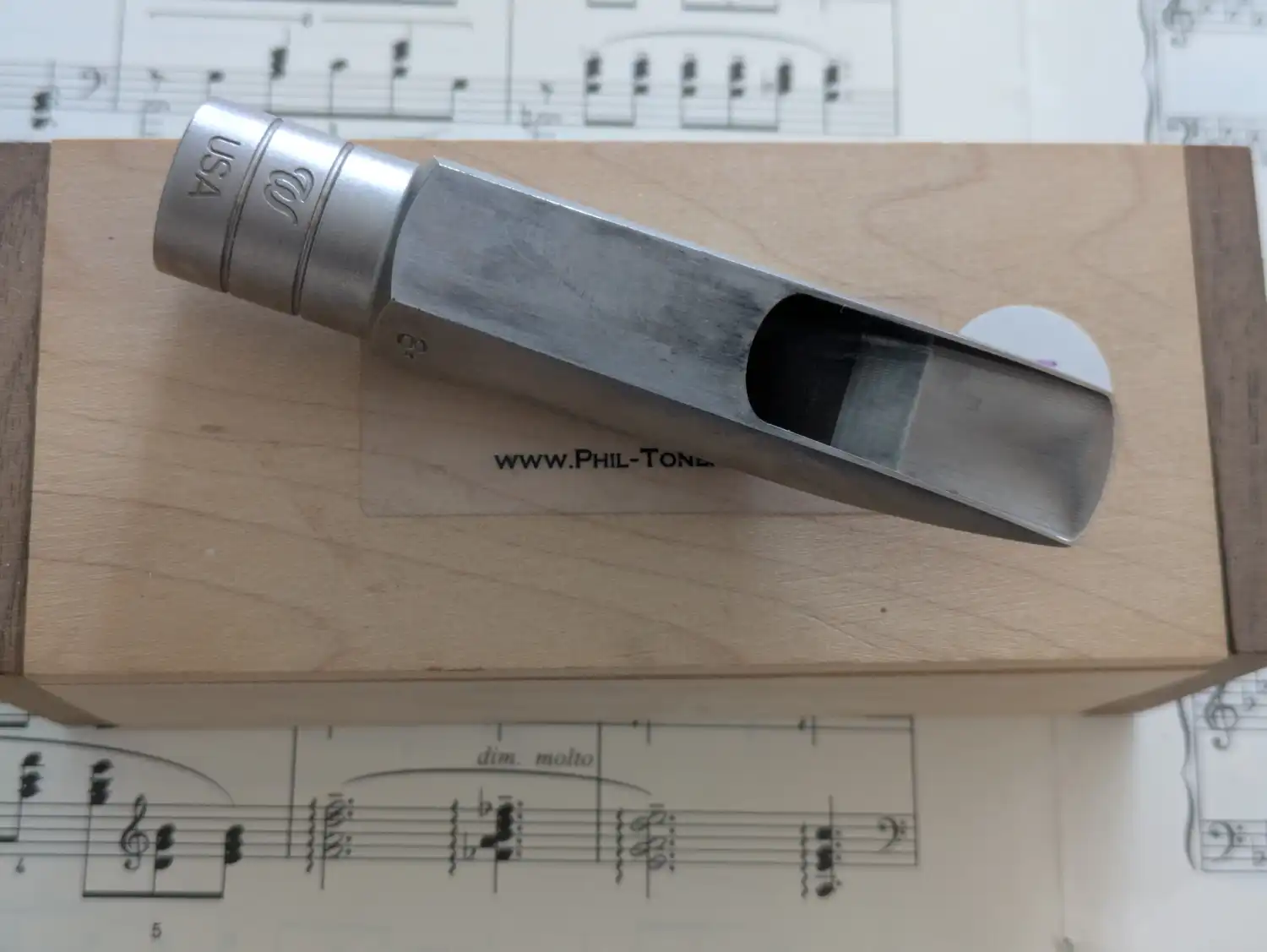


Always used with a patch, I've removed this to give it a clean up for selling and you can see on the photos there's a bit of a colour difference on the beak where the patch has been stuck on. There's also some discolouration on the table which I've shown in the photos below, this was there when I purchased it (I'm not the first owner) but doesn't affect playability - table is flat and rails are unblemished. I've found myself to be more comfortable on rollover baffles, but this needs to be enjoyed by someone instead of sitting on my shelf. UK postage only please.
3 Replies
·
155 views
Blog Tenor Viol's musings
OK. I've thought about doing this for a while - setting up a general thread for me to post in, rather than necessarily creating a separate new thread every time for relatively minor matters, or discussion of how things are going etc.
So, the first item is my FB page got me with an Amazon advert and I seem to have ordered a jazz theory book... It will get delivered to the Amazon lockers at work on Monday
Tomorrow is a Café Trio/Quartet...Septet day where @trimmy is going to demonstrate ascending chromatic scales in augmented fourths, and descending in diminished fifths... 😀
Yesterday was a wind band concert in Maghull. There were about 85 of us playing. We had a contrabassoon in the band...

So, the first item is my FB page got me with an Amazon advert and I seem to have ordered a jazz theory book... It will get delivered to the Amazon lockers at work on Monday
Tomorrow is a Café Trio/Quartet...Septet day where @trimmy is going to demonstrate ascending chromatic scales in augmented fourths, and descending in diminished fifths... 😀
Yesterday was a wind band concert in Maghull. There were about 85 of us playing. We had a contrabassoon in the band...
1919 Replies
·
109774 views

Miscellaneous What is “Politics”?
In the current thread on AI, Pete reminded us to keep politics out of the discussion, and to put side queries in another thread. So here is the side query…
When does a discussion become political? If something is an important societal topic (e.g., the state of music education, or the emergence of AI), there are certain to be politicians and government employees involved somehow. (Well, maybe not in music education, more’s the pity.) I’d like some clarity and perhaps a discussion on where the line is.
Case in point - government involvement in and support of health care. In most of the developed world, this is a non-issue. In the USA it’s a political hot potato. But this topic is important culturally and socially. Studies on strategies for extending lifespan. What tests to get, and where and how to get them. Seeking advice on a particular health condition. Etc. Here in the US, this can stray very easily into political waters - because of the various money, power and philosophical opinions around the subject.
So if I say “I think taxpayer funds should be used to provide a sensible baseline of health care support for everyone”, is that political? Or do I have to add something about a particular politician, or perhaps discuss specific legislation, to make it cross the line? “Joe Blow is an idiot because he thinks Medicare should be cancelled.”
I ask because topics like AI and healthcare affect us all, both as musicians and as humans in society. (Also as saxophonists, because some AI systems seem to think one needs 7 or 8 fingers per hand to play one!)
In the current discussion of AI, which is important IMO, there are obvious cultural and societal implications around the uses of AI. And these very easily stray into discussions of current political topics because various governments and government agencies are actively involved. Some guidelines on where to draw the boundaries of the discussion would be helpful.
When does a discussion become political? If something is an important societal topic (e.g., the state of music education, or the emergence of AI), there are certain to be politicians and government employees involved somehow. (Well, maybe not in music education, more’s the pity.) I’d like some clarity and perhaps a discussion on where the line is.
Case in point - government involvement in and support of health care. In most of the developed world, this is a non-issue. In the USA it’s a political hot potato. But this topic is important culturally and socially. Studies on strategies for extending lifespan. What tests to get, and where and how to get them. Seeking advice on a particular health condition. Etc. Here in the US, this can stray very easily into political waters - because of the various money, power and philosophical opinions around the subject.
So if I say “I think taxpayer funds should be used to provide a sensible baseline of health care support for everyone”, is that political? Or do I have to add something about a particular politician, or perhaps discuss specific legislation, to make it cross the line? “Joe Blow is an idiot because he thinks Medicare should be cancelled.”
I ask because topics like AI and healthcare affect us all, both as musicians and as humans in society. (Also as saxophonists, because some AI systems seem to think one needs 7 or 8 fingers per hand to play one!)
In the current discussion of AI, which is important IMO, there are obvious cultural and societal implications around the uses of AI. And these very easily stray into discussions of current political topics because various governments and government agencies are actively involved. Some guidelines on where to draw the boundaries of the discussion would be helpful.
43 Replies
·
781 views

Animals Show us your Wildlife
Inspired by the convolution of the Show us your pet and Help a Hedgehog threads...
Here's one from another thread;
Red Squirrel
(They exist in Norway)

Here's one from another thread;
Red Squirrel
(They exist in Norway)
877 Replies
·
41475 views
Saxophones C Melody Saxophones
I've been interested in C Melody saxes, for a while.
Apparently, they were quite common in the 1920s-30s, and the general concensus seems to be that the designs got better as time went on. Earlier models were often made in High Pitch (a tuning system that predates using A=440Hz), and should be avoided, unless you want to accompany a Highland bagpipe player.
From what little research I've done, it seems Conn made some of the better sounding ones, and their later models were improvements over the earlier ones. The ones with a "straight" neck, similar to an alto, are supposed to be good. Personally, I don't really like the S shaped neck on a tenor.
Anyway, here's one I've asked about recently. I've posted a couple of these pictures in Ads's review discussion thread of the Sakkusu C Melody sax, but here's all I have.
This is a 1924/1925 Conn C Melody, currently for sale at the Trevor Jones shop in Bristol. It's in low pitch, has had a partial repad, and is ready to play.

Bristol is a bit far for me to visit so I asked if they could send me photos, particularly of the hand positions, because the ergonomics are a bit different on these old saxes, and C melody saxes in particular.

Ermm... there seems to be a 2 file upload limit. Hopefully, that's per post

The thumb rest is apparently soldered on, so can't be adjusted easily, but the position looks good for reaching the right side trill keys (Bb/C/high E). This seems to be an issue on the Sakkusu / Thoman C Melody (see https://cafesaxophone.com/threads/sakkusu-c-melody-saxophone-review.13705/Ads's Sakkusu C Melody review[/URL])
The "L" stamped below the serial number indicates it's built for "Low" pitch - i.e. designed for modern A=440Hz tuning. I've read different accounts of what was meant by High Pitch (and maybe there was more than one definition), but the consensus seems to be it was at least A=450Hz, or A=453Hz - kind of between semitones, in modern tuning, and too far out to compensate for by positioning the mouthpiece differently etc.
It's important to check for that when buying any brass or woodwind instrument from that period. I think military bands kept it going for a while longer, in Britain. Scottish bagpipe and Irish/Scottish Bb flute players tend to still use it, as I understand it. It's certainly the normal tuning for 5 or 6 key Bb flutes.
Apparently, they were quite common in the 1920s-30s, and the general concensus seems to be that the designs got better as time went on. Earlier models were often made in High Pitch (a tuning system that predates using A=440Hz), and should be avoided, unless you want to accompany a Highland bagpipe player.
From what little research I've done, it seems Conn made some of the better sounding ones, and their later models were improvements over the earlier ones. The ones with a "straight" neck, similar to an alto, are supposed to be good. Personally, I don't really like the S shaped neck on a tenor.
Anyway, here's one I've asked about recently. I've posted a couple of these pictures in Ads's review discussion thread of the Sakkusu C Melody sax, but here's all I have.
This is a 1924/1925 Conn C Melody, currently for sale at the Trevor Jones shop in Bristol. It's in low pitch, has had a partial repad, and is ready to play.
Bristol is a bit far for me to visit so I asked if they could send me photos, particularly of the hand positions, because the ergonomics are a bit different on these old saxes, and C melody saxes in particular.
Ermm... there seems to be a 2 file upload limit. Hopefully, that's per post
The thumb rest is apparently soldered on, so can't be adjusted easily, but the position looks good for reaching the right side trill keys (Bb/C/high E). This seems to be an issue on the Sakkusu / Thoman C Melody (see https://cafesaxophone.com/threads/sakkusu-c-melody-saxophone-review.13705/Ads's Sakkusu C Melody review[/URL])
The "L" stamped below the serial number indicates it's built for "Low" pitch - i.e. designed for modern A=440Hz tuning. I've read different accounts of what was meant by High Pitch (and maybe there was more than one definition), but the consensus seems to be it was at least A=450Hz, or A=453Hz - kind of between semitones, in modern tuning, and too far out to compensate for by positioning the mouthpiece differently etc.
It's important to check for that when buying any brass or woodwind instrument from that period. I think military bands kept it going for a while longer, in Britain. Scottish bagpipe and Irish/Scottish Bb flute players tend to still use it, as I understand it. It's certainly the normal tuning for 5 or 6 key Bb flutes.
583 Replies
·
71446 views

Cafe Moderator
Café Supporter
Miscellaneous Daily Check In
Good morning,
We thought it might be good to have a thread where you can just come and say hi, tell us what you are doing today, have a moan, share an idea that you wouldn't necessarily start a thread for ( we can always create a new thread from posts here if it became a substantial discussion).
It doesn't have to be sax related🙂
Basically an easy way to connect on a daily basis.
So to kick us off, I am writing this whilst prepping a casserole for the slo cooker as I am playing sax today with café sax and need a quick easy tea when I get home.
I am still suffering with a cough which will impact my playing today and I am worried as we are playing our first care home gig next Sunday!!
Have a lovely Sunday
Jx
We thought it might be good to have a thread where you can just come and say hi, tell us what you are doing today, have a moan, share an idea that you wouldn't necessarily start a thread for ( we can always create a new thread from posts here if it became a substantial discussion).
It doesn't have to be sax related🙂
Basically an easy way to connect on a daily basis.
So to kick us off, I am writing this whilst prepping a casserole for the slo cooker as I am playing sax today with café sax and need a quick easy tea when I get home.
I am still suffering with a cough which will impact my playing today and I am worried as we are playing our first care home gig next Sunday!!
Have a lovely Sunday
Jx
2801 Replies
·
81195 views


Tech/maintenance LeBlanc 7133 Vito (Jupiter) Alto Sax Service
December 2025, I purchased the subject alto sax, S/N 541xxx on eBay for $118.50 + $35.00 shipping + $12.18 tax, total $165.68, seller from Indianna, US. It appears to be a later model as it has felt adjustments on the bell key pad guards. My earlier Jupiter Vito tenor does not have these adjusters, ditto with photos I've seen of other altos with lower serial numbers.
It was missing the left hand B key pearl and the right thumb rest. However, it had no major dents (a plus at this cost!), keys appeared straight and aligned (another plus), back side has large blotches of tarnish where the lacquer had been worn away.
There are small dents around the bell back area from metal chair bangs, some backside bell lacquer abrasions like it was laid against Portland cement concrete bleachers in a sports stadium. However the bell rim itself was left unscathed, amazing. Case was dusty but serviceable, no major rips in the plastic sheet covering the plywood. Most of the plastic sewn edge guards are intact, not thread rotted.
Considering what it must have been through, it is the basis for a good player with a little work. For $15 I installed the missing thumb rest with an all brass aftermarket one, which replaced the missing plastic one perfectly.

I installed a 14.6 mm plastic pearl from a parts set I bought some time back for one missing on my Vito tenor, over the B key. Photo is before and after.

Someone already replaced the A Key Pearl, its pattern is slightly different than the original. Mine has more of a swirl to it, the OEM ones have a linear streak to them. If I sent it out to a tech, they'd put one from their stock, which may or may not completely match but it will be close. Its a student sax, perfection not required, now feels good.
It needs a going over for cleaning. Pads are intact, no leather cuts or cracks. Some look old. Few bumper corks are missing. As I get more involved, will decide whether I can return it to service or have it sent out for tech servicing.
It was missing the left hand B key pearl and the right thumb rest. However, it had no major dents (a plus at this cost!), keys appeared straight and aligned (another plus), back side has large blotches of tarnish where the lacquer had been worn away.
There are small dents around the bell back area from metal chair bangs, some backside bell lacquer abrasions like it was laid against Portland cement concrete bleachers in a sports stadium. However the bell rim itself was left unscathed, amazing. Case was dusty but serviceable, no major rips in the plastic sheet covering the plywood. Most of the plastic sewn edge guards are intact, not thread rotted.
Considering what it must have been through, it is the basis for a good player with a little work. For $15 I installed the missing thumb rest with an all brass aftermarket one, which replaced the missing plastic one perfectly.
Amazon.com: ERINGOGO Saxophone Thumb Rest with Hook 1 Set Gold Metal Saxophone Thumb Hook Rest Support with Washer and Screw Saxophone Thumb Hook Rest Sax Metal Thumb Rest Holder : Musical Instruments
Buy ERINGOGO Saxophone Thumb Rest with Hook 1 Set Gold Metal Saxophone Thumb Hook Rest Support with Washer and Screw Saxophone Thumb Hook Rest Sax Metal Thumb Rest Holder: Saxophone - Amazon.com ✓ FREE DELIVERY possible on eligible purchases
www.amazon.com
I installed a 14.6 mm plastic pearl from a parts set I bought some time back for one missing on my Vito tenor, over the B key. Photo is before and after.
Someone already replaced the A Key Pearl, its pattern is slightly different than the original. Mine has more of a swirl to it, the OEM ones have a linear streak to them. If I sent it out to a tech, they'd put one from their stock, which may or may not completely match but it will be close. Its a student sax, perfection not required, now feels good.
It needs a going over for cleaning. Pads are intact, no leather cuts or cracks. Some look old. Few bumper corks are missing. As I get more involved, will decide whether I can return it to service or have it sent out for tech servicing.
16 Replies
·
1075 views

Misc recording Recording at Church House ATX: Progger Album 5
Happy Thursday, Cafe Saxophone! Rather than spam other threads, I thought it might be nice to start a new one for this topic since my jazz-funk-rock band just went into a great studio for the first time since before the pandemic to record our fifth album. We're all music full-timers, and between us we've worked with a variety of pretty big names (Bruno Mars, Jon Batiste, Black Pumas, Janelle Monáe, Kool and the Gang, and... yes... even Kanye). But the music I love to play and write is directly descended from the likes of Weather Report, Headhunters, Mahavishnu Orchestra, and things like that, and it's probably pretty apparent in Progger's music.
We just wrapped a few days ago and I'll attach some fun photos here of people and gear, only a little bit of which is saxophone-centric, but I'll be editing tons of audio and video in the coming months that I'll post to this thread periodically. If you're curious what we sound like (and haven't encountered any of my Progger-spam elsewhere yet), here's where our existing music can be heard.
We recorded at a fantastic studio in east Austin called Church House which, in fact, used to be a church. So the high ceilings and spacious central room made for some great drum sounds and a wonderful vibe overall. The studio has some really lusty gear, too, including a Neve "Melbourne" console, Telefunken V72 and V76 pairs, a real Fairchild, plenty of vintage Neumann, AKG, and RCA mics, and much more. Saxophone-wise, I recorded into three mics: a vintage U67 for main capture, a Coles 4038 for more distance, and my Evno clip-on for effects pedals. (My keyboards, a Yamaha YC73 and Roland FA06, went direct.) I'm playing on a Yamaha 82z tenor with a Marantz Florida double-ring, .108", and Rigotti 4M reeds.
I'm happy to answer questions to the best of my ability, so please feel free to ask if you're curious about anything!
We just wrapped a few days ago and I'll attach some fun photos here of people and gear, only a little bit of which is saxophone-centric, but I'll be editing tons of audio and video in the coming months that I'll post to this thread periodically. If you're curious what we sound like (and haven't encountered any of my Progger-spam elsewhere yet), here's where our existing music can be heard.
We recorded at a fantastic studio in east Austin called Church House which, in fact, used to be a church. So the high ceilings and spacious central room made for some great drum sounds and a wonderful vibe overall. The studio has some really lusty gear, too, including a Neve "Melbourne" console, Telefunken V72 and V76 pairs, a real Fairchild, plenty of vintage Neumann, AKG, and RCA mics, and much more. Saxophone-wise, I recorded into three mics: a vintage U67 for main capture, a Coles 4038 for more distance, and my Evno clip-on for effects pedals. (My keyboards, a Yamaha YC73 and Roland FA06, went direct.) I'm playing on a Yamaha 82z tenor with a Marantz Florida double-ring, .108", and Rigotti 4M reeds.
I'm happy to answer questions to the best of my ability, so please feel free to ask if you're curious about anything!
18 Replies
·
1756 views
Try our new Social Feeds
Look out for the navigation icon: . You can now set default social feed view (nested & infinte scroll) in your account preferences.You can easily switch to regular forum view any time.


Member Blogs (currently active)
-

-
 Saxophones Pork Tales: Saxophone Repair DIY Adventures.
- Started by PigSquealer
- Replies: 1K
-

-
 Saxophone beginners Come on now, join the band....(Beginners blog)
- Started by cappers
- Replies: 380
Trending


Popular Discussions on the Café
-
 Saxophones C Melody Saxophones
- Started by Andy Hornblower
- Replies: 583
-
 Playing the saxophone The Cafe Trio grown to Octet down to Sextet
- Started by trimmy
- Replies: 844
-
 Saxophones How will Tariffs affect Sax Prices?
- Started by Ivan
- Replies: 462
-
 Great Players Who sparked your love of Sax music
- Started by jools
- Replies: 619
-

-
 Saxophones Carrying a tenor on a (motor)bike?
- Started by Jay
- Replies: 757
-
 Playing the saxophone Learn to play by ear or by reading music
- Started by Taz
- Replies: 1K
-
 Tech/maintenance My new "DIY" pads...
- Started by DavidUK
- Replies: 393
-
 Theory & Impro Do we really need theory?
- Started by jbtsax
- Replies: 497
-
Misc Reviews Yamaha YDS-150 Wind Synth
- Started by Acc6441
- Replies: 301
-
 Playing the saxophone Learning to Read v Playing by ear
- Started by BigMartin
- Replies: 505
Featured Classifieds
Latest Song of the Month
-
 SOTM SotM September 2026 - Autumn Leaves
- Started by mrblackbat
- Replies: 20
-

-

-
 SOTM SOTM June 2026 "And You Just Smile" (from ear to ear- training)
- Started by LostCircuits
- Replies: 11
-
SOTM SOTM May 2026 - Always Remember Us This Way
- Started by MikeMorrell
- Replies: 39
-
 SOTM SOTM April 2026 - Freedom Jazz Dance
- Started by rhysonsax
- Replies: 14
-
SOTM SOTM and PETE (Play by Ear Training Exercise)
- Started by Wade Cornell
- Replies: 16
-
SOTM SOTM Feb 2026 - On Green Dolphin Street
- Started by mrblackbat
- Replies: 44
-
 SOTM SOTM January 2026: Our Love Is Here to Stay
- Started by GCinCT
- Replies: 46
-
SOTM SOTM December 2025: Wexford Carol
- Started by MikeMorrell
- Replies: 37
-
 SOTM SOTM November 2025 - Red Baron
- Started by sax panther
- Replies: 36
-
SOTM October 2025 - SOTM - Autumn In New York
- Started by mrblackbat
- Replies: 63