Miscellaneous Which is Which

The relative amplitudes (strengths) of the various harmonics primarily determine the timbre of different instruments and sounds, though onset transients, formants, noises, and inharmonicities also play a role. For ex. The inharmonic ringing of the instrument's metal resonator is even more prominent in the sounds of brass instruments.
 

Attachments

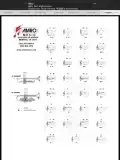
  • image.webp
    image.webp
    20.9 KB · : 153
Trust a clarinet player to open a discussion about a fingering on saxophone nobody uses cause it's duff. It's not a clarinet. It isn't an alternative fingering. Long C# sounds and feels duff on every saxophone I've ever tried which isn't a great many by the way. How can all eight fingers and a thumb be more fluent than no fingers and no thumbs?
 
Trust a clarinet player to open a discussion about a fingering on saxophone nobody uses cause it's duff. It's not a clarinet. It isn't an alternative fingering. Long C# sounds and feels duff on every saxophone I've ever tried which isn't a great many by the way. How can all eight fingers and a thumb be more fluent than no fingers and no thumbs?
I think the point is to learn to make it sound good. Rob Buckland suggests doing exactly this (and even the C and B) in his book. It's more fluent if there's a D either side of it, for example.
 
The long C# with the octave key is a legitimate alternate fingering for that note and it is just one of many others. On some models raising the first finger of the left hand opens up the note a bit. Open C# is arguably the least attractive note on the instrument. It has a dry sound and on most saxophones it is flat. Even on my Mark VI and SBA altos I have to open the middle side key to bring up the pitch of that fingering.

This video by Eugene Rousseau demonstrates the use of several alternate fingerings on the saxophone including several for C#. I was taught that learning all of the possible alternate fingerings for your instrument equips you with the tools to handle any difficult musical passage that you may encounter.
 
It seems we keep comparing apples and oranges.
For the music I normally play, a long C# is absolutely pointless, unless I find a C#D trill, but even in that case I would probably fake it with a palm key.

If we are talking classical saxophone, the general saxophone concept is really different, and the sound of a long C# is probably closer in sound to the open C#.

Sometimes I use long C and long C# (i.e C LC C LC ... ) as a R&R effect, playing with the different sound theses notes have.
 
There is another aspect to this choice of fingerings discussion that I forgot to mention. In symphonic band literature the alto saxophone part is often in unison with the french horns. I have used the "long C# fingering" on numerous occasions because it blends better with the french horn than the dry reedy sound of the open C#. The same is true for the tenor sax and baritone parts. The "musical context" is the determining factor on which fingering is the better choice IMO.
 
As my old teacher put it. When talking about Clarinetists using vibrato to blend in with the other woodwind. It sounds like Bloody Porridge, instead of as the different vegetables. Carrots, green beans. etc.🙂
 
The playing concepts for woodwinds and brass in a symphonic band, wind ensemble, or wind symphony as they are called are markedly different than in a symphony orchestra. In orchestral literature much of the time the tonal "color" of each individual wind instrument needs to "cut through" the strings and be heard as a distinct voice. In band literature unless an individual has a solo or a section has the melody alone, the instruments are played in such a way as to blend and balance to create a homogenous sound much in the same way singers in a choir section do. For those not familiar with this genre of music, here is one of the top university wind ensembles playing Elsa's Procession to the Cathedral by Richard Wagner. Listen to how the instruments blend together until right near the end when the brass take over in the ff section.

 
The playing concepts for woodwinds and brass in a symphonic band, wind ensemble, or wind symphony as they are called are markedly different than in a symphony orchestra. In orchestral literature much of the time the tonal "color" of each individual wind instrument needs to "cut through" the strings and be heard as a distinct voice. In band literature unless an individual has a solo or a section has the melody alone, the instruments are played in such a way as to blend and balance to create a homogenous sound much in the same way singers in a choir section do. For those not familiar with this genre of music, here is one of the top university wind ensembles playing Elsa's Procession to the Cathedral by Richard Wagner. Listen to how the instruments blend together until right near the end when the brass take over in the ff section.


I have to say jbtsax you are persistent, but I can understand that you have spent a large portion of your life working and teaching young students in a wind band environment. But when I Played in the military as a young Clarinetist, I was there practicing most of the time to get out of the Military Band and secure an orchestral position. Like most of the younger players that were there for the music and not a Military pension. So as far as getting me interested in a piece of music written for orchestra and transcribed for a wind band is a lost cause. But each to his own. BTW a few young players in the band went on to play for some prestigious bands. Unlike me who worked for theatre orchestras in Germany, one of the Horn players ended up in the Berlin Phil. Have a nice Day.
 
It's not all about you Jamesmac. I was merely following up on a previous comment about wind players having to blend in symphonic or wind band setting, and to point out that it is different from orchestral playing. I also wanted to share with others the sound of an excellent wind ensemble playing a beautiful work by Wagner that I myself have played several times in collegiate bands.
 
Personal opinions and preferences are one thing, facts are something entirely different. This bruhaha started when I mentioned the long C# fingering with the octave key as one of the alternate fingerings for that note on the saxophone. That is a fact. It is mentioned in the literature and shown on fingering charts as such. One can prefer not to use that alternate fingering or choose another alternate fingering in its place. That is an opinion or a preference which is debatable. That the long C# fingering is a legitimate alternate fingering on the saxophone should not be the subject of debate because it is a fact.
 
[mod's note: this post refers to deleted pre-softening posts]

This is a very mild discussion compared with some I have witnessed.

Homicide amongst linguistics experts would be infinitely higher were it not that most discussion happens online.

A discussion I was involved in had two eminent phoneticians apparently intent on disemboweling each other publicly over which grapheme to use for a phoneme assumed to exist in a hypothetical transitional stage of a language which neither was able to pronounce let alone speak.

It has recently been announced that security is to be stepped up at international linguistics conferences due to the risk of concealed weapons.

Up to PhD level an ordinary body search will suffice. Two PhDs will require a full strip search, and three PhDs or a professorial chair will require an x-ray to preclude the possibility of internally concealed suicide bombs.

It is rumoured, however, that some of the more technologically minded dons are staying away.

It seems that Sears Roebuck are now stocking drones and are offering a very competitive mail order service worldwide.
 
Last edited by a moderator:
The thing I like about threads like this is that we get a thorough airing of the facts from different points of view. It exposes us to fields of experience outside our own personal experience. It also makes me have good look at the saxophone and my playing and try what's being discussed. Just chewing the fat and kicking a can down the road.
 

Social

New! Social Feeds

Look out for the navigation icon:

Follow CafeSaxophone

Latest Song of the Month

Trending

Forum statistics

Topics
32,069
Messages
578,503
Members
8,131
Latest member
Jef B
Back
Top Bottom