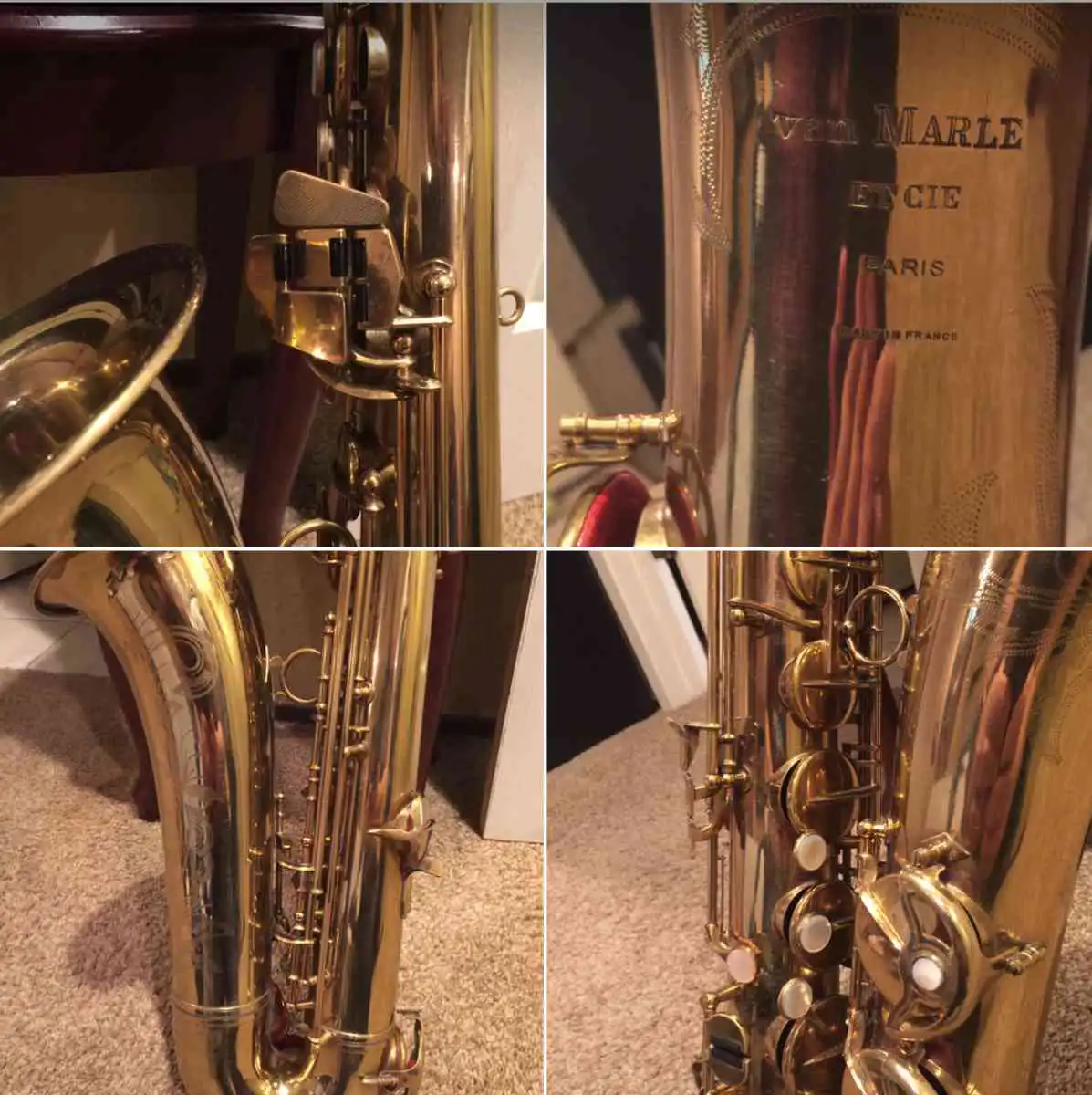
Saxophones Van Marle Baritone, Who made this ?

PigSquealer

Connoisseur of applesauce
Messages
5,800
Location
Los Angeles🇺🇸
Level
Awful
I was gifted a very unusual baritone. I can’t figure out who the maker is. @Stephen Howard @helen @milandro noted some features but were unable to completely identify the maker. This does have some Pierret features. Cann’t find any record of Pierret making a baritone. “Made in France “. You can’t put that marking on unless it was actually made in France .
Overall the parts are not damaged. Although every rod and pivot is stuck with rust. It’s a shame somebody use this as a patio decoration.
Still I would like to know the maker. Also any comments or thoughts about its playing characteristics/ability are very welcome.

1696641752080.jpeg

The beautiful engraving extends all the way to the bow. All three body joints are soldered fittings.
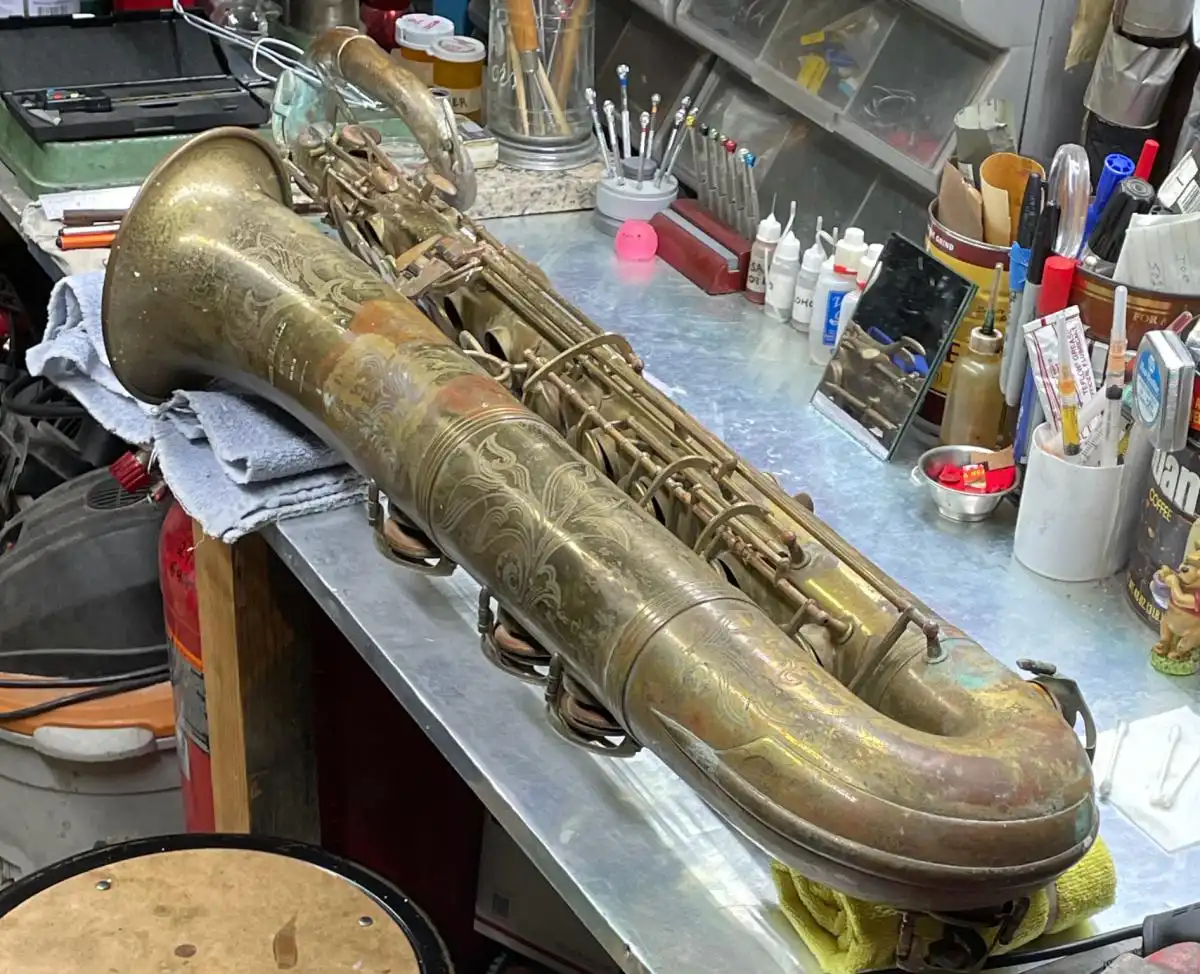
1696642086944.png

The LH pinky table highly resembles a Pierret Super Artista.
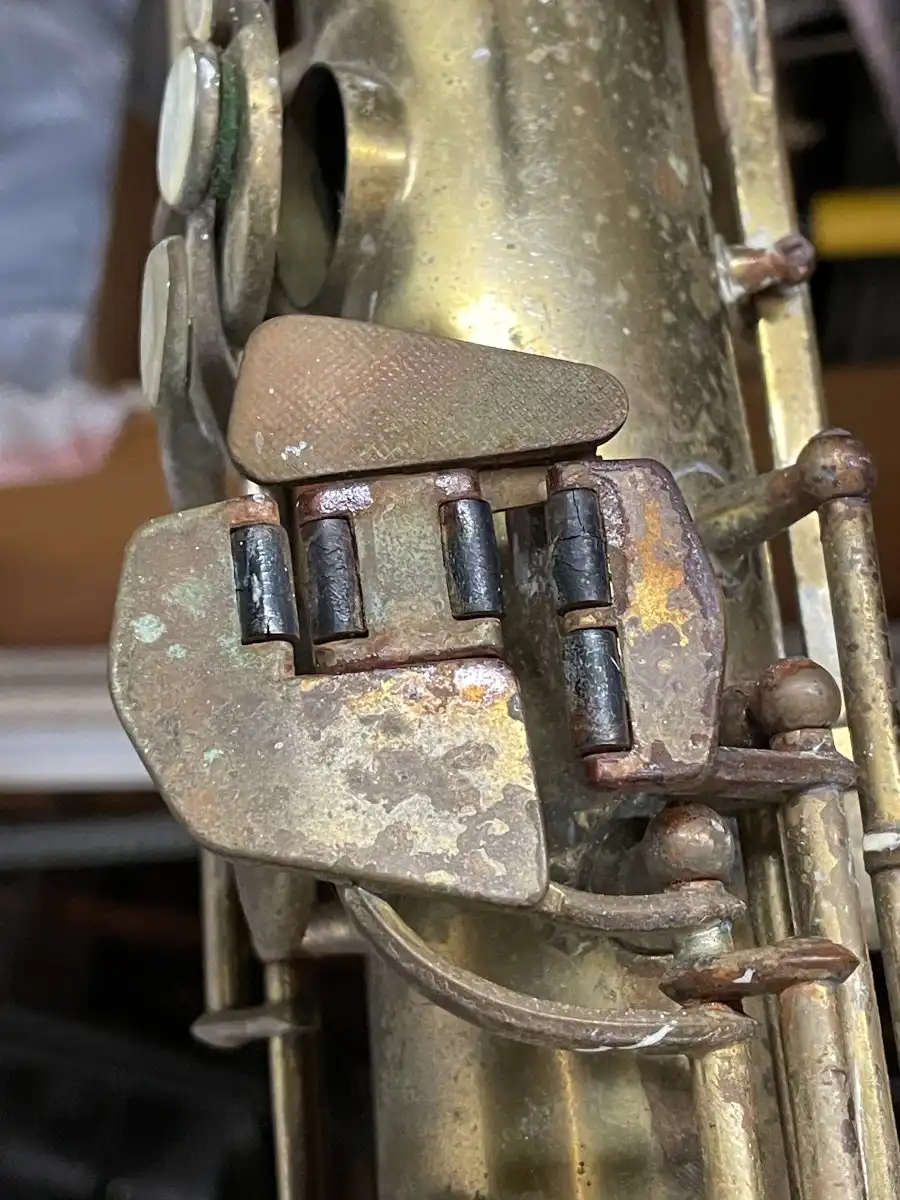
1696642198295.jpeg


1696642416378.webp


View attachment 24107

The sheet metal guards appear to be of the same make and mounting. The RH pinky & palm keys too. What are the chances of the body to bow brace being exact ?
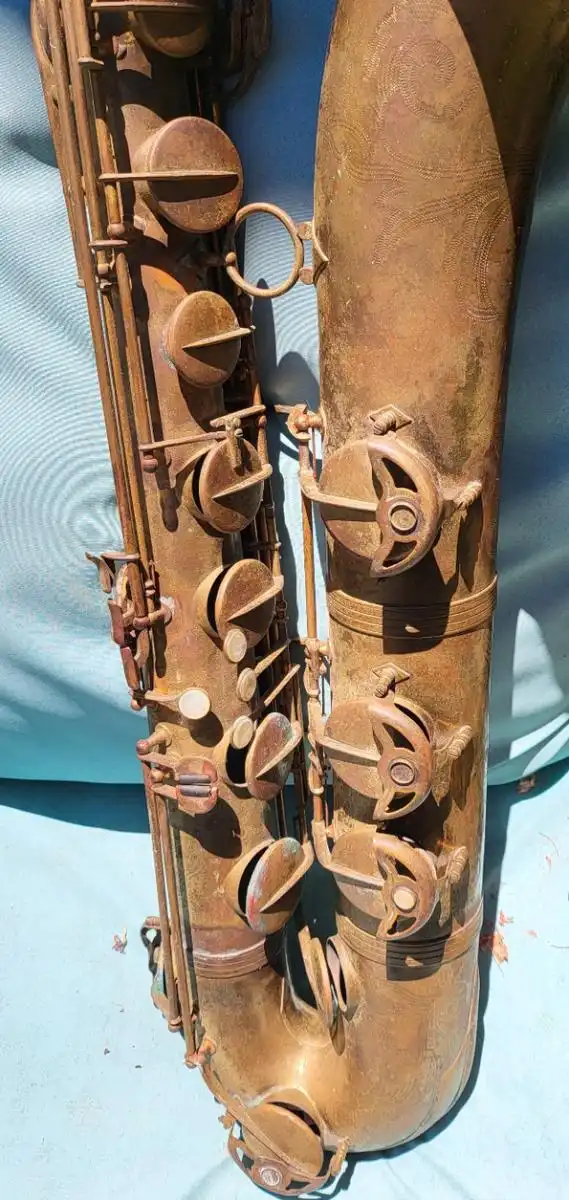
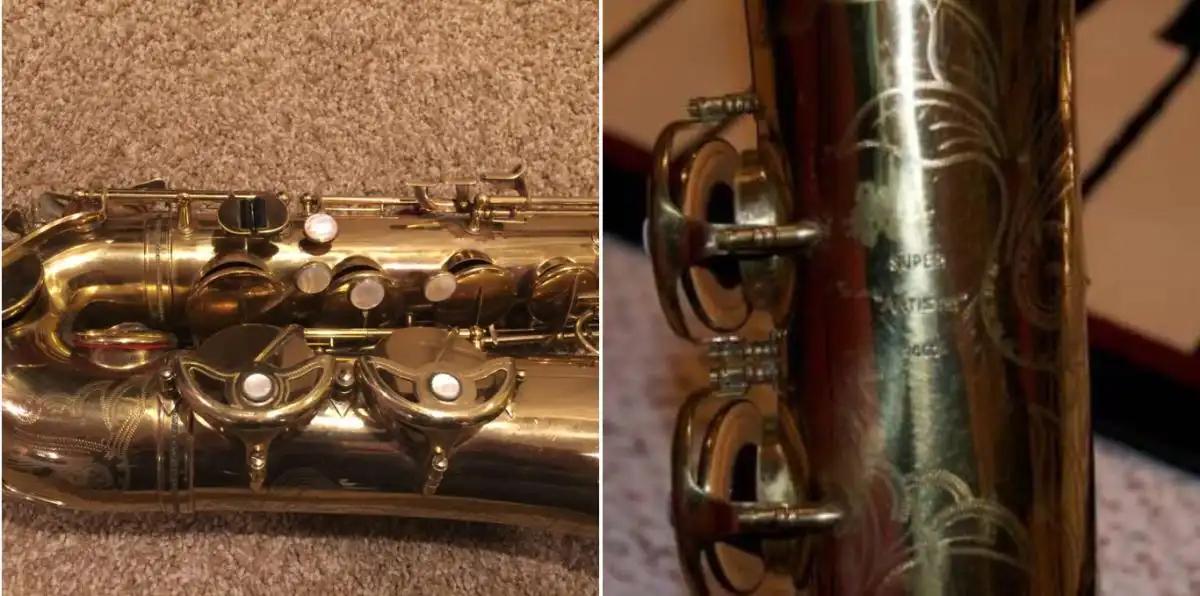
1696642754404.png


1696642931472.png
 
The Van Marle pad guards look rather elegant in construction.

These are the pad guards for my early 1950's Beaugnier Vito. They are a simpler construction, standoff's bent 90 degrees, soldered to the body with brass screws to hold cup in place.

Bari Sax Jewels Left Close.webp
 
Who did a sectioned low A baris? Conn 11M have the low B sectioned. Weltklang had low B,Bb,A tone holes sectioned ...... They added a piece, often not or less conical, somewhere on the bell. This solution was a way spend less money but they could offer a low A bari.

When it comes to European baritone saxes it was often a co-operation between manufactures and brand holders. Malerne company often worked with an Italian manufacturer (I don't remember which) and the saxes were ordered by other saxophone makers or brand holders. To make an ordering of 100-200 baritones was a huge task. In Europe there was also a "home industry" back in the 40's, 50's and part of the 60's. Maybe to give a sax the right attributes? A special design of the key touches, key guards, bell to body brace .... ?
 
Low A mechanism on yours and mine are a bit different, you have that big arced arm bridging over the pinky rods, my low A arm is mounted on other side of those rods....the low A operates solely via a thumb trigger below the LH thumb rest...
(hoping all rods and screws on yours are movable and not seized up)
Strikingly similar. I’m guessing these were built years apart by the same maker. Other than Helen’s site are there any other sources on Pierret ?
Thank you very much for taking the time to post the pictures. Much appreciated !
 
Different ways to deal with low B, Bb and A sections as well. The Pierret bari have a solution more in the style of a low A Weltklang. When were these saxes made? The first low A bari, Selmer SBA, came around 1952-53.
 
The 'band' near top of bell is a Ferrule, there's a seam inside you can feel.

Interestingly on yours the low A tonehole exists on a different piece of bell tube - suggesting they took their usual low Bb bellbut modified it (cut it) to then solder on the low A piece...
...while on mine the toneholes are all on one piece of belltube..so at some point the last ferrule location changed. Not also that last ferrule 'design' on your matches the other ferrules, while on mine it's actually a different 'band' design....

Never have researched a Pierret serial list, does @helen refer to one ?

If not, the closest we could get would be to find any sort of serial registry which shows where the Pierret-made "Parisian" for Olds became the "Olds Pariasian Ambassador"...because there are Olds sax catalogs, dated, floating around out there which show when the Olds "Parisian" changed to "Parisian Ambassador". Thus that can be dated (am thinking late 50's, but solely based on memory).

So if we can determine that date, then find some "Parisian" serial numbers, we can extrapolate that numbers higher than those were later, thus post -19XX, and at least get within a decade of accuracy.
 
I find it interesting that the Van Marle bari is made of red brass, similar or same metallurgy as my early 1950's Beaugnier Vito. Perhaps it was traditionally hand formed and worked similar to the Vito? The engraving and overall workmanship is thing of beauty. Also I am amazed that it has very few dents, seems well cared for. My Vito in contrast took quite a beating as a school instrument.

Once repaired, cleaned up, relacquered, overhauled, it will definitely be a thing of true beauty, and I imagine, play extremely well.
 
The red there is simply oxidation of bare brass, it will not really have a red tinge after a chem bathing and hand polish. Pierret lacquer aged in a variety of colors, lol...I have seen brown tinted, green tinted among others.

Relacuering a baritone, correctly, nicely...is gonna cost like $2g....I would say for something like this, just chem bath and hand-polish and leave the lacq wear as-is. It would never fetch more than $1600, overhauled, on the used market anyway
 
Relacuering a baritone, correctly, nicely...is gonna cost like $2g....I would say for something like this, just chem bath and hand-polish and leave the lacq wear as-is. It would never fetch more than $1600, overhauled, on the used market anyway
I wouldn’t strip the lacquer off of this and polish. If anything it will be gently cleaned. Being attentive to the accumulated iron oxide rust at the posts. That definitely needs to be removed. My intentional finish would be more in the arena of renaissance wax. Sometimes you can’t beat the look of well worn leather shoes cared for.
 
The engraving and overall workmanship is thing of beauty. Also I am amazed that it has very few dents, seems well cared for. My Vito in contrast took quite a beating as a school instrument.

Once repaired, cleaned up, relacquered, overhauled, it will definitely be a thing of true beauty, and I imagine, play extremely well.
Honestly I thought this was a big pile of junk. Originally gifted to me as somewhat of a thank you and a joke. Intended use… flower pot ! A few days after receiving….I picked it up and looked it over well. The first surprise was the Low A. The second surprise was the engraving all the way to the bow. That’s usually a sign of something being a little more upscale.
Upper body tube has a slight bend from where it fell over. That’s probably how the neck got knocked out of the receiver. Otherwise there’s amazingly few dings.
 
The 'band' near top of bell is a Ferrule, there's a seam inside you can feel.

Interestingly on yours the low A tonehole exists on a different piece of bell tube - suggesting they took their usual low Bb bellbut modified it (cut it) to then solder on the low A piece...
...while on mine the toneholes are all on one piece of belltube..so at some point the last ferrule location changed. Not also that last ferrule 'design' on your matches the other ferrules, while on mine it's actually a different 'band' design....

Never have researched a Pierret serial list, does @helen refer to one ?

If not, the closest we could get would be to find any sort of serial registry which shows where the Pierret-made "Parisian" for Olds became the "Olds Pariasian Ambassador"...because there are Olds sax catalogs, dated, floating around out there which show when the Olds "Parisian" changed to "Parisian Ambassador". Thus that can be dated (am thinking late 50's, but solely based on memory).

So if we can determine that date, then find some "Parisian" serial numbers, we can extrapolate that numbers higher than those were later, thus post -19XX, and at least get within a decade of accuracy.
I love these types of research projects. I know a person that may have some Olds catalogs & records. I’m literally 20 minutes away from where Olds was in Fullerton California. Home of Fender guitars too.

The sections all look like they were made at the same time. The upper joint is a true joint. The engraving is consistent on all sections. It has a good flow and the technique looks like the same person executed it. The machining of all the parts is consistent and uniform. Could be worked over in time for New Years party.

:optimistic:

SN #1786. No other markings. The area slightly below the number is an illusion. That’s not a P or LP or anything else.
C96EF1BC-31D6-4637-A396-D524681866BC.webp
 
I wouldn’t strip the lacquer off of this and polish. If anything it will be gently cleaned. Being attentive to the accumulated iron oxide rust at the posts. That definitely needs to be removed. My intentional finish would be more in the arena of renaissance wax. Sometimes you can’t beat the look of well worn leather shoes cared for.
Thanks for the very practical and cost effective tip, @PigSquealer on using Renaissance Wax instead. Periodically I've been cleaning off the bare brass tarnishing on my Beaugnier Vito bari with careful use of Brasso. Your solution would have me doing a whole lot less of this. :thumb:

Honestly I thought this was a big pile of junk. Originally gifted to me as somewhat of a thank you and a joke. Intended use… flower pot ! A few days after receiving….I picked it up and looked it over well. The first surprise was the Low A. The second surprise was the engraving all the way to the bow. That’s usually a sign of something being a little more upscale.
Upper body tube has a slight bend from where it fell over. That’s probably how the neck got knocked out of the receiver. Otherwise there’s amazingly few dings.
Yes, I was amazed how clean it is when it comes to dent abuse. I just love the beautiful quality detailed engraving on it.

The red there is simply oxidation of bare brass, it will not really have a red tinge after a chem bathing and hand polish. Pierret lacquer aged in a variety of colors, lol...I have seen brown tinted, green tinted among others.

Relacuering a baritone, correctly, nicely...is gonna cost like $2g....I would say for something like this, just chem bath and hand-polish and leave the lacq wear as-is. It would never fetch more than $1600, overhauled, on the used market anyway
Actually, I was referring to the type of brass used, exposed by the color it tarnished as, Red (more copper) versus Leaded Yellow (more zinc) brass (tarnishes brown). But yes, once tarnish is removed, it looks just like yellow brass. Reading between the lines, I gathered that red was used over the leaded yellow because it was slightly easier to work by hand tools. I am guessing that the Van Marle was hand made similar to the Beaugniers.

However, I am a user, and to me really doesn't make much of a difference. (One other forum I used to post in seemed to take these arguments to ahem, extremes. 😱)

Thanks @JayeNM on the practical ballpark costs for a relacquer job. As you point out, it would have to be a high cost demanding vintage horn to make such work profitable. :thumb:
 

Social

New! Social Feeds

Look out for the navigation icon:

Follow CafeSaxophone

Latest Song of the Month

Trending

Forum statistics

Topics
32,034
Messages
577,653
Members
8,115
Latest member
kamosax ug
Back
Top Bottom