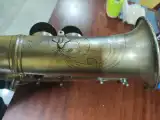
These two horns also share exactly zero mechanical design characteristics/details with the OP's.
I just wanted to show that stamps (not engravings) on a sax is important. I can also se that OP's sax is not a "King Leimare" based on Amati Classic/Super Classic saxophone.
The big saxophone manufacturer (Conn, Selmer, Buffet, ...) stamped their/the patents "id" on the sax. Other manufacturer stamped a logo/trademarke. Buescher; True Tone (TT), H,N,White; Voll Tone later King Super 20, Keilwerth; "JKG Best In The World", Hohner; "Pure Tone", Martin; "The Martin XXXX", "Comm II" ........ . All this was information how the sax was made. I think the stamped info on a sax is important. Most second line or stencil saxes were not protected by trademarks. But there are exceptions.
In Europe we had a "home industry" and small workshops where skilled craftsmen and workmen repaired saxes but also made saxes and parts. It could be to replace a bell-body brace with a bell-body ring, keytouches, lh G# clusters, C/EB(D#) cluster, keyguards ..... . It was posiibible to buy blanks back then as well. To look at the keyguards .... we have a skill member that can do new keyguards pretty close to the original.
Internet and forums are effiecient tools. I had four Martin altos for sale for 10 years ago (I don't play alto anymore); "The Indiana" by Martin, Martin Handcraft Imperial, Martin Handcraft Comm II and "The Martin Alto". A young player didn't believe me when I showed him the difference between a "The Indiana" and a Comm II. He had read on internet that an Indiana was the same as a Committee Martin. I guess he had read sales talk.
I can't say who made OP's sax. My knowledge is limit. I know pretty much about my own saxes. Why do I write on internet? CS is the only forum. I try to get back to handwritten letters, telephone calls, basic e-mail, Blues & Rock meetings and Rock sax meetings, jam ..... . Where is the "leave botton" ?
😉



 acebook
 (bottom of page)