Saxophones Pork Tales: Saxophone Repair DIY Adventures.

Life around the barn.
Tales from a pig that likes to stick his nose into everything.

Paint that S. How difficult could it be ?
1747869014621.webp


1) Search the net.
2) Find the color.
3) Order color.
4) Study task on University of YouTube, aka; For destruction by DYI presented by pro tech.
1747869824677.webp


1747869909688.webp


Do the cleaning & prep.
1747870236970.webp


Paint and cleanup / detail the edges with hard cotton swabs. Sounds easy……:confused:
1747870401847.webp


Yeah tha guy Matt makes it look easy.
Anyone remember your first experience cooking bacon crispy while still in the frying pan !
 
Oooohhh - I am giving my kids some ****e to deal with when I'm dead.

Regarding the magnet - most of them that I can find here at about 100kg pull are round with a central hole. I imagine I'll need a soft former on the outside - something roughly formed to the shape of the tube in the patch where I am, with something soft inside it? I don't have a feel for how the inv sq law is going to work against me.

(ETA - your mention of odd-to-me US thread specs made me grimace, as I was earlier in the week sorting through boxes and boxes of assorted junk trying to find some UNF (or UNC, I can't remember) to clamp up the spring in an old Bridgeport CVT motor pulley. Which, after about an hour, it transpired someone had already re-tapped to M6 🙂 )
 
Oooohhh - I am giving my kids some ****e to deal with when I'm dead.
My daughter will probably sell the house along with the contents. That’s if Ma Squealer doesn’t call the scrapman first.
Regarding the magnet - most of them that I can find here at about 100kg pull are round with a central hole. I imagine I'll need a soft former on the outside - something roughly formed to the shape of the tube in the patch where I am, with something soft inside it? I don't have a feel for how the inv sq law is going to work against me.
Good thread on the subject.
(ETA - your mention of odd-to-me US thread specs made me grimace, as I was earlier in the week sorting through boxes and boxes of assorted junk trying to find some UNF (or UNC, I can't remember) to clamp up the spring in an old Bridgeport CVT motor pulley. Which, after about an hour, it transpired someone had already re-tapped to M6 🙂 )
🤪 assorted junk 🤣 Yeah until the rainy day you need it to save your bacon. That bit was likely 1/4-20 NC, UNC or 1/4”-28 NF, UNF. Close to 6mm. Work on a 1969 Triumph TR6R motorcycle for a year. You’ll learn all three hardware choices.
 
Drawbar for the collet chucks in the works.
View attachment 38826
Done 🙂
It’s solid bar stock so I’ve double nutted the bar for removing once set in if needed.
3/4”-10 TPI and first threads I’ve cut since getting the gearbox back in.
1795160182048.webp

1795160220242.webp

To our non-mechanical members. The tool is a taper press fit to secure. The bar when tightening secures the tool from coming loose.
1795160272438.webp

1795160413934.webp

1795161188608.webp
 
Done 🙂
It’s solid bar stock so I’ve double nutted the bar for removing once set in if needed.
3/4”-10 TPI and first threads I’ve cut since getting the gearbox back in.
View attachment 38848
View attachment 38849
To our non-mechanical members. The tool is a taper press fit to secure. The bar when tightening secures the tool from coming loose.
View attachment 38850
View attachment 38851
View attachment 38852
Go on, put a big fancy handwheel on the end of it. I'd post one to you but it would mean cancelling Christmas 🙂

I was just working on a big cast-iron mechanical hacksaw, the same age as your Triumph. I thought it was much older, because everything that would now be a light steel pressing / fabrication is cast iron - eg some really fancy castings for the coolant sump and pump, all in one, all very thin - they must really have needed to keep the foundry busy. Someone at work wanted to condemn it because the motor bearings (it appears to be the original motor) were noisy (!) - and they turned out to be metric and therefore cheaply replaceable. I wonder when Triumph went to metric bearings - English bearings here are paradoxically often only available from the US, and the price of postage, as already alluded, is ruinous.
 
The tenon was rounded and sized last week. I didn’t take a before work picture, but just visualize a goose egg shape.
1795589438054.webp


I start by removing the octave key. Then peal the cork off.
1795589793256.webp


The cork on Martins is always very thin and usually comes off in little pieces. Here the shellac has failed and the cork came off in big pieces. All normal from years of use.
1795589995490.webp


In preview. I did notice the cork was a bit longer than I like to see. The material is 42mm 1-5/8”. I’m already short to cover any seam stains. Looks like the mouthpiece lived at one location for many years. 50% of cork unused, so why have it !
1795590303954.webp


Interesting key spring(s). @Stephen Howard, this is proof that progressive rate leaf-springs, along with 8-10Hz spring frequency adjusting corks works ! Maybe it’s a mass thing ?
I’ll service this the old school single lightweight way🤣
1795591434633.webp
 
Interesting key spring(s). @Stephen Howard, this is proof that progressive rate leaf-springs, along with 8-10Hz spring frequency adjusting corks works ! Maybe it’s a mass thing ?
I’ll service this the old school single lightweight way🤣
That short, thick spring? It's to help prevent the main spring from deforming if the crook key is opened too far,
The design of the key precludes the use of a hard stop to limit opening.
 
This stop screw performs two tasks.
1) Overextension of the spring.
2) Stops contact of teardrop hitting neck.
1795594088825.webp


The design fabrication doesn’t allow for traditional bumpers.
1795594400006.webp


Traditional bumpers like these examples below IMHO are for handling. In use playing they don’t serve any function.

1)Where the teardrop contacts the crook and dents it.
1795594932968.webp


2) Just above the halo the key arm contacts neck and dents it. Common from stored loose inside case related damage.
1795595477587.webp


So back to the needs of a not bent proper length screw.
Oddly the thread is 5-40 and I have 8-18 stainless spares on hand. Just a little machining is required.
1795595941571.webp
 
Fit check. The old bit was too short. The teardrop made body contact and 2mm gap still between the parts.
1795596305397.webp


Cut the slot.
1795596366487.webp


First time use of the new ER-16 collet ! Time to slice off the extra fat.
1795596571425.webp


Filed & shaped end to curve and it’s done.
1795596821268.webp


Tested. The teardrop is just making contact. Key is way to open. Plenty of turns in left !
1795597028132.webp

1795597522561.webp
 
The tenon was rounded and sized last week. I didn’t take a before work picture, but just visualize a goose egg shape.
View attachment 38900

I start by removing the octave key. Then peal the cork off.
View attachment 38901

The cork on Martins is always very thin and usually comes off in little pieces. Here the shellac has failed and the cork came off in big pieces. All normal from years of use.
View attachment 38902

In preview. I did notice the cork was a bit longer than I like to see. The material is 42mm 1-5/8”. I’m already short to cover any seam stains. Looks like the mouthpiece lived at one location for many years. 50% of cork unused, so why have it !
View attachment 38903

Interesting key spring(s). @Stephen Howard, this is proof that progressive rate leaf-springs, along with 8-10Hz spring frequency adjusting corks works ! Maybe it’s a mass thing ?
I’ll service this the old school single lightweight way🤣
View attachment 38904
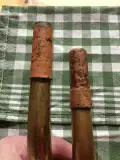
The tenor mouthpiece I use on Magna is a long one. The bore is c 52 mm long so a cork that's 44 mm long is perfect. I use tube corks (tapered or straight) instead of sheet cork. To replace a the cork on the neck is useally considered to be an easy DIY work. I don't think so.

You can reduce the length of the cork to 25-30 mm but I think most of the bore should be supported with cork. To avoid "wobbling" (leaks) and to give more and better respons.

The "stop screw" on the neck is described by Martin to be an adjustment screw. Martin have quick key action. We added a thin piece of corks to avoid metal vs metal.

Magna necks are a little bit longer than other Committee necks. Magna to the left. Pictures are before I replaced the cork necks to cork tubes.
1795597873919.webp
1795597957445.webp
 
Fit check. The old bit was too short. The teardrop made body contact and 2mm gap still between the parts.
View attachment 38914

Cut the slot.
View attachment 38915

First time use of the new ER-16 collet ! Time to slice off the extra fat.
View attachment 38916

Filed & shaped end to curve and it’s done.
View attachment 38917

Tested. The teardrop is just making contact. Key is way to open. Plenty of turns in left !
View attachment 38918
View attachment 38919
What is the O.D. of the neck at the end and 44 mm further down/in?
 
The tenor mouthpiece I use on Magna is a long one. The bore is c 52 mm long so a cork that's 44 mm long is perfect. I use tube corks (tapered or straight) instead of sheet cork. To replace a the cork on the neck is useally considered to be an easy DIY work. I don't think so.

You can reduce the length of the cork to 25-30 mm but I think most of the bore should be supported with cork. To avoid "wobbling" (leaks) and to give more and better respons.

The "stop screw" on the neck is described by Martin to be an adjustment screw. Martin have quick key action. We added a thin piece of corks to avoid metal vs metal.

Magna necks are a little bit longer than other Committee necks. Magna to the left. Pictures are before I replaced the cork necks to cork tubes.
View attachment 38920
View attachment 38921
Your picture, however, shows a Comm 1 or 2 vs a Magna. I believe the Comm 3 ("The") has essentially the identical neck to the Magna.
 
Your picture, however, shows a Comm 1 or 2 vs a Magna. I believe the Comm 3 ("The") has essentially the identical neck to the Magna.
For some years ago I did a comparasion of "The Martin Magna Tenor" -59 neck and a" The Martin Tenor" -55 neck. The magna neck was a little bit longer. I can't find the picture. Not as much as Magna vs Comm II. I just took a cord into the necks so it wasn't any deeper science. They used to say (on internet) that the tube on Committee saxes were the same over the years.
 

Social

New! Social Feeds

Look out for the navigation icon:

Follow CafeSaxophone

Latest Song of the Month

Trending

Forum statistics

Topics
32,082
Messages
578,832
Members
8,140
Latest member
AnnaR
Back
Top Bottom