Tech/maintenance Pitch shift pedal for live performance - recommendations sought

Karina_T

Member
Messages
6
Location
London
Level
Seasoned intermediate
Hi all,

New to the forum but longtime player - looking for real world experience recommendations for pitch shift pedals for live.

I'm a tenor player and in the studio have double tracked and shifted riffs down an octave for pseudo bari - to surprisingly convincing effect (in the overall mix).

I'm considering trying to replicate for live gigs - I used to have a Whammy Wah but the attack never really worked convincingly.

Is anyone doing this and found a pedal that really works convincingly? It doesn't need bells and whistles - really just a simple octaver really.

Thanks for any thoughts.
 
I put octivider pedal in to Google and came up with a page full.

G4m do them as do Thomann, also Amazon.

Thomann have very good customer service and will chat to assess your needs and advise the producct most suitable from their extensive range.
 
Playing live, your unaffected pitch will be heard at standard saxophone volume (loud) as well as the octave down effect. This means when using an octave down pedal such as the robust, no-frills Boss OC-5, you will sound like high and low saxophones playing in unison an octave apart.

I haven’t used one live, but have played with the Boss OC-5 in the practice studio and liked it. At the end of the world, the last things left will be cockroaches, Nokia 3310s and Boss pedals 🙂

I use a DigiTech HammerOn for my pitch-shifting needs now, but it definitely has lots of bells and whistles.
 
I put octivider pedal in to Google and came up with a page full.

G4m do them as do Thomann, also Amazon.

Thomann have very good customer service and will chat to assess your needs and advise the producct most suitable from their extensive range.
Yes thanks, I did the same but I was after people who actually use pitch shifters live on saxes - particularly the lower instruments.
 
Playing live, your unaffected pitch will be heard at standard saxophone volume (loud) as well as the octave down effect. This means when using an octave down pedal such as the robust, no-frills Boss OC-5, you will sound like high and low saxophones playing in unison an octave apart.

I haven’t used one live, but have played with the Boss OC-5 in the practice studio and liked it. At the end of the world, the last things left will be cockroaches, Nokia 3310s and Boss pedals 🙂

I use a DigiTech HammerOn for my pitch-shifting needs now, but it definitely has lots of bells and whistles.
Thanks David.
I'm very famililar with the Whammy but hadn't clocked the Hammer On. Looks jolly robust (like the Whammy).
And of course the loud ambient sound will come through. But I play in a loud punk ska band and the ambient sound will get subsumed by the effected.
In fact, I think the 'cellist (i.e., bassist) may be using the OC-5 as well.... I should check. Thanks again.
And... can I ask how the Hammer On performs with the sax?
 
I'm a tenor player and in the studio have double tracked and shifted riffs down an octave for pseudo bari - to surprisingly convincing effect (in the overall mix). I'm considering trying to replicate for live gigs - I used to have a Whammy Wah but the attack never really worked convincingly.
This is an interesting concept, never heard of this being done before, but if the results pleases the ears of the audience, then I can see where it would expand your horizons in performance.

Good luck, and BTW, welcome to the forum!
 
I use both an octave effect (rack mounted) and a harmoniser pedal that also has an octave option.

You don't say if you're using a sax-mounted mic or stand-mounted. I use sax-mounted exclusively, so can't comment on a standard mic set-up.

Getting the right balance of original sound and processed sound is the main issue. Just because the mix sounds great at home, it doesn't mean it will sound right once you're in the band mix. Usually, it has to sound like there's too much of the effect in the balance for it to sound right out of the PA with the rest of the band. But it's something you need to sort with your sound engineer. If you're using a digital desk, then you can always use the 'soundcheck' mode for the band with your sax in 'live' mode so that you can hear exactly what balance you need. That way, it can be done at home or in the rehearsal room rather than taking up valuable soundcheck time.

The other issue I've had is that the FX unit sometimes misses a note because of the stage bleed into the sax mic. There's not much you can really do about that. Even with IEMs, I rarely hear the issue as it's that fleeting, but it does happen. The quieter the stage, the closer the mic is to the bell, the less bleed and, therefore, fewer missed notes.

Because of my set-up and requirements, I use the simple octave FX on the tenor and the full harmoniser on the alto (as I'm usually playing what was originally a full horn section part and the alto is more suited to that brass sound).

I'm trying to find live examples.

This is the full harmoniser on my alto (phone audio):

Full harmoniser (desk audio):

I can't find any video online of me using just the octave FX on my tenor. TBH, these days I only use it on the beginning of Night Boat To Cairo (Madness).

<edit>
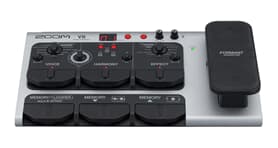
I forgot to say what pedal I'm using - it's a Zoom V6 on alto:

On tenor I use the Behringer 3D (which also provides reverb and delay(s) for both the tenor and alto):
Thanks so much for taking the time to explain your setup in such detail Veggie Dave,
Yes I know the Virtualiser - hadn't thought of using it on my sax to be honest.
The Zoom looks interesting - we've got the Zoom F3 Vocal Processor here at work - I've used it doing BVs and again, hadn't thought of using it on my sax. I'll give it a go. Appreciate the missed notes business.
Thanks for the thoughts!

Oh, and I've been using a stand mic but have a bell mounted wired mic too and going to fiddle about with my Rode wireless radio mics too 🙂

Karina.
 
I bought an entire horn for this but never did it.

That's why I bought my Mexi-Conn tenor; I planned to install a neck pickup (didn't want to drill into my 10M's neck) and go full Varitone only with common stuff. I bought a Boss octaver, but never got to the point of the pickup.
 
A setup a friend has. Alto, C Melody, tenor, and baritone. Sure wireless mic on bell.
1762562877684.webp

1762563093815.webp

1762563331756.webp
 
I use both an octave effect (rack mounted) and a harmoniser pedal that also has an octave option.

You don't say if you're using a sax-mounted mic or stand-mounted. I use sax-mounted exclusively, so can't comment on a standard mic set-up.

Getting the right balance of original sound and processed sound is the main issue. Just because the mix sounds great at home, it doesn't mean it will sound right once you're in the band mix. Usually, it has to sound like there's too much of the effect in the balance for it to sound right out of the PA with the rest of the band. But it's something you need to sort with your sound engineer. If you're using a digital desk, then you can always use the 'soundcheck' mode for the band with your sax in 'live' mode so that you can hear exactly what balance you need. That way, it can be done at home or in the rehearsal room rather than taking up valuable soundcheck time.

The other issue I've had is that the FX unit sometimes misses a note because of the stage bleed into the sax mic. There's not much you can really do about that. Even with IEMs, I rarely hear the issue as it's that fleeting, but it does happen. The quieter the stage, the closer the mic is to the bell, the less bleed and, therefore, fewer missed notes.

Because of my set-up and requirements, I use the simple octave FX on the tenor and the full harmoniser on the alto (as I'm usually playing what was originally a full horn section part and the alto is more suited to that brass sound).

I'm trying to find live examples.

This is the full harmoniser on my alto (phone audio):

Full harmoniser (desk audio):

I can't find any video online of me using just the octave FX on my tenor. TBH, these days I only use it on the beginning of Night Boat To Cairo (Madness).

<edit>
I forgot to say what pedal I'm using - it's a Zoom V6 on alto:

On tenor I use the Behringer 3D (which also provides reverb and delay(s) for both the tenor and alto):
Hi @Veggie Dave, many thanks for your detailed reply! I learned a lot. One more questionto you (as a complete electronics newbie!)

In the (rock)band I play in, I use sax-mounted amplification for gigs. Depending on the size of the location, we either play through a mixer linked to our own 'PA system' (= 2 large speakers). At other (small) venues we just play through our individual amplififiers.

I've been wondering for a while about using more 'reverb' (and possibly other effects) on live performances. Especially on solos. Our 2 guitarists are both adept at switching their 'sound' (guitar+ vocals) between songs, using their 'pedalboards'. I've been wondering about using more live 'reverb' (and/or other effects) for a while. Especially on solos. But I'm also aware that - in mid-size - smaller locations, the acoustic sound of my sax will always be heard.

Am I right in thinking that I would need an 'XLR splitter' from my single XLR output into two outputs? One for the '(raw amplification of my sax' and the other for any 'effects' amplification? With some means (preferably independently of the mixing board) of mixing betwen the two?

I've read previous posts by well-respected members (perhaps including you 😉) that say: 'trying to add 'effects' to a sax in small locations (pubs, etc.) is a waste of time. Because people always hear your 'acoustic sax'. But I've always wondered what the effect would be by adding a 'reverb' to my 'raw acoustic sound'
 
What you're talking about is having a clean signal and an effects signal - 100% sax in one channel, 100% FX in the other - that you or the sound engineer then mixes to suit the venue.

This is a perfect solution to what you want.

A passive splitter is pretty cheap, too, so it's not going to break the bank, either. As long as the desk has enough channels you're good to go.

Unlike the guitarists, you are a loud acoustic instrument so you can't control your dry/wet mix with the same ease that they can. That mix is going to be venue specific until you're on larger stages/in larger venues, where stage spill is no longer an issue.

Of course, as it's a rock band that may not be true in your case. If you've got acoustic drums with all the other instruments using real backlines that are loud enough to compete with the drums, then unless you're blowing your lungs out, stage spill isn't going to be that much of an issue. In which case, you could have your gear set-up in exactly the same way the guitarists do, with everything inline and mixed by your set-up. That way, you can have all the options that guitarists take for granted.

If that's not possible, then you can still pre-mix all your effects at home/in the rehearsal room, but it will be up to whoever's in control of your front of house sound as to the level those effects are heard out front.

Is it worth it? Absolutely. If it's a really small venue then yes, your raw sax isn't going to need any amplification. But that doesn't mean you can't have your reverb etc. coming through the PA. How well it works is going to be dependant on many things, the main one that springs to mind being how directional the sax is, but it will work and is definitely work trying.
 
For anyone curious, I'll attach a photo of my small pedal rig from my recording session last month. I have two octave pedals involved, the "Organizer" from EarthQuaker Devices (don't think it's made any more) and a mini-POG from Electro-Harmonix. In the past, I've also used another discontinued EarthQuaker pedal as well as the readily available Boss PS5 pitch shifter – I think they're on PS6 now but it'll be largely the same. Any of these can work with saxophone if, and it's a big if, the signal logistics are handled properly, as some fine folks here have already discussed.

My solution to that is a vocal preamp/DI with an integrated effects loop that was specifically designed to use guitar pedals with a microphone signal. I've used it for around a decade and it's excellent at what it does. I use the one by Radial, the Voco-Loco, but there are others that should work comparably well (Radial units tend to be built like tanks, which is why I went with that one, and so far so good).

There are lots of different ways to manage effects pedals (usually designed for guitars) with microphones/wind instruments but the logistical challenges are always there. Everything from a knob on a pedal to a patch cable introduces a variable and a potential point of failure. "Which pedal should I buy" is only the beginning! 🙂
 

Attachments

  • IMG_0462.webp
    IMG_0462.webp
    123.1 KB · : 102
The Zorg Effects Blow! is a good pedalboard-friendly alternative to the Voco-Loco. It uses a standard guitar pedal power supply and is nice and compact.


Similar threads... or are they? Maybe not but they could be worth reading anyway 😀

Social

New! Social Feeds

Look out for the navigation icon:

Follow CafeSaxophone

Latest Song of the Month

Trending

Forum statistics

Topics
32,051
Messages
577,984
Members
8,120
Latest member
lundalux
Back
Top Bottom