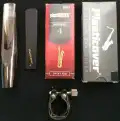
Mouthpieces Just invested in a pro mouthpiece (Beechler)

@Pete Effamy and everything in between. Obviously you have the knowledge to say what level is best suited to a Beechler. It's a harder to play mouthpiece in the advanced range. It's what Dave Koz plays that's why I said pro I guess? Not many are playing the 4C at advanced level, if they were I'd have stuck with it as well! I get it, you hate "beginners" getting the same set-up as advanced players when they don't have the chops or expertise to play them well, fair enough. I've had the 4C and my Yas-62 for a year now, and I'm not getting any younger so I just went for it...I might still get a Jody Jazz or something a bit more inbetween the two yet but I'll see how I go.

I don't see anyone hating beginners nor anyone that's envious of your pro mouthpiece. Those of us with a few thousand hours on the horn are just trying to help you find a less tortuous path to success.

Enjoy as best you are able.
 
I don't see anyone hating beginners nor anyone that's envious of your pro mouthpiece. Those of us with a few thousand hours on the horn are just trying to help you find a less tortuous path to success.

Enjoy as best you are able.
I don't think anyone's envious, never crossed my mind! I'm genuinely trying to take everything on board and appreciate the advice.
 
In your early posts in this thread you said several things that made experienced players on here worried about your choice to dive in to a relatively open, metal, high baffle mouthpiece.
Problems that you talked about are usually indicators that this wouldn’t be a good step for your future progression. All answers have voiced concern.
To use my earlier analogy of bikes, would it not go something like this:
I’ve been riding a moped for about a year, and sometimes I wobble a bit. But Valentino Rossi rides a Yamaha R1 so I thought I’d just jump in.
I managed to ride around a bit and haven’t yet crashed; does this mean that I’m finally getting some real riding skills?
Ok point taken.
 
So much has to do with the facing and chamber. At the risk of appearing to include a shameless and gratuitous mention of PPT mouthpieces, I advertise the alto 5 as being suitable for beginners. But it is also the mouthpiece that I use (as a seasoned pro).

However I would not recommend a tenor 5 to a beginner due to the baffle.
It was also only slight since I noticed when I recorded and not during playing.
As you've recorded, it would be very appropriate to post those recordings and we may have a much clearer idea when debating the merits (or not) of a beginner using this mouthpiece. As I've said above a really good test is whether you can especially play quietly low down with good articulation and tuning. As well as high notes of course.
 
There's a big difference between squeaking on purpose and accidentally. The former is altissimo, the latter a squeak. Once you learn to control them, all your squeaks become altissimo.

The OP's squeaks are clearly unintentional and do not add to the music he's trying to play. So in this case, embracing the squeak is not the best solution.
I know. Just one way to avoid squeaking and that is to do different exercises with the new mouthpiece. I used to do:

- Note bending. Try to bend down a quarter step. Start on C2 to and go chromatic up. Then go chromatic down from C2.
- Legato without tonguing. Start on C2 to C3 and go chromatic up. And from C2 down to C1 ... Bb2 to low Bb1. Low A is the limit on altos and basis. High F# is the limit on most modern saxes. Maybe high G on some saxes.
- Staccato. Think that your tongue is the drumstick and the reed is snare drum. Important if you are into Rock & Roll sax!!!!!
"Bricks". A powerful start and an abrupt ending. Close the tip/mouthpiece with the reed by putting the tongue on the reed. Blow with full force and draw away the tongue as you would say "ta". Visualize the tone you think you are going to hear. End the tone abrupt by putting the tongue on the reed (close the airstream). This is one of the embouchure excercises that was/is hard for me to learn. Visualize means her to think on the right tone height /pitch so try not to "slur/glide".
- Overtones. Matching and switching.
- Intervals with octave switch. From C2 to D2, C2 to Eb2, C2 to E2 ...... . Expand the intervals so you get used to bigger intervals as well. If you are often playing in concert G, A, D, E .... you find intervals that are useful. And play intervals without octave key. For me the higher tones comes out easier when I think about (visualize) how nice and rich the tone would come out.
- Long tones: Different tempos, patterns, keys ........ . The slower and longer, the better. Full "klang" (klang is timbre in Swedish) and volume as well.

I'm not doing all these exercises every time I practice/play. 2-3 exercises/day or time. Use a metronome and start at 60 bpm. I didn't have a sax teacher to show me these exercises. But Ulf Andersson (abba's saxman), Andrew Clark, Tim Price and Derrick "Big" Walker lead me so I did the exercises right. Andrew and Big Walker was demonstrating on their saxes as well. I "modified" the exercises so they suited me better.

When playing/blowing a new mouthpiece I think it's inevitable that your jaws get sore, blisters or marks on your lips and tongue, slightly bloodshot whites of eyes and maybe some aching in your teeth as well ....
didn't stopped me.

 
Last edited:
It’s the sore jaw mainly that concerns me. Even the few times in my life I’ve played 8 hours or more, I’ve never gotten a sore jaw. Something is wrong if you’re using enough force to make your jaw sore. That points to biting, which can also cause squeaking. At this point, I think some private lessons are in order.
 
It’s the sore jaw mainly that concerns me. Even the few times in my life I’ve played 8 hours or more, I’ve never gotten a sore jaw. Something is wrong if you’re using enough force to make your jaw sore. That points to biting, which can also cause squeaking. At this point, I think some private lessons are in order.
I don’t disagree, but it’s the terminology that is odd. I’d never say that, and I’m sure that none of the other experienced contributors on here would either, so I think that Jools could be more specific. He may just mean aching cheeks. Though if it is from biting it would be the muscles that actually work your jaw. This can be really painful and lead to all sorts of referred pain too.
The most likely first symptom would be a rut in your lower lip from your teeth..
@jools28 - can you be more specific?
 
Time to re-post my Andrew N White III story. It's really HIS story, and I'm just re-telling it. If you don't know who Andrew N White was, look him up. He wrote a column in Saxophone Journal for a couple years that was chock full of insights, for those who would be receptive.

Anyway, the story goes something like this - he has his first meeting with a student. She comes in and he sees right off she's having trouble controlling here equipment. So he says, "Here, let's switch equipment" and she plays a bit on his setup, it's a revelation to her. She suddenly has all kinds of control and flexibility and can play expressively.

So he says, "Let's compare. You're 20 years old, been playing saxophone for 5 years, 5'4" tall, weigh about 120 lbs., and you're playing a #7 mouthpiece with a #4 reed. I'm 55 years old, been playing saxophone for 45 years, 6 feet tall and 190 lbs., and I'm playing a #5 mouthpiece with a #2 1/2 reed. Why do you think you have to work so hard?"
Most of us expect this sort of thing. But every now and again a student walks through the door and you think that they have no business at all being able to play in the way they do. Sometimes you tell them this, and you see no reason therefore to “fix” it, but still might have reservations because of X, or Y further on down the road. Or not, maybe.
Anyway. We can’t just presume with Jools28, even though he has given us some cause for concern so far.
As Pete said, posting a recording would explain exactly, far better than words.
 
So much has to do with the facing and chamber. At the risk of appearing to include a shameless and gratuitous mention of PPT mouthpieces, I advertise the alto 5 as being suitable for beginners. But it is also the mouthpiece that I use (as a seasoned pro).

However I would not recommend a tenor 5 to a beginner due to the baffle.

As you've recorded, it would be very appropriate to post those recordings and we may have a much clearer idea when debating the merits (or not) of a beginner using this mouthpiece. As I've said above a really good test is whether you can especially play quietly low down with good articulation and tuning. As well as high notes of course.
I know it is an insane jump going from a 4C to a Beechler 7. That's why I was prepared to have a back up Jody Jazz or Otto link with a less open tip but we'll see in a few weeks. Your mouthpieces are definitely something to keep in mind as well 🙂

Yes I was thinking the same thing about a recording. I think in a few days I'll be ready to put something up. My current recordings have too many mistakes (I play by ear) as it's just me messing around playing as many songs as possible so I really don't wanna subject you to that! I really should stick to one song but I have so many on my list and it's kind of addictive....after I get one song down perfect though I can put it up.

I think what I should've said before is I was expecting a lot of resistance with this mouthpiece which I didn't get, and that surprised me. I can see how it requires more air and a bit more effort but it's not hard for me to play physically. Whether I'm playing well is of course an entirely different matter. Is it more a case of anyone can get a sound out of a Beechler 7 but not necessarily play it well? Because if that's the case I totally accept that's what is happening with me. I should've just put across that it's "easy" enough for me to play it (as in no resistance or trouble getting notes etc.) rather than make it seem like I was thinking I could now play like a pro or something. Everything about it being such an open tip was making me think "I won't even get a sound out of this" that's the impression I got from my research but I guess it's not about the physical ease of playing it necessarily.
It’s the sore jaw mainly that concerns me. Even the few times in my life I’ve played 8 hours or more, I’ve never gotten a sore jaw. Something is wrong if you’re using enough force to make your jaw sore. That points to biting, which can also cause squeaking. At this point, I think some private lessons are in order.
I think lessons would help for sure, I need to at least see if I'm playing correctly and don't have any bad habits (which I'm sure I do at this point) I don't know about biting, I'm trying not to-it's hard to know what you're doing and not doing on the saxophone. Maybe a few lessons would be good.

I don’t disagree, but it’s the terminology that is odd. I’d never say that, and I’m sure that none of the other experienced contributors on here would either, so I think that Jools could be more specific. He may just mean aching cheeks. Though if it is from biting it would be the muscles that actually work your jaw. This can be really painful and lead to all sorts of referred pain too.
The most likely first symptom would be a rut in your lower lip from your teeth..
@jools28 - can you be more specific?
I'm a she 😉 yes aching cheeks might be it rather than the jaw. It would be the very back of my jaw if it is the jaw. Nothing at the front. I don't experience any of that kind of pain you mention thank god, that sounds awful-certainly don't want to have any of those kind of problems! Are aching cheeks normal because it could just be that then? Sorry for the confusion.
 
I know it is an insane jump going from a 4C to a Beechler 7. That's why I was prepared to have a back up Jody Jazz or Otto link with a less open tip but we'll see in a few weeks. Your mouthpieces are definitely something to keep in mind as well 🙂

Yes I was thinking the same thing about a recording. I think in a few days I'll be ready to put something up. My current recordings have too many mistakes (I play by ear) as it's just me messing around playing as many songs as possible so I really don't wanna subject you to that! I really should stick to one song but I have so many on my list and it's kind of addictive....after I get one song down perfect though I can put it up.

I think what I should've said before is I was expecting a lot of resistance with this mouthpiece which I didn't get, and that surprised me. I can see how it requires more air and a bit more effort but it's not hard for me to play physically. Whether I'm playing well is of course an entirely different matter. Is it more a case of anyone can get a sound out of a Beechler 7 but not necessarily play it well? Because if that's the case I totally accept that's what is happening with me. I should've just put across that it's "easy" enough for me to play it (as in no resistance or trouble getting notes etc.) rather than make it seem like I was thinking I could now play like a pro or something. Everything about it being such an open tip was making me think "I won't even get a sound out of this" that's the impression I got from my research but I guess it's not about the physical ease of playing it necessarily.

I think lessons would help for sure, I need to at least see if I'm playing correctly and don't have any bad habits (which I'm sure I do at this point) I don't know about biting, I'm trying not to-it's hard to know what you're doing and not doing on the saxophone. Maybe a few lessons would be good.


I'm a she 😉 yes aching cheeks might be it rather than the jaw. It would be the very back of my jaw if it is the jaw. Nothing at the front. I don't experience any of that kind of pain you mention thank god, that sounds awful-certainly don't want to have any of those kind of problems! Are aching cheeks normal because it could just be that then? Sorry for the confusion.
Sorry to give you a sex change without your consent!
Aching cheeks are absolutely fine - just fatigued muscles. This could be a good sign, as it’s usually when the embouchure isn’t relying mostly on jaw pressure with teeth pushing through the lip (biting).
If you’re not aware, a game changer can be the jaw positioning: about midway forward (as though you’re at the dentist and have been told to bite, putting your teeth together with front top and bottom aligned. There are times when this position changes but see what you are doing say, from B (mid-stave) up to E (top space in stave).
Yes, in some ways it’s good that you got a sound out of the Beechler at first without it just sounding like a honk. Then it’s about not sounding really harsh and thin, and then it’s about controlling it and it feeling easy to play no matter what you play or how you’re trying to play it.
 
Oh that's encouraging thank you! Hopefully it is just my cheeks then. I will keep an eye on whether I could be biting or not anyway. Thanks for the tips. I definitely think I need to get my sound a bit more full, that's something I'm going to try and work on.
 
Sometimes I get tired when playing. The result is sore jaws (slighty hurting) caused by tension, static load, nervousness, new mouthpiece .... . When I play new reeds my lips and sometimes my tongue as well can be irritated. I have to live with marks on my lips but that is not caused by the mouthpiece, it's the reeds fault. Sometimes my teeth are hurting (slightly) after I've been playing. My dentist said that my slightly hurting teeth is normal after playing. I use mouthpiece cushions.

I'm 68 and been playing, more or less, since 1968. I can still play my #10 (.130") tenor mouthpiece with # 4 plasticover reeds. I work hard to be able to play this set-up. I just love the sound! So far I'm able because I'm stubborn and have a background in football, hockey, swimming ... so I'm used to pain and training. I still think the benefits from playing saxophone is bigger than the downsides. I play the saxophone as I played football and hockey; hard and intense. I never insist on playing in front of an audience or for money. I'm just happy to honk at home. And I never say that anyone else should practice and play as I do. Or get the same equipment.
 
The other reason that people here are “sucking their teeth“ is that the Beechler is a very specific mouthpiece, aimed at a specific style of music. Namely, loud and bright. If that’s the style of music you are interested in, well good. If, as a beginner, you are looking to develop more well-rounded tone, then maybe the Beechler is not the best choice. There is also the danger that you will learn “bad habits” on this type of mouthpiece.

The Yamaha 4C is definitely a beginner mouthpiece. Think of it like saxophone training wheels. It can’t play too loud, it’s not capable of a wide range of tonal color, it sounds kind of bland, but it’s easy to play and is forgiving of poor embouchure and breath support. It’s a great platform for learning fundamentals. Most people move on from a 4C after a year or two or three because they are looking for more flexibility or a specific tone or better articulation or…

That is not to say that there aren’t other pieces suitable for beginners, there certainly are. Many of these are also played by professionals Most saxophonists would not include Beechler in this category.

However, if it works for you, great! Just pay attention to the fundamentals.
 
@skeller047 oh I know, I'm sucking my own teeth about it as well! It does tire my mouth quickly, I think I would struggle to get through a whole song with this mouthpiece, but I expected that. Maybe I did downplay how easy it is to keep going on it. Definitely noticed I'm taking more breaks to recover, but yeh same as if I go up a size on reeds I guess. Hopefully get used to it after some more practice.

I knew it'd be loud-and I can definitely hear the difference in that respect. I like that though. If I post a clip in a few days I'm sure I'll get some good advice on how to improve and if I have any bad habits etc. I need to practice long tones and overtones more to get a better tone as well. But yeh I understand the concern, it was a risk going for a much more open mouthpiece. I don't know if it's paid off or not yet! Thank you for the advice I know people just don't want me getting an unsuitable mouthpiece and developing bad habits which is totally understandable and my concern as well.
 
In other words Thom, a bucket and a plank!
Yes, but i make good noise with my bucket and plank. Here is what I'm playing right now. A Rovner Deep-V high baffle #10, plasticover baritone # 4 (#5 is out of production) and an Ed Daniels ligature. This is the best set-up for me and the type of music I play (Rock & Roll and electric blues). As I wrote above I work hard to make it possible to play this set-up. A goal and somekind of my own thing.

For some months ago I started to play again after 2-3 years long break. I started on tenor reeds so I bought a box of mixed tenor plasticovers. From 3, 3½ and 4 to make it a little bit easier in the beginning. But now I'm back to baritone reeds. I'm blessed with big lungs and "thick forehead bone". A shame not to use?
rovsetup.JPG
 
Last edited:
Yes, but i make good noise with my bucket and plank. Here is what I'm playing right now. A Rovner Deep-V high baffle #10, plasticover baritone # 4 (#5 is out of production) and an Ed Daniels ligature. This is the best set-up for me and the type of music I play (Rock & Roll and electric blues). As I wrote above I work hard to make it possible to play this set-up. A goal and somekind of my own thing.

For some months ago I started to play again after 2-3 years long break. I started on tenor reeds so I bought a box of mixed tenor plasticovers. From 3, 3½ and 4 to make it a little bit easier in the beginning. But now I'm back to baritone reeds. I'm blessed with big lungs and "thick forehead bone". A shame not to use?
View attachment 23950
The Norseman Sax Method :clapping::rofl::sax:
 

Social

New! Social Feeds

Look out for the navigation icon:

Follow CafeSaxophone

Latest Song of the Month

Trending

Forum statistics

Topics
32,072
Messages
578,569
Members
8,133
Latest member
walthang
Back
Top Bottom