Saxophones I find this for 350€

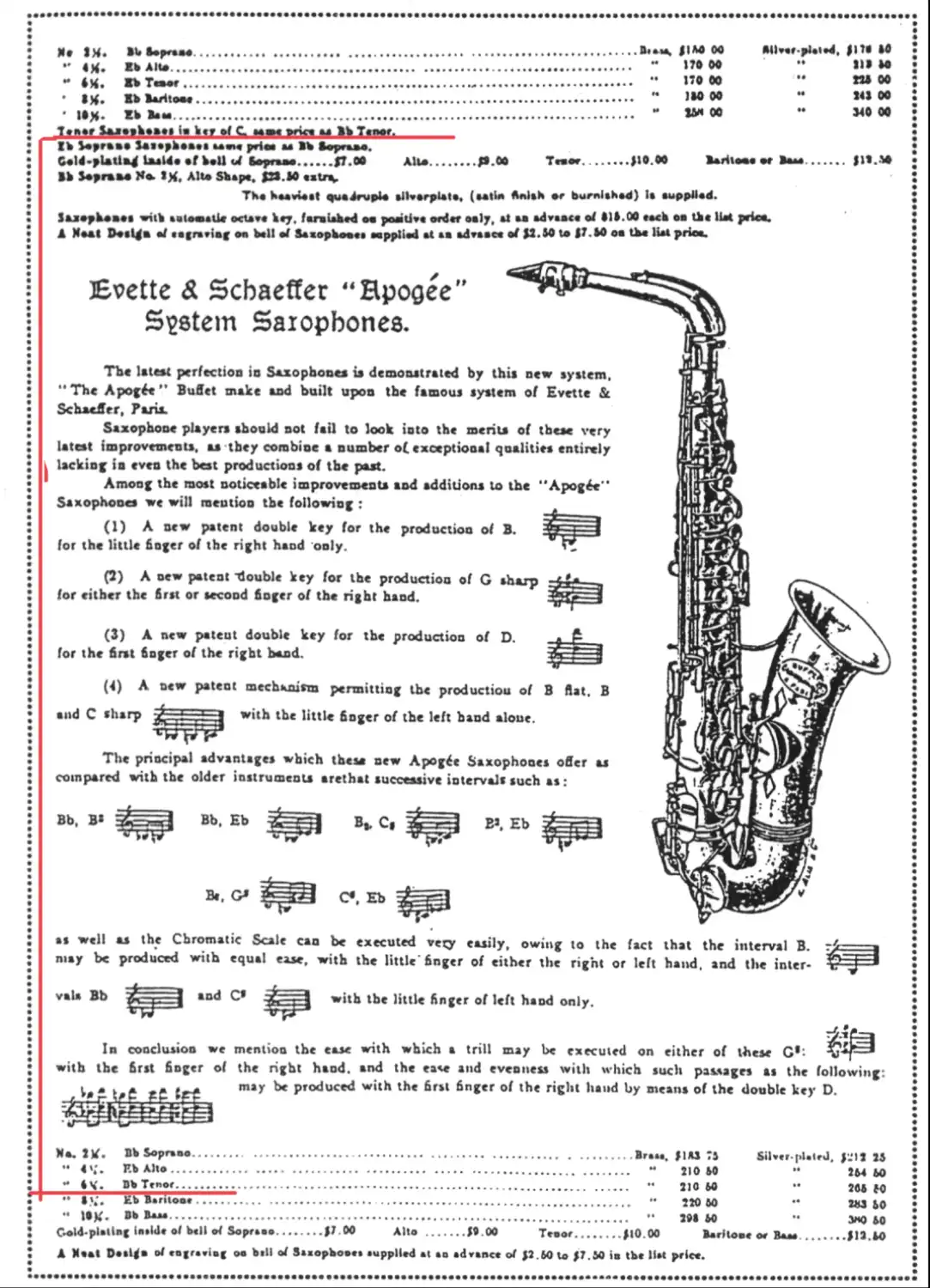
@jcn664 yes I am familiar with the Apogèe system. This was available in C Tenor by special order.
1770754956612.webp
 
You're very wrong, vintage curved soprano With High F is rare, maybe you could find one buescher or conn, but
Sir while I appreciate your enthusiasm for vintage saxes...there are times you claim things based upon your somewhat limited experience.

First off, if you re-read my post, I noted very specifically a year range/era where high F became the NORM.

Secondly, before choosing to claim my statement as "very wrong"...it may have been wiser to do 10 mins of internet research looking at curvies from the date period I mentioned in order to see if they had high F's or not.

Had you done such things, again instead of relying upon whatever narrower understanding you had of this, you would have seen that in fact, my statement was quite accurate.

It was a simple as gong to a few websites which have a good index of sax photos referenced by manufacturer and vintage/year (Saxpics for example).

Instead, you did not bother and ended up posting erroneous information which I chose to correct - if not for the sake of helping you out, at least for the sake of posterity...
....so readers who would come along this thread would not walk away with the notion that "vintage curved sopranos were rarely keyed to high F".
sorry, i used translate and never, you have precision about in you first commentary and i missed to see that your precision, i didn't see, after a second reading, i understand more,
Me i think you say old curved vintage before 1925, you talked about curved begin really around 1924/1925 and after.

But little wrong for High F, the curved soprano with high F begin more 1925/1926, (i don't say it hasn't before, just majority)

and it has the two modele with high F and without high F, my perfect curved lyons and healy hasn't high F made during approximatively 1925-1926.

And the high F was essentially in option for Luxe and high-end product, i don't know for usa market, but it was the function of european brand : for exemple couesnon used the double octave keys until 1934/1935 for this low cost horn, and many maker did this (for france) usa, i don't know.
and i'm not agree with you, not anachronisms, i don't like this word, because it hasn't very sense in French, sorry, but i'm french guy, and that is just cultural, in french we used anachronism majority for error in film or artistic work for exemple to have new franc in france during 1950 (it was old franc not new franc, we say it's anachronism) in france, the word anachronism is majority assimilated at temporal anomaly and majority used for the domain of arts,

but it's interessant to see that difference of langage of different country, it's really cool

I understand that you what you mean, don't worry, but i'm will say more, it's obsolete.
After that, yes i'm okay with you, curved or soprano with low Bb and only high Eb is obsolete but it's interessant for the history, you can see reallly the evolution between generation at generation, and the breakpoint between the begin of curved soprano with high F and the total popularity with high F,

but for me, i'm disagree with you 1922-1923 not really, so early for high F (in majority), they're transitional period between, for me it's really more around 1925 (for the breaking point and the tipping when the high F was automaticaly on soprano)

 
sorry, i used translate and never, you have precision about in you first commentary and i missed to see that your precision, i didn't see, after a second reading, i understand more,
Me i think you say old curved vintage before 1925, you talked about curved begin really around 1924/1925 and after.

But little wrong for High F, the curved soprano with high F begin more 1925/1926, (i don't say it hasn't before, just majority)

and it has the two modele with high F and without high F, my perfect curved lyons and healy hasn't high F made during approximatively 1925-1926.

And the high F was essentially in option for Luxe and high-end product, i don't know for usa market, but it was the function of european brand : for exemple couesnon used the double octave keys until 1934/1935 for this low cost horn, and many maker did this (for france) usa, i don't know.
and i'm not agree with you, not anachronisms, i don't like this word, because it hasn't very sense in French, sorry, but i'm french guy, and that is just cultural, in french we used anachronism majority for error in film or artistic work for exemple to have new franc in france during 1950 (it was old franc not new franc, we say it's anachronism) in france, the word anachronism is majority assimilated at temporal anomaly and majority used for the domain of arts,

but it's interessant to see that difference of langage of different country, it's really cool

I understand that you what you mean, don't worry, but i'm will say more, it's obsolete.
After that, yes i'm okay with you, curved or soprano with low Bb and only high Eb is obsolete but it's interessant for the history, you can see reallly the evolution between generation at generation, and the breakpoint between the begin of curved soprano with high F and the total popularity with high F,

but for me, i'm disagree with you 1922-1923 not really, so early for high F (in majority), they're transitional period between, for me it's really more around 1925 (for the breaking point and the tipping when the high F was automaticaly on soprano)

1923:1924 transitionnal periode with two models exists
1925-1926 only model of soprano with high F was sold

but you forget one thing, the french market was different,
all technologies or similar thing wasn't totally made by maker, it divided in many models for many price and have low coast, (in french market it was that

you could find one alto double octave keys, without bb between b and A (left hand) was made during 1930-1935 for low cost models. Couesnon or thibouville (i don't remeber) continued this made this models and now you can find it in second hand for 50€-100€ maybe couesnon
 
Sir while I appreciate your enthusiasm for vintage saxes...there are times you claim things based upon your somewhat limited experience.

First off, if you re-read my post, I noted very specifically a year range/era where high F became the NORM.

Secondly, before choosing to claim my statement as "very wrong"...it may have been wiser to do 10 mins of internet research looking at curvies from the date period I mentioned in order to see if they had high F's or not.

Had you done such things, again instead of relying upon whatever narrower understanding you had of this, you would have seen that in fact, my statement was quite accurate.

It was a simple as gong to a few websites which have a good index of sax photos referenced by manufacturer and vintage/year (Saxpics for example).

Instead, you did not bother and ended up posting erroneous information which I chose to correct - if not for the sake of helping you out, at least for the sake of posterity...
....so readers who would come along this thread would not walk away with the notion that "vintage curved sopranos were rarely keyed to high F".
i'm confused by the word anachronism, sorry
 
i'm confused by the word anachronism, sorry
No need to apologize. It means "out of date" ....commonly translated as "too old".

Many players feel that a sax which is not keyed up to High F is of no use to the player. Many players feel that a sax with NO front F key on the upper stack is a problem.

Things like that.

I know some soprano players who play older Sopranos with no high F, just to high Eb. But I also sell saxes, and I can never sell a soprano like that. Nobody really wants one.

I can occasionally sell a sax with no Front F, however....particularly a vintage Soprano with no front F, as long as it has a high F.
Not worry, We used more obsolete for too old,

You're globally true but i will say they're 2-3 exceptions like that

Selmer curved soprano modèle 22 has no front F but it's selling because it's selmer and very rare too,

Adolphe sax soprano is globally good selling but they're another reason why it good selling for that


And in great majority the French soprano (curved or straight) has exception for many reason, it's in majority good horn, not very expensive and rare with different sound, it sound not like usa horn.

But you're right without this exception.

My Pierret with full restorate will be sold around 1500-1800$ max, not very great expensive in compareason with curved soprano conn with high F key at 2500$-3000$

For exemple my buffet crampons with evette and scheffer system, i see in totally full restorate sold for 2100$ (i see many modèle as my mine sold at this price)

It's probably expensive if We see only the price, but compareason with buescher high F key 2000$ but not condition to play,

It's around 2500/3000$ for full restorate with high F keys maybe more in Shop

We talk about curved soprano for y fench soprano buffet and Pierret , for Pierret straight or other straight without high F is around 1000$/1500$ with full restorate vs 1900$/2500$with high F keys

They're difference of price around 500€/1000€ between models with high F and without high F

I don't sale but if i will sale my pierret with full restorate, i will asking 1300/1600€ but not more (maybe around 1300/1400 max)

And 1600€/1800€ max (maybe more 1600€) for my buffet with full restorate (overhauled)

Not excessive price, and i'm agréé with you, but not for sale

My estimation is based on majority curved soprano vintage in my country sold around 2000/2500 with high F keys
 
Not worry, We used more obsolete for too old,
Obsolete is not quite the same thing. I may well be wrong but I thought an anachronism is something from a different era, e.g. it is out of place whereas obsolete is more about something whose use is no longer required due to (e.g.) advances in technology (less to do with fashion) but could still be in the same era. A subtle difference. And maybe sometimes they overlap.

So anachronism may well be to do with fashion, e.g. if I walk around wearing a top hat 🎩 that would be an anachronism. If I brought out a new model of saxophone with a double octave key that would be obsolete .
 
You can use anachronics for all, in France too, but it's rare,

We used commonly in France, for describe a detail within a story, rather than a description of an object or a discussion of a vintage item, is more commonly used in France to describe an inconsistency in an object within a specific period, such as the presence of a TV in 1850 within a story.
After you can use for all other thing, but not common.
For exemple, in
english : To remain idle
In french, you can say je m'accagnardes ou je vais m'accagnardes but it's very rare, you will say more je vais paresser, je vais flemmarder
 

Social

New! Social Feeds

Look out for the navigation icon:

Follow CafeSaxophone

Latest Song of the Month

Trending

Forum statistics

Topics
32,047
Messages
577,887
Members
8,114
Latest member
old hippie
Back
Top Bottom