• New!

    Try our new Social Feeds, look out for the navigation icon: . You can now set default social feed view in your account preferences.

Playing the saxophone Falling from Altisimo A? (and falls in general)

mizmar

Eternal early intermediat
Messages
6,002
Location
Trondheim, Norway
Level
Eternal early intermediat
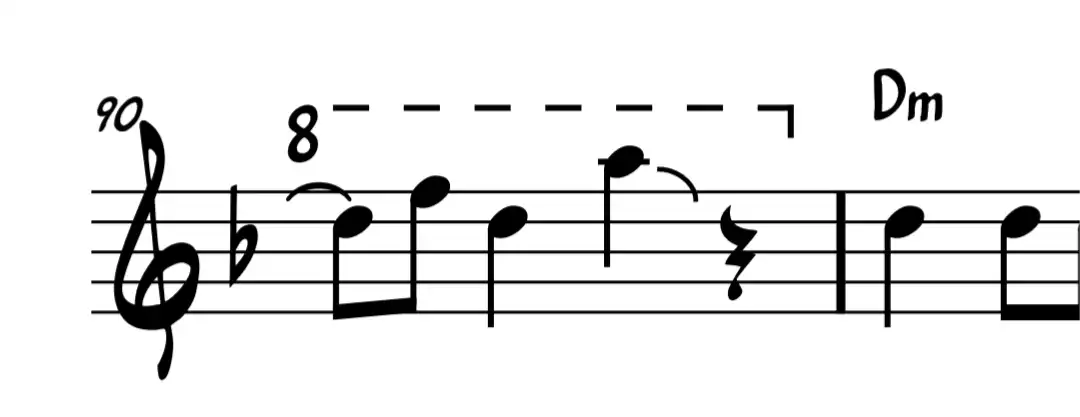
In an arrangement of Oye Como Va, by Johnny Ferreira we have

1000000714.webp

DFDFDFA on the second register, then at the top.

I'm just about stable on D to altisimo A - good exercise for me!

But G is quite far away, fungering wise..
My best alt A is L23+a side key.

How would you approach the fall?

Thanks.
 
Most falls are of a sort of indeterminate length and hence quite ragged. They can be anything from a small bend to a full on chromatic scale. If it’s a long fall you’d probably want to add some falling tailing off notes to the bend. If you literally cannot bend/lip the A then start off falling with scale notes that tail off. What scale? The easiest notes that fall nicely.

Always a good idea to discuss at rehearsal.
 
To play a fall - off: using chromatic or diatonic notes - I’d expect one of those squiggly lines (a glissando) to be written. The small curved line would usually mean to bend / “lip” down rather than what I’ve always called a fall - off.

Lip produces a (proper) glissando - a slide. Fingering a fast downward stepwise scale whilst diminuendoing to nothing (and maybe going towards subtone) is what I would call a fall - off.

- if you time your finger movements playing a scale sufficiently behind your embouchure it is possible to play a completely pure slide / glissando like the clarinet, though a lot harder without the open holes. It basically hinges on each note being very flat and that ratio staying as you move up. Same on clarinet really, the sliding fingers is the least of it.

It does depend upon where it is on the horn, who is playing what around you and how long the effect lasts. Trumpets might half valve it if long, which sounds like a slide, but if a “lip down” will probably just flatten that note and let the air go.

It’s like the opposite to a scoop (lip up to pitch, starting maybe a semitone or tone flat).

I think for me, that’s another distinction: the lip off is over a small interval and will be fast. A fall - off might be fast still, but will travel at least a minor 3rd down by end (has to be a chromatic scale or you only have one note in between) to longer, larger fall - offs which, if really big intervals are involved you’ll want to use whole steps more (in order to get anywhere fast enough). To a certain extent, any notes can be used if fingering “in key” is awkward, it will be heard as an effect, if fast enough. Otherwise, a slow(er) fall - off needs to follow harmony more.

The longer the note length the longer the effect. There are things to discuss with a section (if in one) here:

If over say, 4 beats or even longer; when does the effect start (and stop) etc. Will be more important in context for some tunes than others.

It’s not an exact science.

 
It does depend upon where it is on the horn
I got stuck exactly because this is altisimo A so fungering down to G risks dislocating a finger or tearing a tendon or something and still missing the target... Or takes a lot of practice.
And, mostly, any adjustment - at my level - just causes the note to break into another partial altogether... So, I need some work there.

Which is not to say that your points aren't useful also for the 2nd register A drop... Certainly worth exploring some options.
 
To play a fall - off: using chromatic or diatonic notes - I’d expect one of those squiggly lines (a glissando) to be written.
I agree that a long fall is best with the squiggly line but I've often seen the shorter curved line to mean a fall also. i.e. a proper fall as opposed to bending the note down

How you actually execute the fall is open to interpretations as trumpets will often use a half valve and trombones similar or just slide if the note permits. Often the whole point is the raggedyness - I've never ever come across a situation where players attempt to synchronise exactly.

With some notes on saxophone it is possible to easily bend down far enough for it to be considered a fall as opposed to just a note bend that is often no more than a semitone. A altissimo is one such note ( I can fairly easily manage an octave bend)
I got stuck exactly because this is altisimo A so fungering down to G risks dislocating a finger or tearing a tendon or something... Or takes a lot of practice.
Due to the assumed and intentional raggedyness, don't get too bogged down in being correct. If it's a log fall and you do a scale type fall you could miss out the immediate note below (G).
 
I got stuck exactly because this is altisimo A so fungering down to G risks dislocating a finger or tearing a tendon or something and still missing the target... Or takes a lot of practice.
And, mostly, any adjustment - at my level - just causes the note to break into another partial altogether... So, I need some work there.

Which is not to say that your points aren't useful also for the 2nd register A drop... Certainly worth exploring some options.
As Pete says, being so high the “lip down” is capable of a going a long way. But if you wanted a fingered fall off for a fair range you don’t have to start as a fingered fall off (ie playing G, F# etc - super awkward) - you could start from F, and maybe lip to the F too to make the gap.

If in doubt, find some recorded examples.
 
If it’s not something that you have naturally picked up / were able to do, it’s important to stress how much is going on beyond downward finger scaling movement.

For example:
Play a fast downward chromatic (or diatonic) scale.
Play a fast downward scale and go from forte to piano.

Neither sound like a fall - off. They sound (or should sound) as described.

So that shows that you need to add to it.

I presume the rest is in Pete’s video above.
 

Similar threads... or are they? Maybe not but they could be worth reading anyway 😀

Trending

Latest Song of the Month

Forum statistics

Topics
32,236
Messages
575,098
Members
8,066
Latest member
Boomer
Back
Top Bottom