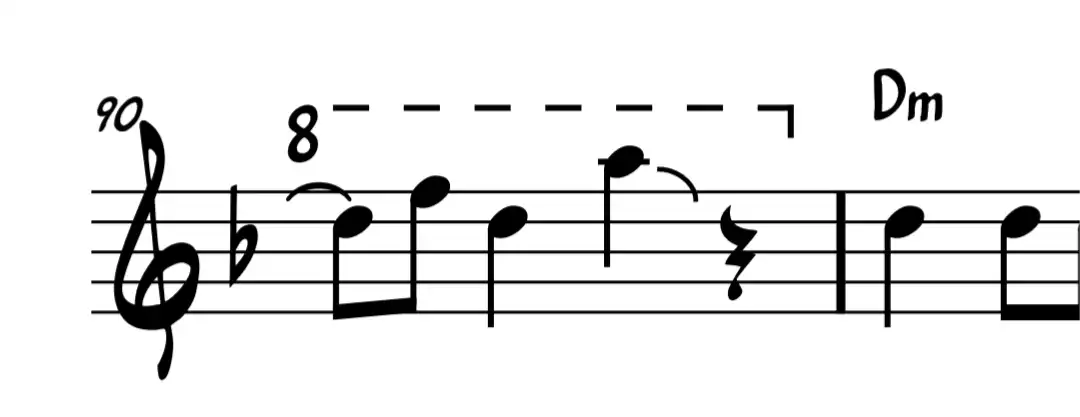
To play a fall - off: using chromatic or diatonic notes - I’d expect one of those squiggly lines (a glissando) to be written. The small curved line would usually mean to bend / “lip” down rather than what I’ve always called a fall - off.
Lip produces a (proper) glissando - a slide. Fingering a fast downward stepwise scale whilst diminuendoing to nothing (and maybe going towards subtone) is what I would call a fall - off.
- if you time your finger movements playing a scale sufficiently behind your embouchure it is possible to play a completely pure slide / glissando like the clarinet, though a lot harder without the open holes. It basically hinges on each note being very flat and that ratio staying as you move up. Same on clarinet really, the sliding fingers is the least of it.
It does depend upon where it is on the horn, who is playing what around you and how long the effect lasts. Trumpets might half valve it if long, which sounds like a slide, but if a “lip down” will probably just flatten that note and let the air go.
It’s like the opposite to a scoop (lip up to pitch, starting maybe a semitone or tone flat).
I think for me, that’s another distinction: the lip off is over a small interval and will be fast. A fall - off might be fast still, but will travel at least a minor 3rd down by end (has to be a chromatic scale or you only have one note in between) to longer, larger fall - offs which, if really big intervals are involved you’ll want to use whole steps more (in order to get anywhere fast enough). To a certain extent, any notes can be used if fingering “in key” is awkward, it will be heard as an effect, if fast enough. Otherwise, a slow(er) fall - off needs to follow harmony more.
The longer the note length the longer the effect. There are things to discuss with a section (if in one) here:
If over say, 4 beats or even longer; when does the effect start (and stop) etc. Will be more important in context for some tunes than others.
It’s not an exact science.


 (bottom of page)