Theory & Impro Do we really need theory?

I can't say "we" need theory, but I can say that "I" find it more than quite useful, possibly because going to music school brainwashed me in that regard.

While studying with Jerry Coker I was indoctrinated into the George Russell way of thinking. It was put across to me as a method of ear training that I would eventually discard, just playing what I thought sounded right. I said "why not just realize that on the altered dominant the 5th, 7th and 9th are altered from a major scale instead of thinking of lydian augs?"...
I'm with you there. Why not just think in terms of altering the major scale rather than altering modes of the major scale. That's another layer of complexity I don't need, and too many steps for me to do in an instant.

I knew Jerry Coker when he taught at UT. He even played (piano) at my wedding back in the 80s behind my friend, one of his students, on sax. For a sax player, he was an excellent pianist. I've got his books and still refer to them. Never did quite finish working all the way through any of them though, just the bits I was interested in.
 
I've been pondering this, it's a thought-provoking thing. Years ago I knew an R&B player that just plain played his butt off, I learned so much from him -- yet he didn't even know all the names of the notes on his horn, nor what all the keys did. But I'm serious, he was an incredible player: sound, chops, pocket, inventiveness, just everything was there. His altissimo chops were quite impressive, he just somehow figured all that out by himself.

He asked me to give him lessons and I turned him down. His feelings were hurt, and I told him I'd be afraid that I'd mess up the natural greatness he had. I told him a story Stan Samole, famed guitarist who had taught at Miami, related about teaching lessons to Pat Metheny when Pat first showed up there. Stan said he gave him a few lessons, and then stopped teaching him, because he didn't want to interfere with Pat's natural approach. By his 2nd or 3rd semester, Pat was on the faculty.

My R&B friend eventually took lessons from another friend who didn't know very much nor play very well. I don't know how that turned out, I had moved away. But there's a case to be made for ignoring convention in rare cases, and just letting well enough alone. Just play, man, because I dig you already, you know? BTW I still play the tenor mouthpiece I traded a Dukoff for on a gig with that guy. A beneficial trade for both of us, I hope. I had it refaced by the masterful Phil Engleman. That's another topic I guess.
I think that many have posted in a similar vein in this thread. People like your guy have a “knowing “ and so don’t need theory to inform what they already excel at.
If he were to want to begin writing big band arrangements though or writing orchestral pieces then he’d need theory most likely.
 
There are people, I'm not one of them, that can just 'hear' music and immediately play it back (that is my definition of 'play by ear'). From there they have the ability to improvise, seemingly without effort (in reality, they probably practice and play a lot and develop those particular skills).

Does such a person 'need' to 'know' a great deal of theory? Probably not, but doing so might help with understanding 'why' and 'how' things work.

Conversely, people like me are the complete opposite. I like to know 'how' things work, so I've read and studied a lot of theory. Playing the viol and early music does mean I got a lot more exposure than most to some of the more arcane aspects of tuning and temperaments.

I don't find playing from memory at all easy to do. I have done it, I did it with the Bach G minor fantasy on sax with my teacher (solo with piano accompaniment - here is a version for sax quartet). As for improv... you don't want to hear me try that.
 
There are people, I'm not one of them, that can just 'hear' music and immediately play it back
I can do that to an extent, depending on how complex the musical phrase is. With a simple melody or lick, I can usually pick it up right away, but in some cases, I need a few attempts to finally get it. But I do think knowing some, or a fair bit, of music theory is what has allowed me to develop my ear to that point. For example, knowing what key the music is in helps a lot in terms of picking out the notes by ear, or recognizing the phrase. A phrase based on the blues scale has a certain sound and if I know what key it's in, I can pick it up quickly. Or just knowing the phrase fits a ii-V-I progression is helpful. Lots of other examples come to mind.

I actually really enjoy learning anything about how the music is constructed (chords, scales, etc.) and music theory has certainly helped whatever ability I have to improvise. Just knowing the chord progression to a song is very helpful, imo. That doesn't mean I'm thinking about all the theory while improvising but having learned & internalized that knowledge definitely helps. For me, I'd say it's essential.

I like knowing things such as the fact that raising the root on a dominant chord immediately gives you a diminished chord. Or that playing a diminished chord rooted on the 3rd of a diminished chord gives you a dominant b9 chord (i.e. B D F Ab on a G7 chord). Of course, you have to get all these things 'in your ear' so you can hear them. All the various relationships are fascinating to me, so keep the discussion going.
 
But I do think knowing some, or a fair bit, of music theory is what has allowed me to develop my ear to that point. For example, knowing what key the music is in helps a lot in terms of picking out the notes by ear, or recognizing the phrase
Yes I think it may seem paradoxical in the context of this discussion or whenever people discuss “theory vs ear” that theory knowledge does really help your “ear playing.”

For example playing a riff (when there are no charts) and your theory knowledge means you can predict the way the chord changes may be going, then you adapt the riff to suit.
 
For example playing a riff (when there are no charts) and your theory knowledge means you can predict the way the chord changes may be going, then you adapt the riff to suit.
Exactly! Just one of many examples, but a good one. Along the same lines, being a blues player, one common adjustment to, say, a major pentatonic riff (on the I7 chord) in a blues is to simply flat the 3rd when moving to the IV7 chord. Many other kinds of adjustments could be cited. And again, knowing what it will sound like is important.
 
Or that playing a diminished chord rooted on the 3rd of a diminished chord gives you a dominant b9 chord (i.e. B D F Ab on a G7 chord).
Correction! I just realized I made an error in the statement above. Too late to edit the post, so I'll correct it here:

That should read: "playing a diminished chord rooted on the 3rd of a dominant chord gives you a dominant b9 chord."

Hopefully, the example in parentheses (B D F Ab on G7) made it clear, but I didn't want anyone getting confused.
 
That should read: "playing a diminished chord rooted on the 3rd of a dominant chord gives you a dominant b9 chord."

Hopefully, the example in parentheses (B D F Ab on G7) made it clear, but I didn't want anyone getting confused.
Exactly, and you could apply a diminished arpeggio (or scale) from the b9, P5th or b7th too if you wanted, same symmetry/notes. This alters the 9th of the dominant while leaving a perfect 5th. It's an interesting symmetry when applied to a cycle: play diminished going down in half steps to spell a 7b9 with a perfect 5th while going around a cycle. I picked this up the other day practicing a Bird lick from Merry Go Round in 12 keys (top of the 2nd chorus, starting on 2 rather than on 1st beat of the bar).

1795637216444.webp


It makes for a warmup type exercise for me to play while applying the Marcellus method of breaking in reeds -- something to play in the middle of the horn on new reeds, just a few minutes per day for a couple weeks, as part of the breaking-in process. As noted in a post about Van Doren Red suddenly not working for someone, and someone posted a link to a clarinetist describing this break-in process. I'm only 3 days into that, we'll see what 2 weeks of daily break-in on a box of 5 new reeds does.
 
.....
That should read: "playing a diminished chord rooted on the 3rd of a dominant chord gives you a dominant b9 chord."

Hopefully, the example in parentheses (B D F Ab on G7) made it clear, but I didn't want anyone getting confused.
There's always someone.....like me!

G7 (1 3 5 b7) = G B D F 3rd=B

Bo (1 b3 b5 bb7) = B D F Ab

but I thought B7b9 (1 3 5 b7 b9) = B D# F# Ab C, not B D F Ab C ???

(Be gentle!)
 
There's always someone.....like me!

G7 (1 3 5 b7) = G B D F 3rd=B

Bo (1 b3 b5 bb7) = B D F Ab

but I thought B7b9 (1 3 5 b7 b9) = B D# F# Ab C, not B D F Ab C ???

(Be gentle!)

Let me point out first that a diminished chord and a dominant b9 with the same root can't be the same chord.

So that said, the clue I think is the Ab, which is the b9 of what?
 
Let me point out first that a diminished chord and a dominant b9 with the same root can't be the same chord.

So that said, the clue I think is the Ab, which is the b9 of what?
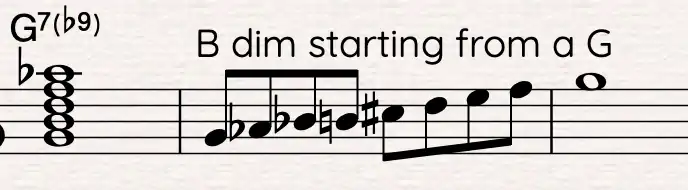
Ab is the b9 of G. Specific to this example, we're talking about chord/scale relationships, as they're often called. Given a chord like G7b9, the scale that corresponds to all the notes that work with that chord are Abdim -- or Bdim, Ddim, Fdim, and Abdim, because those are all the same scales/notes, they just start from a different place in the scale. There are only 3 unique diminished scales in that way, because of their symmetry of whole-half-w-h-w-h-w-h steps. Some people like to start them from yet another different note, so the first interval is a half step instead. You could think of a diminished scale applied to a G7b9 as being a G half-whole diminished scale if you want to -- G, Bb, Db, or E half-whole dim scales, because they're all the same. (Muddied the waters enough yet?!) 🙂 Me, if I'm thinking, I think in terms of whole-half dim scales applied to altered dominants from the b9. It's just habit.

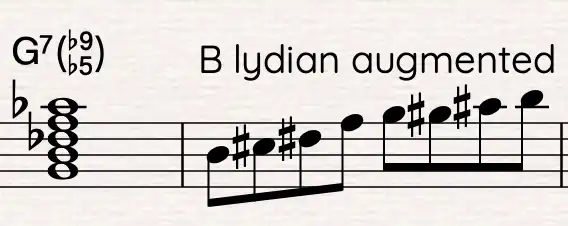
Here's a stacked voicing of a G7b9, and a diminished scale spelled from G -- but it's a B, D, F or Ab dim. scale, they're really all the same, just starting from a different note. Notice it has a perfect 5th as applied to the G chord (i.e. a D); that's not unheard of, but more often the 5th on an altered dominant will be either sharped or flatted too (a D# or Db). The chord symbol will sometimes say so, as in G7b9b5, but not always, you might consider it implied, or you might prefer the perfect 5th. Altering the 5th too is a different chord/scale relationship, you'd apply (in the case of G7b9b5 or G7#9#5) a B lydian augmented scale -- a lydian aug from the 3rd of G. Lydian augs aren't like diminished scales, there are 12 of those, while there are only 3 unique diminished scales. That's due to lydian aug construction in half and whole steps: W-W-W-W-H-W-H.

1795673055771.webp

1795673082956.webp

1795673115588.webp


I mean this to be helpful, if it's just irritating please tell me and I'll refrain from all this. I am in fact (if you hadn't noticed yet!) a terrible teacher. If you like I can recommend some books or better instructional materials that would make better sense of it than my humble attempts. It might seem overly complicated, but if you work with them awhile it kind of trains you to consider it normal. While playing, it results in thought things like "I'm playing a G right now and that's the root, but I'm going to a C chord and it'll be the 5th, then a Bb chord it'll be the 6th, then Ab it'll be maj7th", and it all just flows along naturally without any conscious thought, dealing with them as just their sounds and not all this structural/theory stuff. In the end, it's really ear training.

 

Social

New! Social Feeds

Look out for the navigation icon:

Follow CafeSaxophone

Latest Song of the Month

Trending

Forum statistics

Topics
32,084
Messages
578,907
Members
8,140
Latest member
AnnaR
Back
Top Bottom