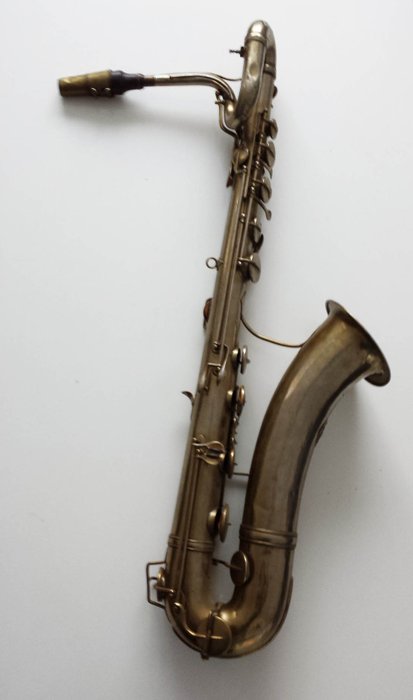
Tech/maintenance DEP saxophone: anyone has details?

A few details are Boiste-like, there are some similarities....the tube ferrules, the heavy wire bellbrace, for example.

One very curious think about this DEP horn is the bell proportion and how it rises from bow and orients. It is a very vertical bell piece, and it's lip flares fairly severely from the bell tube, as opposed to gently.

So it has 'esque" details here and there...Buescher, Kohlert, Pierret, Boiste....but none, as Helen noted, are dead-on identical details from any of those mfr's. And sheet guards on a splitbellkey horn....almost NEVER seen....

Some interesting details which drew my eye:

~ the neck tube, it's swoop/curvature particularly
~octave key, look at how the 'spine' is shaped right before it 'hits' its keycup
~the aforementioned keyguards
~the curious shape of the spat touches, and the short/undersized rollers on them in comparison to the size of the touches themselves
~again, the bell shape
~the sorta amateurish engraving execution


This one is a real puzzler !!!! Cool horn, however.
 
Last edited:
I'm not seeing a high F# key, in which case the horn would be The New King.

Toneking was exactly the same horn, but it had a high F#. You can see it here on mine.

Yes: the main reason I posted that was the Holton-esque key. I think you are probably aware of some of the other "touches" that make me think it could be a German factory's product, made with some kind of overlap with Keilwerth (neck brace ornament, the keyguard look/approach, neckpipe curve, bell flare, lots of little things).

I think my earlier post may be easy to misread (my fault): I don't think this horn has anything to do with US production. To me, it clearly owes design elements to the influence of European or Eastern Bloc manufacturers specifically influenced themselves by Conn/Buescher/Holton.

The RH F# trill key's design (Buescher like) agrees with some Keilwerth tenors, not with others. I believe most D&J tenors have that type of F# key, but I just can't remember with 100% certainty right now. I'm very familiar with D&J and the Keilwerth Bundy Special period, from using them for "Connversion" parts, but that key isn't really part of them so it is just one bit of data that escapes recollection.

Another avenue of approach/research I can't pursue right now, but will later if no one else beats me to it: The Nev and Max ("Catfish") approach. I plugged a cropped image, this one

catfish1.jpg


into Google Image Search. I didn't get a hit, but I did get this amusing result:

catfish2.jpg


This can be done of course for any of the unusual features, but I suspect they'll all turn up non-hits like what mine did.

Honestly, I think if this thread appeared 15 years ago, I'd probably recognize something on it that suggests a firm starting point. This is basically a large picture puzzle -- once you figure out what piece to begin with, to attach the other elements to, the ID will probably fall in place quickly. I tend to agree that Kohlerta and Eastern Bloc (e.g. Amati) and those regions, for the period, are also high likelihoods.
 
Hi. I was asked to drop in. TL;Dr: I dunno, but I can tell you a lot of things it's not.

I really just kinda skimmed this thread.

  • It's not a Kohlert unless it has a Kohlert serial number. Not that the horn looks like a Kohlert ("Kohlerta" is a variant spelling of "Kohlert"). I think y'all might have these models in mind.
  • It's not a J Keilwerth without a J Keilwerth serial number. Not that the horn looks like a J Keilwerth.
  • Amati wasn't formed until the end of WWII. I don't think this is a post WWII horn. Let me elaborate slightly on this.

A bunch of manufacturers offered several different models, up through the 1930s, with the most basic being a low B horn that looked like an A Sax instrument. One company example, off the top of my head, is Couesnon.

If I had to pick a Germanic saxophone maker for this horn, I'd pick FX Huller, because they had so many stencils and some had radically different keywork from their own-brand models. I don't necessarily think this is a Huller, though.

(Oh. Someone mentioned similarities to Holton. If you want a Germanic sax that looks like a Holton, that'd be a GH Huller Olymp.)

Someone mentioned Pierret. That's a good guess, as Pierret had a bazillion models. I don't necessarily think it's a Pierret.

I think that there's a chance it could be by Beaugnier. I just haven't seen any split-bell-key Beaugniers, though, so I'm not calling this a good pick.

Do note that there were a lot of manufacturers in the Netherlands/Belgium/Holland/trying to be all inclusive area. If I had to pick a manufacturer from that area, I'd say Mahillon.
 
I can find similarities with my Maurice Boiste.

But that's probably more because they are from the same period.


I always liked these wing key guards and would be tempted if I found one for sale! 😳

I only just now took a look at your link, and then did a quick Google search for Boiste tenor photos.

IMO of everything named and mentioned (imagine for a moment that the actual maker is known to have been mentioned) Boiste would make a lot of sense based on what I see in your photos of your Boiste.

The shape of the RH palms other than the high E, the baroque aesthetic sense, the playful changes made to keyshapes and so forth (the shape of the Eb/C on the "DEP" are out of step with most makes mentioned), the attention to ornamentation for the neck brace, the weird combination of more modern looking (and ornate) keyguards and modern hardware/mounting styles -- a lot of the sensibilities you see at work in the "DEP" are also at work, even though the expression is different, on that Boiste.

I'm not saying it is that, only that it would make a lot of sense if the same designer/factory was behind both.
 
I think part of the problem here, as far as identifying goes, is the horn's age....splitbell keys, pre WW-2 definitely. Post WW-2 things got a lot more identifiable.

Now usually some distinguishing features of splitbell horns can act as tipoffs....but the problem here is...none do.

Spat key shape ? Not familiar.
Pinky table. Not familiar.
Keyguards ? Not familiar.
One that I like to use a lot: the body/bow ferrule profile. Unfortunately, in this case, inconclusive.
Shape of posts and their feet ? Of no help here.
Octave mechanism ? We haven't really focused on THAT detail...perhaps we should (?)

So the problem is...there are no familiar, defining features which ...so far...anyone can identify and say : "oooh, THAT detail is such-and-such maker".

Just a bunch of "sorta reminiscent of's".....

This is one of the best sax mysteries I have seen in my 12 + years on sax forums, actually....
 
Last edited:
As far as Mahillon ?

Well, they were located in Belgium...and the company was around during that time frame (we are assuming somewhere around 1920-mid 1930's, methinks). Mahillon existed from 1870's-1940's. So if one wishes to assume that in that era, an Antwerp shop might NOT contract a stencil from a far-away factory, in that respect it's a valid guess.

BUT..... beyond that, when looking at the few extant examples of their saxes, we again run into the same problem:

None of the usual sax details one uses to identify...correlate to images of old Mahillons (at least not images I quickly came across via a websearch).


Last edited:
I think part of the problem here, as far as identifying goes, is the horn's age....splitbell keys, pre WW-2 definitely. Post WW-2 things got a lot more identifiable.

Now usually some distinguishing features of splitbell horns can act as tipoffs....but the problem here is...none do.

Spat key shape ? Not familiar.
Pinky table. Not familiar.
Keyguards ? Not familiar.
One that I like to use a lot: the body/bow ferrule profile. Unfortunately, in this case, inconclusive.
Shape of posts and their feet ? Of no help here.
Octave mechanism ? We haven't really focused on THAT detail...perhaps we should (?)

So the problem is...there are no familiar, defining features which ...so far...anyone can identify and say : "oooh, THAT detail is such-and-such maker".

Just a bunch of "sorta reminiscent of's".....

This is one of the best sax mysteries I have seen in my 12 + years on sax forums, actually....

Yeap -- as above, 1st reaction on my part is definitely to react to the opposing bell keys with a kneejerk reaction to place it in the 1920s, but I kind of think on further inspection that it could be 1930s or even 1940s, well past the era where you'd normally see opposing bell keys. This could be, for example, a horn constructed from found or leftover parts by someone totally unrelated to the factories that actually made the parts (the cartoonish engraving sort of makes me give more than passing credence to that possibility).

In this case, because so many other elements look decidedly UN-1920s, this is probably a case where the opposing bell keys are misleading as far as dating it (IMO). This is just speculation, but I think you know what I mean about how other aspects don't look 1920s at all -- e.g. the sculpting of the keys, the guard design, rib design, all kinds of little details where the execution technique looks more 1930s or even 1940s or later. Agree about pre WWII, but that too is inevitably instinct/intuition (i.e. my agreement's of dubious value, is just a second modestly informed guess that overlaps.
Yup, a reasonable assertion that it could be a decade or so younger than the typical splitbell...
 
Do note that there were a lot of manufacturers in the Netherlands/Belgium/Holland/trying to be all inclusive area. If I had to pick a manufacturer from that area, I'd say Mahillon.
Interesting link there.
If you put one and two together.
Muziekinstrumenten DEP BVBA Home --> In 1901 Frans De Prins founded this shop ..... he built his own copper instruments ......
and Belgian Makes & Models / De Prins Gebr - Gebreveteerd, België |
De Prins was in Borgerhout, Antwerp, Belgium.
Really nice info at http://www.rjmartz.com/horns/DePrins_092


So my guess would be that there must be a family connection between these 2 companies. Chances are that the DEP saxophone was made by Karel De Prins who was responsible for the woodwinds at Gebroeders De Prins
 
Dear all, sorry for the silence, holiday period... I am grateful to anyone participating to this thread, including Wonko for his tip here above, I learned a lot.. Next step will be go to Antwerpen one day, visit the DEP shop and the small De Prins museum, perhaps the curator can give some more details. For the one interested, google for "Museum van de ambacht gebroeders de prins".

The museum contains the original machines used by this manufacturer to build their horns (mostly brasses, for which they were known in Belgium)

Have a great day! Luigi
 
How is the DEP playing? The neck looks like a Dolnet neck! A 440 Hz sax? Can you use modern mouthpieces? Interesting sax. I have a Hammerschmidt tenor (Klingsor) in very good condition. A mid 50's sax. But out of time already in the 50's. A looker but not a player. And a keeper. Double body octave keys, rolled toneholes, pearls, a nice case tha gives the bell flare a knock ....... why did they make a horn like this in the mid 50's?
klingsoricase.jpg
klingsorboch Bb.jpg
 
Considering that I didn't do much on it as yet, it's playing quite well down to low C, it's a low pitch instrument and has more a French sound than an American one, I mean rather sweet, not dissimilar from my Dolnet, that's why I was initially thinking Pierret... I just contacted again the guy from which I bought it, he said that he will talk to the previous owner looking for more detail. It looks like a custom made instrument, perhaps the commissioner really wanted basically a '20 design, including all those additional trill keys, but with some modern features available when it was built, post-war... I'll post whatever additional info I will get... And I will fix major leaks and post some audio, presumably end of August. Cheers!
 
Some smaller European manufactors made saxes that were pitched below 440 hz, The early Buffet S1 ( 70's saxes) was available in both 440 and 442 hz. But that's a higher pich. A 442 HZ or a 438 Hz sax can play with modern instruments. The pitch is there, but they timber can be different. A grand piano here in Sweden is often tuned A = 442 Hz. So don't use the digital tuner .....
 
I just played it along with a CD, to make sure it's not a 'too high' pitch. Also size-wise it compares well with other low-pitch instruments I have, although the shape of the neck is dissimilar from anything else I can compare to. I guess assessing whether it is pitched at 440, 442 or 438 Hz will be quite cumbersome, require multiple measurements at high and low C, for different mouthpiece insertion depths... And possibly varying depending on the mouthpiece you use.. Just for curiosity, how do you do that?
 
I
[…]. I plugged a cropped image, this one

View attachment 15055

into Google Image Search. I didn't get a hit, but I did get this amusing result:

View attachment 15056

This can be done of course for any of the unusual features, but I suspect they'll all turn up non-hits like what mine did.
[…]
…just in case there was any doubt about what I found amusing …
 
Last edited:
I had an email exchange with the curator of the Gebroeders De Prins Museum in Belgium. He confirmed that the DEP company was founded in 1952 (from the former Frans de Prins company founded in 1901). Therefore this sax was made post-war. He also said that the body could be coming from earlier stock (the company stopped producing during WW2) which could explain the 'old' split bell design AND the modern keyguards...
 

Similar threads... or are they? Maybe not but they could be worth reading anyway 😀

Social

New! Social Feeds

Look out for the navigation icon:

Follow CafeSaxophone

Latest Song of the Month

Trending

Forum statistics

Topics
32,084
Messages
578,903
Members
8,140
Latest member
AnnaR
Back
Top Bottom