

• New!

    Try our new Social Feeds, look out for the navigation icon: . You can now set default social feed view in your account preferences.

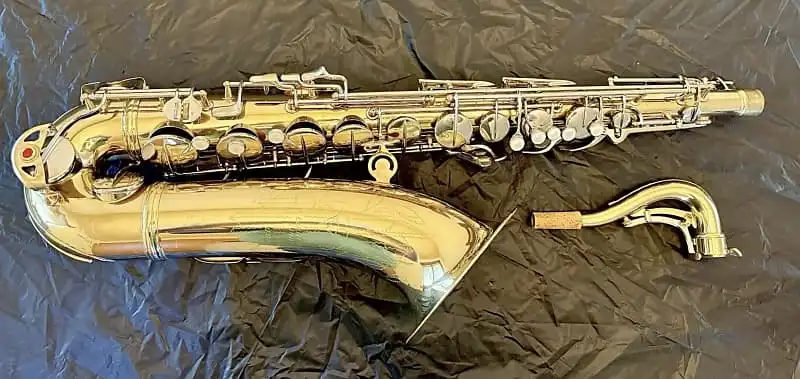
Saxophones Can anyone throw some light on this neck that came with my newly acquired vintage Conn tenor?

Messages
25
Location
Dorset South coast
Level
beginner
Hi I have just acquired a Conn 10M tenor apparently 1963 vintage. It seems it has a replacement neck
I have studied pictures of Conn tenors, but none have this style of neck with the tone hole underneath. Can anyone throw some light on what this neck is please
f2j1czvtxmxvisw1bbee.webp
 
Solution
Underslung octave keys are cool. Conn was trying to bring back coolness.

Several cool-category vintage horns had underslung neck octaves. The original 6M had a true underslung key just like that. The King Super 20 and Buescher 400 both had underslung keys but with the octave pip still on top. The Yanagisawa 880 and 99X paid homage to these models.
OP, if yours looks like the picture Pete posted, that's the correct neck for 1960s Conn 10Ms. They changed from the octave key over the top of the neck to beneath sometime in the early 60s.

Of course in the used horn market where many sellers don't actually know anything about saxophones, strange things happen, so you need to make sure the neck you have works with the horn you have.
 
Vote:
Upvote 0
Vote:
Upvote 0
Underslung octave keys are cool. Conn was trying to bring back coolness.

Several cool-category vintage horns had underslung neck octaves. The original 6M had a true underslung key just like that. The King Super 20 and Buescher 400 both had underslung keys but with the octave pip still on top. The Yanagisawa 880 and 99X paid homage to these models.
 
Vote:
Upvote 0
Solution
Underslung octave keys are cool. Conn was trying to bring back coolness.

Several cool-category vintage horns had underslung neck octaves. The original 6M had a true underslung key just like that. The King Super 20 and Buescher 400 both had underslung keys but with the octave pip still on top. The Yanagisawa 880 and 99X paid homage to these models.
Thanks for that. You appear to be quite knowledgeable , so next question - why did Conn place the clip ring, apparently for most, too high
 
Vote:
Upvote 0
Thanks for that. You appear to be quite knowledgeable , so next question - why did Conn place the clip ring, apparently for most, too high
Habit?*

Or it's a preferable and more comfortable position when playing seated?

* I have an old Conn Melody C with the sling ring positioned perfectly to knock out your front teeth if you let go**

** Or... Conn had a private deal with a dodgy denture company to provide discounted top plates to careless players***

*** How's that for alliteration?
 
Vote:
Upvote 0
Thanks for that. You appear to be quite knowledgeable , so next question - why did Conn place the clip ring, apparently for most, too high
Well, of course, you're making an implied assertion there - I would suggest that it's NOT too high. I've been playing Conns since 1978 and I've never had one reach up and hit me in the teeth; it's hard for me to visualize what people are doing to have this happen, but it seems to be a frequent internet phenomenon if not in real life.

But at any rate, the horn should be situated so that only light steering forces from the two thumbs are required to get the mouthpiece into the mouth, without craning the neck down or up, twisting, etc. Of course the horn that hangs more vertically will require less force to move it to playing position.

If you want yours to hang more horizontally it's a trivial job to attach a new ring lower on the horn. Personally, I'm more concerned about playing the thing than going round with it hanging from the neck strap, so I think I'd vote for the Conn ring position.
 
Vote:
Upvote 0
Underslung octave keys are cool. Conn was trying to bring back coolness.

Several cool-category vintage horns had underslung neck octaves. The original 6M had a true underslung key just like that. The King Super 20 and Buescher 400 both had underslung keys but with the octave pip still on top. The Yanagisawa 880 and 99X paid homage to these models.

I don't know that Conn's objective was "cool factor". They may have been trying to reduce the number of pieces mounted to the neck tube. In the modern era, Theo Wanne did a similar approach of mounting the neck octave pivot to the neck brace.
 
Vote:
Upvote 0
I don't know that Conn's objective was "cool factor". They may have been trying to reduce the number of pieces mounted to the neck tube. In the modern era, Theo Wanne did a similar approach of mounting the neck octave pivot to the neck brace.
It doesn't look to me like there's more or less stuff soldered to the neck. I too have wondered why, in the early 60s with the saxophone industry beginning its long decline, and all the manufacturers studentizing their horns, Conn suddenly decided to put the same octave mechanism on the 10M that had been on the 6M for 25 years. It's more complicated and it's not backward compatible.

As I read the history of Conn, I've been struck by the number of times their upper management gives off the clear impression of having NO idea what to do, so they just "do something". Rename Pan Am as Director! Put nickel plated keys on everything! Change the 10M neck! Move to Nogales Ariz.! No, wait, not the Artist, just the Director! Change the design of the Director alto to a Beaugnier design! Move to Nogales MX! Move back to Elkhart! Rebrand some Keilwerth horns as DJM! Now rebrand them as Conn! Now sell some stuff to Armstrong! Flail about wildly, with no actual plan! Sell the company! Sell it again! Sell it yet again! Merge! Unmerge!

--sigh--

Really, rather dizzying. I've been in the corporate world long enough to recognize when the suits have no clue what to do other than sucking yet some more cash out of the husk and then running away with their bonuses when the last big thing turns out not to have worked.
 
Vote:
Upvote 0
These days it the something they do would be install AI >:)
Yep, typical executive.

"Business is declining. Let's add something new and shiny!"

Been there, done that. Been through so many new computer systems and documentation requirements that would solve all problems. Watched a million dollars worth of inventory, that people had ordered and wanted to take delivery and pay for, sit on the shop floor for a year because the new computer system's billing and accounts-receivable modules weren't working, and no one had the guts to send a bunch of people out there with spiral notebooks and calculators to get the damn stuff shipped and billed and take in the money.
 
Vote:
Upvote 0
I don't know that Conn's objective was "cool factor". They may have been trying to reduce the number of pieces mounted to the neck tube. In the modern era, Theo Wanne did a similar approach of mounting the neck octave pivot to the neck brace.
If they really thought about it, it would have been way cooler to have the octave pip and mechanism on the side.

"Which side?" I hear you ask.
 
Vote:
Upvote 0
Well, of course, you're making an implied assertion there - I would suggest that it's NOT too high. I've been playing Conns since 1978 and I've never had one reach up and hit me in the teeth; it's hard for me to visualize what people are doing to have this happen, but it seems to be a frequent internet phenomenon if not in real life.

But at any rate, the horn should be situated so that only light steering forces from the two thumbs are required to get the mouthpiece into the mouth, without craning the neck down or up, twisting, etc. Of course the horn that hangs more vertically will require less force to move it to playing position.

If you want yours to hang more horizontally it's a trivial job to attach a new ring lower on the horn. Personally, I'm more concerned about playing the thing than going round with it hanging from the neck strap, so I think I'd vote for the Conn ring position.
In response to your post, I removed my home-brew adaptor and decided to persevere using the original sling ring . After a couple of hours playing, I had to give up and replace the adaptor. With the original ring I found it very uncomfortable to play, the sax kept trying to force itself into my mouth. I tried several playing positions standing up and sitting and could not find a comfortable solution. So, back to the adaptor I'm afraid. Pity not any response from others to support my findings.
 
Vote:
Upvote 0
Blimey! What have I started? More response to my post re too high sling ring on the Conn would be nice. Perhaps a survey happy v not happy with the ring
I had a Conn C Melody, a very nice sax, it had been well set up. I also found the sling ring far too high up the body of the sax and found it didn't hang naturally. I made up an aluminium extension to shift the balance of the sax to where it felt more natural, and, well, balanced.
 
Vote:
Upvote 0

Trending

Latest Song of the Month

Forum statistics

Topics
32,235
Messages
575,047
Members
8,066
Latest member
Boomer
Back
Top Bottom