- Messages
- 2,611
- Location
- Black Forest
Nice work! I have tons of pictures of c-Mel and c-sop (Buescher, York, Conn, Holton, Martin - Wurlitzer), just in case you need any additional pics.
Could be a Rascher mouthpiece.I know next to nothing about early Buescher mpcs... anxious to hear your thoughts @PigSquealer.
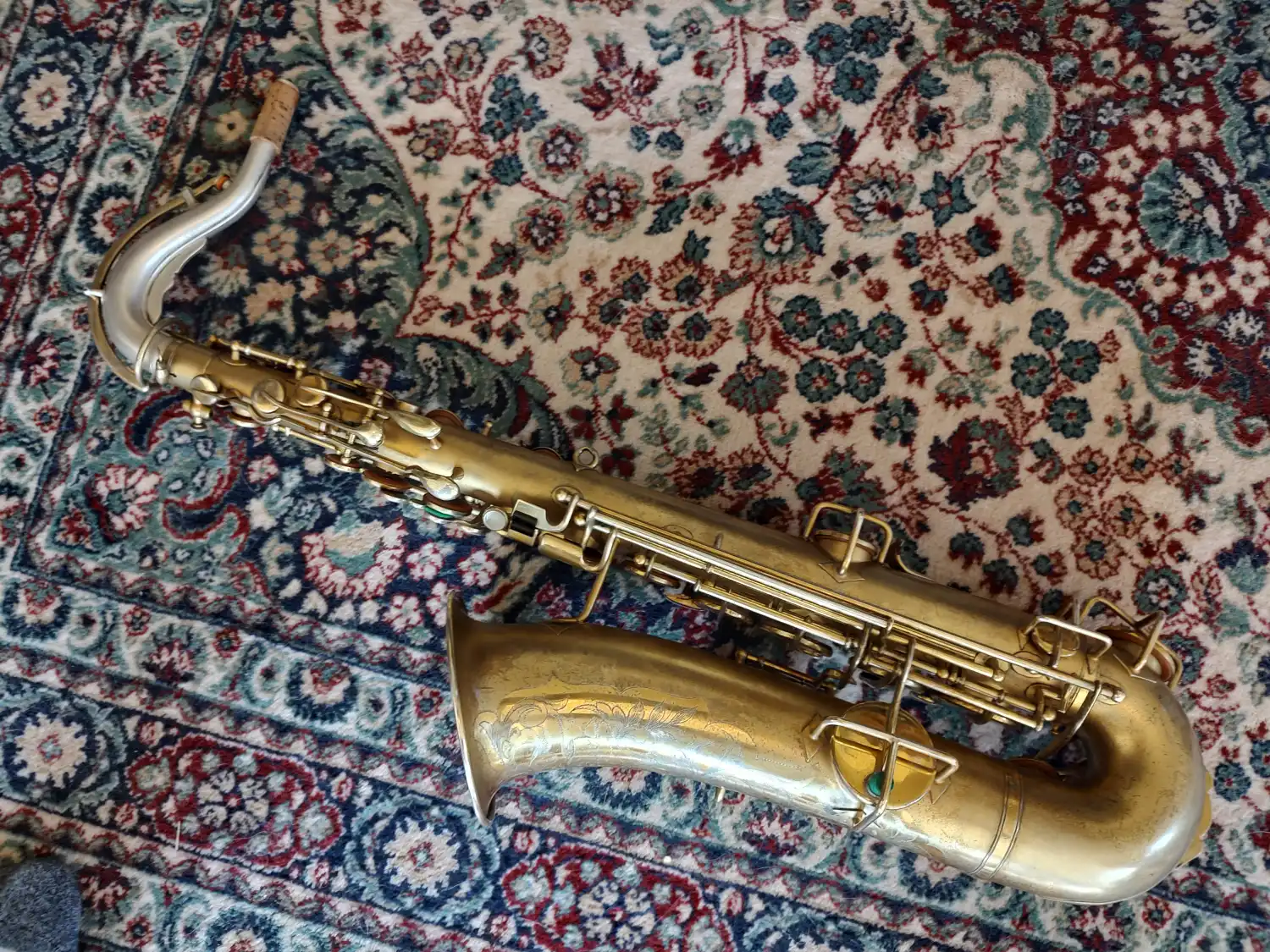
View attachment 36793View attachment 36794View attachment 36795View attachment 36796View attachment 36797
Well, no.Just a word on the HP/LP issue. Your point is very valid but when you say "modern instruments" keep in mind that especially "modern instruments" like keyboards have features to transpose and shift the pitch or tuning to whatever you want them to be. And string instruments, there is really an inherent sliding scale for their tuning. So what it really comes down to is "Who are you playing with?"
Ok, you go to a jam and you'll be lost.
You play with other "fixed pitch" instruments, fugeddaboudit ...
You play with some acoustic guitar / mandolin / bass / whatever in a small ensemble and there is no reason why it can't be made to work.
In other words, don't throw out the baby with the bath, it's a matter of communication with the other musicians.
Selmer USA bought horns from several manufacturers and labeled them "Selmer XXX" at various times. "Selmer Pennsylvania", "Selmer New York", "Selmer USA" and probably some other labels. I know some are Conns and some are Bueschers; I wouldn't be surprised to find Kings Martins or even Yorks.Interesting that Buescher made it. I have a mid 20s TT alto here - feet on posts, banding around body and bell, LH pinky keys etc look the same, engraving is a similar style. Bell key holes on mine are drawn. So Buescher had a relationship with Selmer-America right at the start, as well as right at the end.
Respectfully, that doesn't make any sense, guitar players use custom tunings all the time, or else change string gauge, which puts far more differential tension on the instrument than tuning up 1/4 step.Well, no.
You find an HP instrument, it's 95+ years old and has been unusable in any ensemble for the past 90 years. That means 90+ year old pads, corks etc. , keys that haven't moved in 90 years so they're probably frozen solid, no oiling in 90 years so it's going to be one heck of a job to get them out, 90 years worth of mold and mouse poop in the 90 year old case built to fit a horn for which you can't buy a properly fitting replacement case. You can't play with any other wins instrument, they can't push in enough or pull out enough. String instrument players with quality instruments are not going to want to tune UP to meet you and increase the tension on their instruments.
It makes zero sense. Put the time and effort into a low pitch horn. High pitch saxophones are obsolete, period.
Yes true, but what years / time era to the various Selmer XXX name(s) used? Honestly the Selmer New York or the variants are highly under researched. This subject is worthy of a thread subject all alone.Selmer USA bought horns from several manufacturers and labeled them "Selmer XXX" at various times. "Selmer Pennsylvania", "Selmer New York", "Selmer USA" and probably some other labels. I know some are Conns and some are Bueschers; I wouldn't be surprised to find Kings Martins or even Yorks.
This statement is insanely accurate and not limited to Elkhart. Like Frank Holton and Ernst A. CouturierFrom what I've read there was a lot of interlocking directorates and a lot of employee back and forth at Elkhart, as one would expect in a relatively small industry in a small geographical area.
Well, slabs are one thing, but Lester Flatt used to go through about one Martin a year because he liked to tune high. How about those violin E strings?Respectfully, that doesn't make any sense, guitar players use custom tunings all the time, or else change string gauge, which puts far more differential tension on the instrument than tuning up 1/4 step.
Yes some HP instruments fit the category you describe but I am talking about playable instruments that were not subjected to the stink of mainstream wisdom. I know for a fact that, despite its archaic keywork, my 1898 Conn is one of the most sought after instruments within the "general community of visitors to my house" and believe it or not, the HP label has not discouraged anybody from borrowing it. Of course, I am talking about professional musicians but that actually underscores my point.
And no, there is no replacement case needed, I have a case that works.
Ok, I was offered (for free) a gorgeous upright piano made for A=432 Hz and the piano tuner was afraid of bringing it up to 440 because of fear of damaging the frame but that's an altogether different story.
Yes, SRV tuned his guitar down to accommodate the heavy strings but that was playability rather than fear of warping the neck. Just in case you wondered
I have a HP English Harmonium (they blow, whereas American reed organs (ahem) suck) from the 1860s which I loosely 'restored' - that is, it sort-of works, whereas it sort-of didn't. When my kids move out I might have space to have another go at it and fix the sticky keys. I only own it because the previous owner threatened to burn it if I didn't take it on (he's long gone, but he saw himself in me because I am pretty sure he acquired it decades earlier in similar circumstances). I can play a few hymns but only in C or Am. I tried to give it to someone earlier this year and my elder daughter (who plays a bit of piano accordion) got the hump, which means she _wants_ it one day. Imagine! 🙂Honestly. I don’t see any player these days who(m) are knowledgeable/ instrested about an instrument in H.P. OR any old pitch of playing.….are, Well….. Walking into an uncomfortable situation.