

Tech/maintenance Buescher C Melody stuck keys

Royston

Member
Messages
614
Location
Wirral, United Kingdom
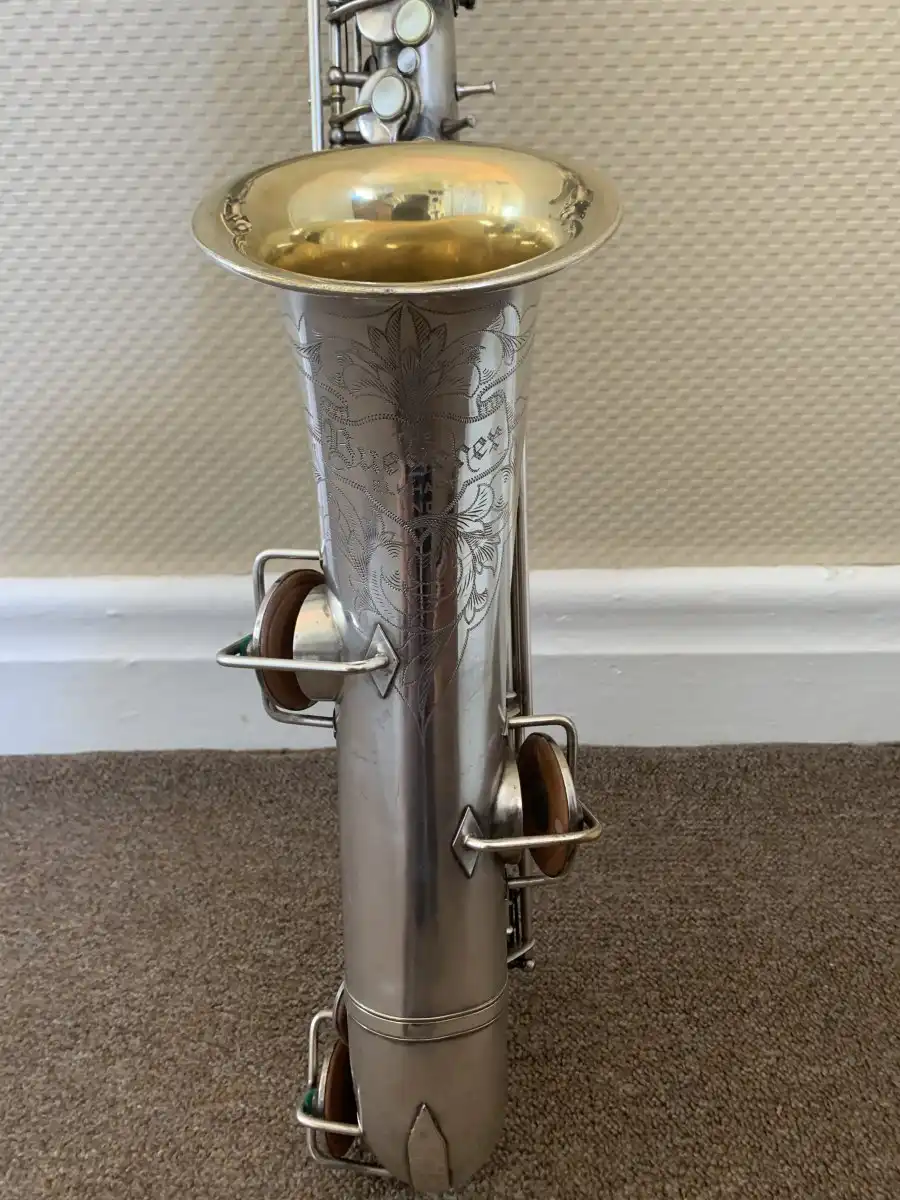
1922 Buescher C Melody
1616709709721.webp


I’m a sucker for a pretty face. Recently bought this, via an auction house, sight unseen (physically that is) due to COVID regulations.

Didn’t really want to spend a lot on it really but might have to. Any advice apart from take it to a tech would be much appreciated. ( Long term project )

The bell with gold wash is beautiful and the rest is mainly just heavily tarnished which I’m working on.

The main issue is all the keys are seized, I think, to the pillars. B,A,G close together but not independently. Same with D,E and F. Also when l close bottom stack DEF, BAG close aswell.

Slot screw in rod on top stack buggered.

Any ideas on loosening they keys so they close independently. I’ve tried WD 40 fast release penetrating oil and WD 40 degreaser plus heat, to no avail. If rod needs to be drilled out any ideas where can I get a replacement?

Thanks in advance.
 
Solution
They do these at B&Q in 2.5 and 3 mm. Would they be suitable do you think?
Those are the ones I have - they'll be just fine.
If you carry on repairing for any length of time you'll probably amass a fair collection of screwdrivers. Extra long ones that allow you to bend the shaft around obstructions; swivel-head drivers; stubby ones etc. It's all about what feels comfortable in the hands and what works best for you.
And with the aid of a grinder (even a drill-mounted arbor job) you can tailor the tips how you please.

CK do a nice set of changeable blade drivers, which come in handy for those times when you encounter small screws (flat springs, adjusters etc.) that have Philips or Torx screws.
Liquid Wrench doesn’t appear to be available in the UK. Ordered some PB Blaster from Amazon. Should be here tomorrow.
Will keep updated.
You may have some success inquiring at an auto parts store, Hardware store or industrial supply for the equivalent. It’s commonly used as a penetrant/thread cutting oil.
 
Vote:
Upvote 0
Yep pretty much so.
Have tried auto stores an Amazon UK but to no avail. Will try the PB Blaster stuff.
Starting to get some movement already🙂
That’s great news! Once you get all that loose the next phase will be getting the hinge rod out. Can you post a picture of the buggered screw slot ? And maybe the opposite end @ post.
 
Vote:
Upvote 0
The screw head won't be too much of a problem. Worst case scenario is that you have to desolder the pillar and remove it - after which you can a pair of grips around the rod screw.

But before you get to that point it might be possible to use one or other of the keys to turn the rod out. Simply put, you use a screwdriver to hold the screw in place while you move one of the keys so that it acts like a sort of ratchet.
Thanks Stephen
I don’t think the second part will work, unless I’m mistaken, which is quite feasible, as the rod doesn’t move when I move the keys?
 
Vote:
Upvote 0
Thanks Stephen
I don’t think the second part will work, unless I’m mistaken, which is quite feasible, as the rod doesn’t move when I move the keys?
That's unusual. I'm trying to work out how the keys can move as a group - but not independently - without at least one key being stuck to the rod screw.
Are there any keys on the stack that don't move at all?
 
Vote:
Upvote 0
That's unusual. I'm trying to work out how the keys can move as a group - but not independently - without at least one key being stuck to the rod screw.
Are there any keys on the stack that don't move at all?
They’re all starting to free up a little now with the heat/oil/ wiggle routine. When I turn the screw the pads close so I’m presuming the rod is seized in the pillar??
 
Vote:
Upvote 0
They’re all starting to free up a little now with the heat/oil/ wiggle routine. When I turn the screw the pads close so I’m presuming the rod is seized in the pillar??
Nope. If the rod was seized in the pillar it wouldn't budge at all. If the keys move when you turn the screw it means they're binding to the rod screw.
This is semi-good news 'cos it means the technique of holding the screw still and moving the keys to maximise the torque will come into play.

Keep at it...there's no rush.
 
Vote:
Upvote 0
The only things I can add to this discussion are some ideas my mentor taught me. 1) the oil will be drawn to where the heat is applied 2) in addition to heat and penetrating oil sometimes light tapping can be effective in breaking up rust or corrosion. In the shop we use small plastic or rawhide mallets. A small screwdriver plastic handle makes a good substitute.
It's a good principle (1) but can be complicated by the presence of dried grease residues - where heating the part can actually make things slightly worse. Moot point really, 'cos you'll have no idea what the status quo is until you get the rod out...so it's a case of damned if you do, damned if you don't. Just worth noting, is all.

Good call on the tapping. Follows the principle of "If it doubt, gi' it a clout!". Usually works.
 
Vote:
Upvote 1
Nope. If the rod was seized in the pillar it wouldn't budge at all. If the keys move when you turn the screw it means they're binding to the rod screw.
This is semi-good news 'cos it means the technique of holding the screw still and moving the keys to maximise the torque will come into play.

Keep at it...there's no rush.

Hmm. I see the o logic now :doh:
Will give holding the screw still a go if I can borrow another pair of hands.:clapping:
As you say..... there’s no rush!!
Cheers
 
Vote:
Upvote 0
Hmm. I see the o logic now :doh:
Will give holding the screw still a go if I can borrow another pair of hands.:clapping:
As you say..... there’s no rush!!
Cheers
You don't need another pair of hands - you need to be able to feel how much tension there is on the screwdriver/key.
 
Vote:
Upvote 0
You don't need another pair of hands - you need to be able to feel how much tension there is on the screwdriver/key.
Okeydokey will give it a try.
Am I right in thinking then that the hinge rod is probably not stuck but the keys stuck to the rod stopping it from turning?
Things are beginning to loosen a lot now. Will also give the “If in doubt gi’ it a clout” theory.
 
Vote:
Upvote 0
Am I right in thinking then that the hinge rod is probably not stuck but the keys stuck to the rod stopping it from turning?

Bingo.
However, the sign that this is happening is that the head of the screw will rotate slightly as the keys are moved.
If the head doesn't rotate then the usual cause is that the threaded end is biding in the pillar, due to corrosion.
 
Vote:
Upvote 0
Well something sooner or later will let go. I can’t really think of any other variables that have not been discussed. It would be insane to think a hinge rod is broken in half midway. Or the possibility a previous tech has used a two-part rod. I really don’t see how a stuck hinge tube is not moving/spinning the rod. Some light taps on each end is a good idea. Just don’t kill it.
 
Vote:
Upvote 0

Similar threads... or are they? Maybe not but they could be worth reading anyway 😀

Social

New! Social Feeds

Look out for the navigation icon:

Follow CafeSaxophone

Latest Song of the Month

Trending

Forum statistics

Topics
32,080
Messages
578,785
Members
8,137
Latest member
AdrianoHoma
Back
Top Bottom