

Tech/maintenance Buescher C Melody stuck keys

Royston

Member
Messages
614
Location
Wirral, United Kingdom
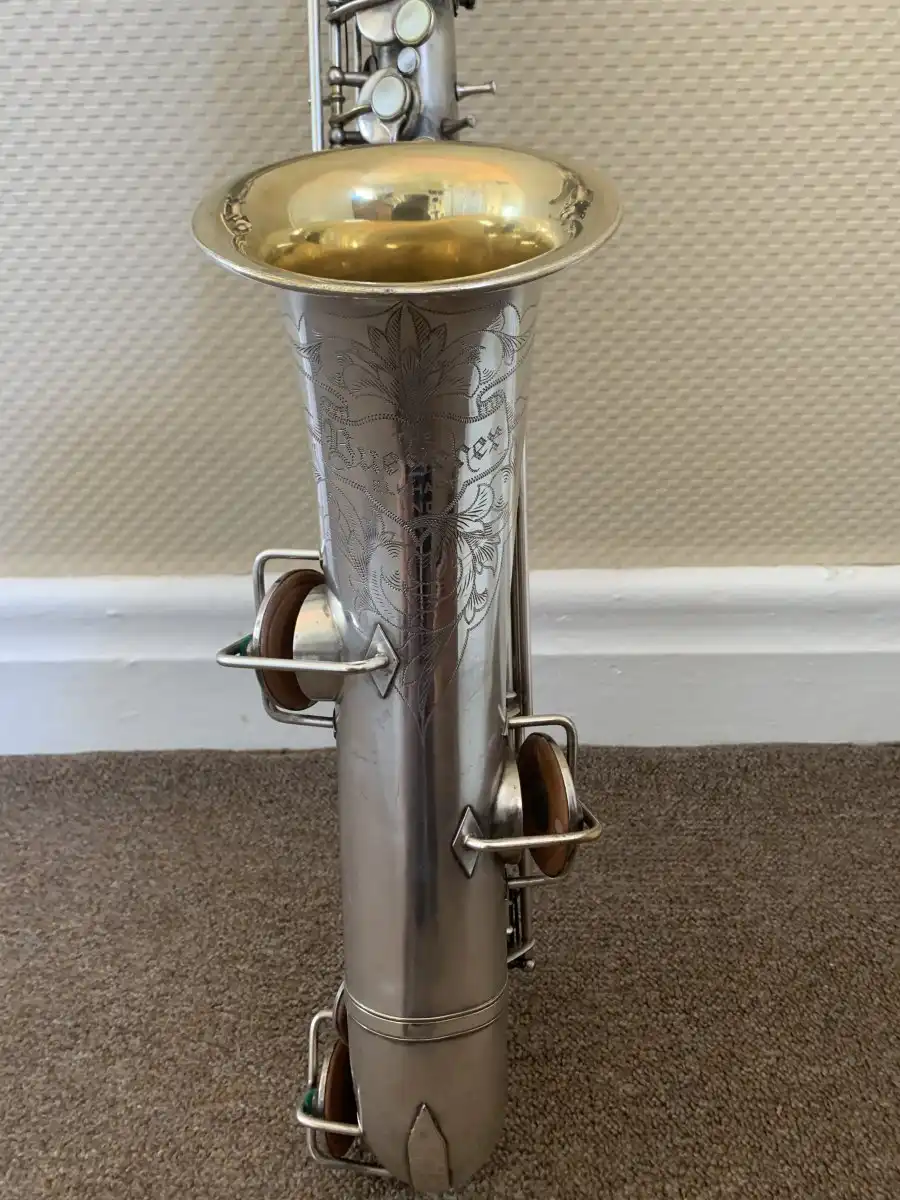
1922 Buescher C Melody
1616709709721.webp


I’m a sucker for a pretty face. Recently bought this, via an auction house, sight unseen (physically that is) due to COVID regulations.

Didn’t really want to spend a lot on it really but might have to. Any advice apart from take it to a tech would be much appreciated. ( Long term project )

The bell with gold wash is beautiful and the rest is mainly just heavily tarnished which I’m working on.

The main issue is all the keys are seized, I think, to the pillars. B,A,G close together but not independently. Same with D,E and F. Also when l close bottom stack DEF, BAG close aswell.

Slot screw in rod on top stack buggered.

Any ideas on loosening they keys so they close independently. I’ve tried WD 40 fast release penetrating oil and WD 40 degreaser plus heat, to no avail. If rod needs to be drilled out any ideas where can I get a replacement?

Thanks in advance.
 
Solution
They do these at B&Q in 2.5 and 3 mm. Would they be suitable do you think?
Those are the ones I have - they'll be just fine.
If you carry on repairing for any length of time you'll probably amass a fair collection of screwdrivers. Extra long ones that allow you to bend the shaft around obstructions; swivel-head drivers; stubby ones etc. It's all about what feels comfortable in the hands and what works best for you.
And with the aid of a grinder (even a drill-mounted arbor job) you can tailor the tips how you please.

CK do a nice set of changeable blade drivers, which come in handy for those times when you encounter small screws (flat springs, adjusters etc.) that have Philips or Torx screws.
If you know a nice dental hygienist, or else have access to some ultrasound, that will greatly speed up things.
Ultrasonic cleaning? I don’t know what that would do to the pearls. Although you’ve given me an idea. I have a couple electric engraving tools. I could grind the tip flat and use it like a micro jackhammer.
 
Vote:
Upvote 0
Ultrasonic cleaning? I don’t know what that would do to the pearls. Although you’ve given me an idea. I have a couple electric engraving tools. I could grind the tip flat and use it like a micro jackhammer.
That should work, too. I managed to separate a stack of old Kodak prints that refused to yield to any other treatment and unclog a fountain pen that's been sitting useless for about 2 decades, not to mention some rusted rods and nuts.
 
Vote:
Upvote 0
I have an ultrasonic cleaner that I’ve used for clocks and carburetors. I put a pocket watch in it once. I was too lazy to set up my other tank. It did a fabulous job shattering all the rubys out of it:doh: That’s why I asked the question about the pearls.
 
Last edited:
Vote:
Upvote 0
I have an ultrasonic cleaner that I’ve used for clocks and carburetors. I put a pocket watch it at once. I was too lazy to set up my other tank. It did a fabulous job shattering all the rubys out of it:doh: That’s why I asked the question about the pearls.
I can see how it would do that but the rubies are set (only friction) whereas the pearls are glued. I'd still pay attention to them but I wouldn't be overly concerned, certainly not more than with using any solvent. It might show any cold solder spots but again, in that stage of restoration, that might even be a good thing.

Definitely would help freeing up those rods and letting the lube penetrate, though!
 
Vote:
Upvote 0
Ultrasonic cleaning? I don’t know what that would do to the pearls. Although you’ve given me an idea. I have a couple electric engraving tools. I could grind the tip flat and use it like a micro jackhammer.
Been there, done that. Great minds think alike. 😉 I thought that vibrating the end of the rod with an engraving tool might free the rust or corrosion. All it did was cause an ear of the screwdriver slot to break off making the problem worse. 🙁
 
Vote:
Upvote 0
Been there, done that. Great minds think alike. 😉 I thought that vibrating the end of the rod with an engraving tool might free the rust or corrosion. All it did was cause an ear of the screwdriver slot to break off making the problem worse. 🙁
The trick is to put a piece of dense material between the tool and the pillar. Delrin is good. That said, I can't say that it makes any difference.
Trouble is, it's kinda hard to set up a test - there are just too many variables.
 
Vote:
Upvote 0
The screw head won't be too much of a problem. Worst case scenario is that you have to desolder the pillar and remove it - after which you can a pair of grips around the rod screw.

But before you get to that point it might be possible to use one or other of the keys to turn the rod out. Simply put, you use a screwdriver to hold the screw in place while you move one of the keys so that it acts like a sort of ratchet.
Am I right in saying with the screwdriver holding the key open you then push it down to close it. Thereby turning the rod lefty loosey??
 
Vote:
Upvote 0
I can see how it would do that but the rubies are set (only friction) whereas the pearls are glued. I'd still pay attention to them but I wouldn't be overly concerned, certainly not more than with using any solvent. It might show any cold solder spots but again, in that stage of restoration, that might even be a good thing.

Definitely would help freeing up those rods and letting the lube penetrate, though!
A lot of the vintage watches have man-made rubies. They are held sometimes with a minuscule spot of shellac. I literally had red sand in the bottom of the tank. 19 Jewels worth. Good thing I only have a 1 gallon tank. I would be tempted to experiment.
The trick is to put a piece of dense material between the tool and the pillar. Delrin is good. That said, I can't say that it makes any difference.
Trouble is, it's kinda hard to set up a test - there are just too many variables.
I was just thinking the same thing after @jbtsax made the comment. I have some 1/4” nylon rod around here somewhere. I can drill a little hole and make a tip. that way I wouldn’t need to grind the tip flat too.
Am I right in saying with the screwdriver holding the key open you then push it down to close it. Thereby turning the rod lefty loosey??
Think of tightening and loosening in this way. To make it last a long time go with time. Clockwise. To go back in time (loosen) go counterclockwise. People get confused with the righty tighty lefty Lucy. Hold the screwdriver lift the key up if you’re looking down the stack. From the neck end.
 
Vote:
Upvote 0
Been there, done that. Great minds think alike. 😉 I thought that vibrating the end of the rod with an engraving tool might free the rust or corrosion. All it did was cause an ear of the screwdriver slot to break off making the problem worse. 🙁
I would not use it as a vibrating screwdriver, rather just make contact without pressure to facilitate the lubricant to soak in. Breaking off one ear can always happen, especially if they are already on the brink, so those are two "marginally related" issues, that ear would have broken off no matter what. But I appreciate your post, definitely something to watch out for.
 
Vote:
Upvote 0
Am I right in saying with the screwdriver holding the key open you then push it down to close it. Thereby turning the rod lefty loosey??
Sort of. With the keys in the closed position you hold the screw head in place while you open one or other of the keys against the binding friction. Release the screw, press the key down and the friction will turn the screws anticlockwise. Repeat it often enough and the screw will work its way out.

Whether this technique is available to you depends on how many keys are stuck on the rod screw, and to what degree. It may be necessary to hold down/raise several keys at once.
You can also use it between keys - using one to hold the screw static and another to provide the turning motion.
It's a bit difficult to describe, but once you have a picture in your head of the mechanics of the thing, you can adapt the technique to suit the state of the key group in question.

It also relies on there being at least some 'slip' on all the keys - AKA tight but not stuck fast...otherwise you'll just keep going backwards and forwards.
It's particularly effective when you're dealing with a bent rod screw.
 
Vote:
Upvote 0
Sort of. With the keys in the closed position you hold the screw head in place while you open one or other of the keys against the binding friction. Release the screw, press the key down and the friction will turn the screws anticlockwise. Repeat it often enough and the screw will work its way out.

Whether this technique is available to you depends on how many keys are stuck on the rod screw, and to what degree. It may be necessary to hold down/raise several keys at once.
You can also use it between keys - using one to hold the screw static and another to provide the turning motion.
It's a bit difficult to describe, but once you have a picture in your head of the mechanics of the thing, you can adapt the technique to suit the state of the key group in question.

It also relies on there being at least some 'slip' on all the keys - AKA tight but not stuck fast...otherwise you'll just keep going backwards and forwards.
It's particularly effective when you're dealing with a bent rod screw.
Think I’m just going backwards and forwards unfortunately. Will keep at it but if it had to be drilled or cut out in the end where in the UK could I get a new rod made?
 
Vote:
Upvote 0

Similar threads... or are they? Maybe not but they could be worth reading anyway 😀

Social

New! Social Feeds

Look out for the navigation icon:

Follow CafeSaxophone

Latest Song of the Month

Trending

Forum statistics

Topics
32,080
Messages
578,785
Members
8,137
Latest member
AdrianoHoma
Back
Top Bottom