
• New!

    Try our new Social Feeds, look out for the navigation icon: . You can now set default social feed view in your account preferences.

Saxophone beginners B major blues scale

Blimey, some people can't catch a break!
Ed gets it in the neck through many threads with people going "learn some basic theory..."
Now asks a straight question (from today's jazz/blues pedagogy) and still can't get put back on the road!

Nowhere did Ed say he wants to "slather" the blues scale over anything. (although its fairly clear that that would be a bad idea).
But it's probably a good idea to have a range of scales and arpeggios under the fingers - including various pentatonic and blues ones. Whatever you end up playing and as a prelude to focusing on playing with harmonic progressions
 
Well no, because if it's a major blues, going by the notes in the key signature for a B blues is not going to help because most of the time the A# (as a major 7) will not sound as good as an A. You are approaching blues the wrong way by looking at key signatures.

And listening to people here may even be confusing as I'm sure I will be saying different things to turf3 - there is unlikely to be a consensus when approaching trying to theorise blues.
sorry the question re Blues scales sort of came out of trying to improvise over Hello mary lou instrumental which is just B major...Didn't mean to open a can of worms just looking up something and saw the flattened D and thought Id read blues scale had flattened 5th in its simplest form..Time to do some reading..
 
Well no, because if it's a major blues, going by the notes in the key signature for a B blues is not going to help because most of the time the A# (as a major 7) will not sound as good as an A. You are approaching blues the wrong way by looking at key signatures.

And listening to people here may even be confusing as I'm sure I will be saying different things to turf3 - there is unlikely to be a consensus when approaching trying to theorise blues.
No just B major key sig not blues
 
Blimey, some people can't catch a break!
Ed gets it in the neck through many threads with people going "learn some basic theory..."
Now asks a straight question (from today's jazz/blues pedagogy) and still can't get put back on the road!

Nowhere did Ed say he wants to "slather" the blues scale over anything. (although its fairly clear that that would be a bad idea).
But it's probably a good idea to have a range of scales and arpeggios under the fingers - including various pentatonic and blues ones. Whatever you end up playing and as a prelude to focusing on playing with harmonic progressions
lol ta was just trying to do the instrumental on Hello mary Lou using the notes from B major key sig (not blues) and came accross someting which led to the question..I always have the scale on the song Im doing so practice before playing..
 
lol ta was just trying to do the instrumental on Hello mary Lou using the notes from B major key sig (not blues) and came accross someting which led to the question..I always have the scale on the song Im doing so practice before playing..
Ok. It's not unusual that folks ask a "how do I do X" question where X is their assumed answer to some other question - it's often better to take a long run up to the question you have so folks have context...
 
Well, I just listened again to the song. "Hello Mary Lou" is a very traditional kind of pop song. Far more akin to tunes from the 20s and 30s like "Dinah" or "Sweet Sue" than any 12 bar blues song.

I, IV, V7; there's a little trip to III, vimin, II, V7. Play diatonic. State the chords. Blues scale won't work here. You might get away with a little bluesy lick here and there, but only as occasional seasoning.
 
You are approaching blues the wrong way by looking at key signatures.
Even the key signatures are sometimes confusing.
I've even found 3 sharps in an E-Blues - probably because E is the dominant of A.

But I think most of the time we're talking about a blues scale that's -3/W/H//H-3/W, so in B it would be B/D/E/F/F#/A/B.
B/C#/D#/E/F#/G#/A would be a Mixolydian Scale, which would also fit the I in a B Blues.

On the songs that are "not so bluesy" a blues scale on the parallel minor would fit (aka "Swing Scale,"Country Scale", Pentatonic b3).

In B that would be B/C#/D/D#/F#/G# - the same as a G# blues scale. This scale often used by players like Grover Washington, David Sanborn etc. It has more consonant notes to the harmony.

Cheers, Guenne
 
Well, I just listened again to the song. "Hello Mary Lou" is a very traditional kind of pop song. Far more akin to tunes from the 20s and 30s like "Dinah" or "Sweet Sue" than any 12 bar blues song.

I, IV, V7; there's a little trip to III, vimin, II, V7. Play diatonic. State the chords. Blues scale won't work here. You might get away with a little bluesy lick here and there, but only as occasional seasoning.
Sorry the question re blues arose out of trying to play over the instrumental..I was using the key sig notes of B major not A# tho missed that one..thanks @Pete Thomas. So B C# D# E F# G# A# and B..Then something popped int my head re a pentatonic scale with a flattened 5thvbeing a blues scale..
 
AFAIK, the standard definition of a blues scale is a minor pentatonic scale with a flatted fifth added. In B, that would be B-D-E-F-F#-A-(B). F is the flatted fifth.

Pentatonic scales are traditional, they date back thousands of years and exist in many different cultures. Note that the same standard rules of minor and major relationships exist - the D major pentatonic and B minor pentatonic have the same notes. So the notes B-D-E-F#-A could be considered either a B minor pentatonic or a D major pentatonic.

Not to put a wrinkle in - but Eddie it sounds like you might want to use the B MAJOR pentatonic to fool around with improvisation on Hello Mary Lou! I remember this song from my childhood, we used to watch Ricky Nelson on Leave It To Beaver every week, and I recall this song being a big hit.

B - C# - D# - F# - G#

I'm glad I didn't meet Mary Lou - goodbye heart indeed 🙂
 
We did some RockSax workshops for 10-12 years ago. Andrew Clark made the masterclass "Five Common Styles In Rock" for Saxophone Journal. When he was in Scandinavia we had workshops on the rural side of Scania and Copenhagen as well. The "Five Common Styles In Rock"workshop was dealing about how to play solo, fillings, riffs .... in different styles; Traditional blues, James Brown funk, Reggae, Ballad, Soul. Most adults on the workshops. Players that recently returned to the sax, readers that have been hiding behind a note stand too long, younger players that were curious to try something "new" ..... .

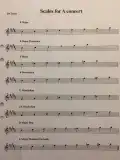
We didn't want the workshops to be a readers workshop. So we send out some scales and arrangement in advance so it was possible to learn the scales, chord tones, chord changes for the different songs/basic grooves .. so it was possible to be a bit prepared.

Here is the scales for soprano/tenor that was sent out. All songs were in in concert A so it was easy for us to compare the different scales. What scales sounds best and how to borrow from the other scales to put in more interest .....? I know that some players don't think some scales doesn't belong on this paper.
IMG_4834.JPG
 
Last edited:
Talking about ketchup ......

..... I was working as second man at the "fish stove". A big band leader was in town and he was staying at the hotel. Before the gig he wanted something to eat so he went down to the restaurant. He ordered a very tasty fish course: "Sole Marchand de Vin" ( sole filet, coat of clarified butter and covered with mie de pain, carefully fried in clarified butter served with a red wine sauce finished with butter). Chef de cuisine came out of his cave and told us to take a step back because he was going to do the cooking for the VIP guest.

15 minutes later the sole filet was laying on a dish and sauce and potatoes à parte. Ready to be served. The waiter arranged the plate. The band leader looked at it and asked if he could have a bottle of ketchup. The waiter couldn't believe his eyes when a big hand grab the bottle and gave it slap in the bottom with the other hand. Everything was covered with ketchup.

A 60-70 years old man is eating as a 12 year old child or an adult man searching for the right groove for a song ....... . Both enthusiastic and happy, trying to satisfy their hunger for food or music.

Here is a later version, from the 80's, with turbot filet instead of sole and served on a plate. And no "mie de pain". IMO turbot have better and more taste compared to sole. We were already cutting costs!

Off topic, but it started already with the ketchup. "Give the ketchup bottle to the leader" can be a good name of a Rock & Roll/Blues song in a 12 bar blues format in concert A.

IMG_4835.JPG
 
Last edited:
" I find that many sax players who are into Jazz, Funk, Fusion or Pop music end up taking gigs in Blues bands because they could use the work and it's considered easy. What most don't know is there are many saxophone stylistics in Chicago Blues that developed unique approaches to group playing either as a small section or by themselves " said Sax Gordon back in 2001. How to teach blues saxophone as Eddie Shaw, A.C. Reed, J.T. Brown, Harold Ashby (Duke Ellington) .....? They are now dead and gone. Is it possible to theorize the blues they played?

And all the talk about that it was jazz saxophonists that made the best and most famous blues and rock & roll solos.

Blues is not a song, it's just a blues.

Harold Ashby playing on a Wilie Dixon recording from 1958. I can trace the Chicago blues saxophone.
View: https://youtu.be/thpqb10Uinc?si=rP-5iSHv1uk4nRe7
 
What's the background of writing the flat 5th
Just a blue note
as we all know, in real life it's not even an F) as an augmented 4th E#?
It can be either I think depending on context. As a blue note or descending passing note I'd say it's F as a ♭5, but as an ascending neighbour or passing note I'd call it a E# or #4 or #11.

Or id just play it without calling it anything.
 
Yes. The Blues Scales, Blue Notes etc came long after the theoretical framework that was in place in the 16C or 17C. "The Blues Scale" - I'm with Skeller and Pete in that I only know of one "The Blues Scale" (not that it matters) is an altered scale, and the Western Harmony key signature of the same "key" doesn't make a lot of sense.
 
I think if you are writing a scale ascending, it makes sense to have passing notes as sharps. And likewise if you write a scale descending you have passing notes as flats.

In B maybe it is moot but in E it is better maybe to write:

E G A A# B than E G A Ab Bb.

:confused2:

It has more to do with elegance of writing (fewer accidentals) than it has to do with enharmonic correctness maybe.
 
I'm going to ask Andrew Clark so we know if it was a mistake or ..... .

As I wrote earlier we wanted RockSax workshops to be more "play by ear" or "listen and learn from each other". I think that is the traditional way to learn the blues. Charts and sheet music cut hours. And of couse ther were player who must have a note paper in front of them. So we were keen to please everyone.
 

Similar threads... or are they? Maybe not but they could be worth reading anyway 😀

Trending

Latest Song of the Month

Forum statistics

Topics
32,244
Messages
575,357
Members
8,072
Latest member
Max18
Back
Top Bottom