Playing the saxophone Which is the best fingering for A# / Bb on saxophone?

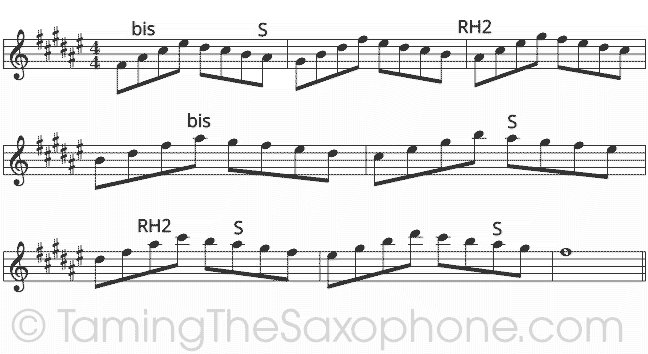
This may come across as "pedantic", but the most logical use of each of the Bb fingerings (and other alternate fingerings) can be found in Larry Teal's The Art of Saxophone Playing. As far as remembering which one to use in a difficult technical passage in a piece I am preparing, I always pencil it in above the note so that I use the same fingering every time and develop a pattern.
You can't do that when you're improvising, though. I belive I've mentioned how I feel about Teal's book before >:).

As far as always using the bis for everything, I'll have a contest with anyone using that method trilling from B to Bb. Any takers. 🙂

Can't remember the last time I needed/wanted to do that, but OK, I probably wouldn't use the bis key for that.
 
Ok, I win that one by default. There is another important aspect I forgot to mention, and that is the speed and duration of the notes in the passage containing the Bb/A#. Up to a point, any of the fingering is usable and even practical. In other words it doesn't matter which one you use. It is when mastering the technical difficulty of the music becomes very challenging and requires a lot of "woodshedding", that choosing one alternate fingering over another can make a big difference.

If one only plays "tunes" at moderate tempos and improvises, then choice of fingerings probably doesn't matter because folks don't (or shouldn't) try to play sequences of notes not already "under their fingers" when they solo. The Caprice En Forme De Valse by Paul Bonneau (below) is a well known unaccompanied saxophone piece that is a good example of where using the "best" alternate fingering is important. Here is an excellent recording of this wonderful piece done by James Romain (Drakesaxprof on SOTW) DeadAudiolink Removed
 
Last edited:
Greg Fishman is amazing. If that fingering for B to Bb works for him, that's great. Some of us learned that "Bonneau Piece" and others in order to get an advanced music degree (for which I was was well paid over 30 years as a music teacher). To be honest not that well in Utah.

Some of the most fun I ever had playing my sax was playing **** kicking music in a country western band in a bar in Wyoming when I was still in high school. It doesn't get much more "low brow" than that.
 
That could be called the "thumb bis". For my beginning students, I didn't even teach that fingering until the end of the 2nd year to prevent its over use. You can always tell the sax players who started on flute, they play all the Bb's 1 - 1, and all the F#'s xxx|oox. 🙂
 
Neat example Pete. I get the reason for the 2nd RH2 usage, but why are you suggesting RH2 in the 1st instance going from B to A# followed by C#?
Because while paying B it's so easy to just slam down the RH2 - one finger instead two or rolling to the bis.

RH2 to C# is no biggy.
 
Last edited:
Real answer: I never liked long Bb
Fake answer to look cool: I use side A# if I play B major, long Bb if I play Cb major.
 
Last edited:
This may come across as "pedantic", but the most logical use of each of the Bb fingerings (and other alternate fingerings) can be found in Larry Teal's The Art of Saxophone Playing. As far as remembering which one to use in a difficult technical passage in a piece I am preparing, I always pencil it in above the note so that I use the same fingering every time and develop a pattern.

As far as always using the bis for everything, I'll have a contest with anyone using that method trilling from B to Bb. Any takers. 🙂

Couldn't you do it using the middle finger on the bis?
 

Similar threads... or are they? Maybe not but they could be worth reading anyway 😀

Social

New! Social Feeds

Look out for the navigation icon:

Follow CafeSaxophone

Latest Song of the Month

Trending

Forum statistics

Topics
32,088
Messages
579,077
Members
8,143
Latest member
ReneGuenotSale
Back
Top Bottom