PPT works well on a ‘36 12M as well as a B900 Yanag.
So often the cause on any sax. Should give bigger sound too with a better core.Push in and play lower on the input pitch.
If you are in Manchester (as the LHS of the webpage suggests) and you want to try my metal Link on your horn, I live in Whalley Range and as far as I know have no orally-transmissible diseases (aural transmission...can't guarantee anything. Do you like bad amateur bebop?). But I am about to be away for a fortnight, so up to you.Horn: Buescher Aristocrat
Mouthpiece: Berg Larsen 105 2 SMS (Ebonite)
Reed: Legere 2 / 2.25.
Overall the horn plays well. The low notes are deep and lush, but the upper octave is wildly flat, the only way I can over come it is by applying pressure with my embochure. It feels excessive compared to playing tenor, which I can managed by adjusting tongue/throat.
The Berg won't seal for a pop test. Thinking maybe the table was concave tried with a cane reeds, soaked the reed, changed ligature, just doesn't want to pop.
Any pointers welcome, before I start disappearing down a rabbit hole.
Maybe, the consensus seems to be the older horns prefer larger chambers. They work well on my old Alto/Tenor horns.@Digger2054 you miss my point.
I am indeed, I live over near Wigan, but "work" in Salford so could sort something out. It would be interesting to compare it to the BergIf you are in Manchester (as the LHS of the webpage suggests) and you want to try my metal Link on your horn, I live in Whalley Range and as far as I know have no orally-transmissible diseases (aural transmission...can't guarantee anything. Do you like bad amateur bebop?). But I am about to be away for a fortnight, so up to you.

It used to be that the old "dill pickle" type piece, where the chamber diameter is notably bigger than the cork bore, and the baffle is extremely small or nonexistent, was what you'd call a large chamber; and pieces like a Link where the chamber diameter is essentially the same as the cork bore, would be called "medium". (Meyer even labels their most common design "medium chamber" and its ID is about the same as that of the cork bore.)
theowanne.com
Morgan Mouthpieces make good gear. I've been playing their classical tenor mouthpiece for decades. For bari 'pieces on older instruments, I especially appreciate that one can order an elongated shank (XL) for no extra charge.Anyway, there are any number of makers selling variations on the Link design - low short rollover baffle, concave side walls, chamber about the size of the bore. Maybe check out Morgan, who offer several different models of this general design type.
www.morganmouthpieces.com
Is the chamber the same diameter as the bore? See the link in Post #27 regarding chamber sizes.Both Morgan and Getasax offer a Gregory/Gale based bari mouthpiece. Morgan using an original mold and Getasax 3D printing their Gale Holywood model. I got a Gale Holywood in 6 = 0.100 a few weeks ago. It has a gorgeous tone and plays extremely well on my Yanagisawa BW-O1. I don‘t know if it is considered a large chamber piece but there is little baffle and the side walls are slightly carved out. It is offered in a long shank version for Conn and Buescher baris. How it compares to the Morgan I have no idea, but these Gregory/Gale models would certainly be worth a try.
I 'work' (PT) at the university in Salford, so maybe we could meet there (I don't drive in, but I could probably tie the bari case to my bicycle trailer - and I hav access to our yard where someone could park for an hour). Send me a PM if you want to try to meet in a couple of weeks.Maybe, the consensus seems to be the older horns prefer larger chambers. They work well on my old Alto/Tenor horns.
IMHO, it would make sense try a larger chamber. The Selmer & 5C aren't 'large' chambered, and I'd potenially still be fighting to get it in tune.
Maybe I am missing the point, but I don't see the point of going 5C, then to Selmer, that still might not fix it... skip that and pick a large chamber piece and adjust to that?
I am indeed, I live over near Wigan, but "work" in Salford so could sort something out. It would be interesting to compare it to the Berg![]()
No. Increasing the length of a mouthpiece that plays too sharp because the chamber's too small, just allows you to pull it out further, which fouls up the scale (flat high notes, sharp bell notes, in other words exactly what the OP's complaining about).According to Theo‘s definition it is not a large chamber. Since it can be ordered as a long shank version for vintage horns it should work nevertheless.
View attachment 33947View attachment 33948
Are both the octave keys opening the same height ? Has the crook vent been cleaned lately.but the upper octave is wildly flat
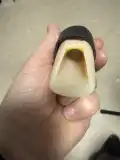
That looks like a “small” chamber - the chamber is smaller in diameter than the bore.According to Theo‘s definition it is not a large chamber. Since it can be ordered as a long shank version for vintage horns it should work nevertheless.
View attachment 33947View attachment 33948
That's ace I don't work far from the Uni, near media city.I 'work' (PT) at the university in Salford, so maybe we could meet there (I don't drive in, but I could probably tie the bari case to my bicycle trailer - and I hav access to our yard where someone could park for an hour). Send me a PM if you want to try to meet in a couple of weeks.
cheers
Mark
Not sure about the heights.Are both the octave keys opening the same height ? Has the crook vent been cleaned lately.
Funny, I did the exact same thing. Lots of the makers have pre & post dated offerings. That’s how I came up with looking directly at factory available for 1937.One last thing about the Gale Hollywood mouthpiece. Looked up on the Wanne homepage when these were in production since they are not exactly modern. Seems Gerry Mulligan played a Gale Hollywood on his Conn 12 m. This doesn‘t proof it will work on a Buescher but at least there could be a chance it might.
Since I have zero experience with vintage horns this is all guess work. I will shut up and leave it to the experts.