Theory & Impro Soloing Over "Jazz Blues Changes"

It looks like this topic has wondered around all the ways to play melodically..But does it address the point of what does the player want to play..If he/she wished to play " Standards" then as we are all aware there are certain rules that help mere mortals like us get around the changes.. Unless you are the next Ben Webster etc.. If you do not point out these things then a player will end in the realm of free jazz..Hmmm not quite my cup of tea but each to there own..Once the player has the basics under there fingers then surely they must seek out a teacher that can teach the style they want. If I wanted to play classical music I wouldn't go see see a tutor who teaches jazz improv.. As for that type of playing being dead well I feel sure that a good rendition of " In Sentimental Mood" on a Saturday afternoon will get the attention of more than one or two people. Here in the UK the over 50's is probably the largest age group. Even if they don't listen at home you can bet they know the tune..But then see this tends to start another topic..Do we play what we want or do we play what the audience wants here..>:)

So would you get paid for a set of standards or a set of originals???

We have seen many ways to learn to play melodically from some good players. So we can see there are many ways to the same goal.. Most of all though it should be about an individual learning how to play the music they want to.
 
Well, I had to say something now didn't I>:)..A a side point though, does just because people haven't heard the music mean its become useless and not worth listening too??>:)

There are many many generations worth of worthy songs, all of which would sound fresh to most younger ears. The problem with "standards" is the "formulae". It starts with a presumption that the listener knows the tune so that those "oh so clever" variations that follow have resonance with the listener. It’s almost a sick joke: What’s a standard? Something that nobody knows!

Stop and remove yourself (if you can) to a point where you are simply listening as most of today’s generation would (without the reference of knowing the tune): Something is played for a short while in a pleasant but plain manner, then each of the band members try to impress you with how good their technique is. They then go back to playing in a plain fashion again, then it ends. Hearing the head once does not make this a tune that you "know". The "formulae" is flawed simply becasuse the listener does not already know the tune.
In music, as in literature, the art that reaches the audience is a story that has a beginning, develops has a climax and ends. A series of improvisations based on an unknown melody generally does not tell any story but instead speaks only of the musician's ability. Each solo generally has its own climax, then the whole thing goes back to being rather plain again. There is no cohesion that gives a listener a narrative that makes the music work as a whole. The only saving grace is if the listener already knows the "standard" and can thus appreciate the series of variations on what that original meant to them. As we know audiences do NOT know these tunes, so that one justification does not exist. The form is severely flawed as it seems to only attract other musicians who want to hear how good (or bad) another mainstream player's technique is.

By all means we should play whatever we want. However it’s doubtful that a student sax player has a burning desire to learn a bunch of tunes they have never heard, spend years learning an overly technically based style that communicates to few, and have no audience for what they have learned to do. Students are TOLD by (hopefully) well meaning instructors that then MUST learn standards and the accompanying mainstream style of playing. New students generally do not have the insight to know what teacher they want or need. They just take in the information and do the best that they can. Teaching for jazz sax is 99% based on standards and mainstream style playing. Look around this or other sites, how much do you see or hear for students that does not fit this flawed paradigm?

The fact remains: It is not working. The question remains when and how does this stop.
 
it is only by each new generation playing these tunes that they will carry on and continue to give enjoyment as they were intended to do. 🙂

I am not quite 50 yet but was definitely brought up listening to them (and Glen Miller, Acker Bilk, Herb Alpert.... the joys of having an ex-lancaster (the plane not the place) man as a father)

I am forever grateful of that.
 
Wade while I can see your point of view, I still don't get your dislike of standards. If classical players took the same view think what would be lost and never played. Pushing to one side the history of something is no better then saying it doesn't matter as it wasn't worth listening to.. Now I don't think that is what you are trying to say, but what is wrong with saying this is jazz based on 251 chord progressions and different chord subs..As the genre grew quickly it went modal then free.. that kinda makes things simple. You know yourself a lot of the early tunes had 51 progressions to start then that became 251 etc..Dare I say if it doesn't swing its not jazz.>:)Oops too late said it>:)..As for showing of ones technical prowess, maybe in the bebop era. But Basie's words to his trombone player where "don't play all you have in one tune leave them wanting more. Play some of the melody the Jazz guys won't kill you for doing that..."It all depends on what people define as jazz..No I am not even going to try..I just know what I like to listen too..So here's the deal your out busking, you play a set of your originals or you play a set of standards..Which will get people pausing for a moment..That is not to say the originals are no good, but Gran out on a Saturday afternoon is more likely to listen to " In Sentimental Mood" than something She doesn't know..By all means I know music has to grow, but at what cost " As Time Goes By " with a hip hop feel and rapping..btw that was one of the things that ended up on TV not to long ago, somehow it didn't quite work for me but hey the guys out there playing where gigging with and playing to a full club..Really is food for thought, people will listen to what they like and players will play what they like( or pays the most money)..
 
Last edited by a moderator:
As you may know I'm not in England, so can't say what works there or what generation stopped hearing "standards", but it's certain that most under 50 years old would not know them. The idea of it somehow being a "duty" to keep these tunes alive is museum talk rather than a live art form. You cannot force people to love or adopt in their times what has gone before. It is history. The comparison was made to Classical music. That survives because it is based on compositions that (as said in the earlier post) tell stories and conform to giving an audience something that is first and foremost musical rather than an exposition of the Musician's abilities. It obviously takes enormous training and talent to be a good classical player, but what the audience hears is music first that is facilitated by that talent. Mainstream jazz tends to put technical talent as the object of playing rather than creating a musical story. It has run its course. All of the arts and culture move and change over time. The history of those artistic phases can certainly be visited, and some certainly are imprinted on the music of their time. For the vast majority culture moves on. This is also true of Classical music which has undergone many transformations.

I have heard no valid argument for forcing students to try and sound like they are playing in the 1950s or 1960s. Jan Garbarek can fill the Albert Hall. Who [FONT=&amp]today[/FONT] that plays strictly mainstream jazz can accomplish that? As you may know Mr Garbarek does not play standards, and I think his audience would disappear if he did. His audience knows he plays original compositions and would be very disappointed if he did not.

My trio plays mainly originals based on ethnic music. We do have one standard that we have at times played. It gets no special response. Maybe you think that it's a good idea to have a senior citizen demographic? I just can't fathom it.

Times and culture change, for improvised music to wallow in any specific period is cultural death. This is NOT something that should be foisted and perpetuated on yet another generation.
 
Last edited by a moderator:
I don`t really have much energy tonight but would like to add my 2c to the mix. I`ve always thought of all popular music " Pop music" as being a natural progression facilitated by what came before and also importantly by advances in the available technology.

This idea has become pretty obvious in the case of mainstream " pop music" as which we all know very rarely features traditional musical instumentation or even " real singing" these days. Some here might say this is a very bad thing.

All I say is. Welcome to the 21st century and also unfortunately for us horn dudes ..Welcome to " Not being as useful as we once were".

Up here in Scotland the traditional Scottish music scene is a living thing mainly due to Tourism and Weddings.. So if you want to make cash you need to equip yourself with the Set and the Sounds for these Occasions.

Of course in the USA " Jazz" IS the traditional music of the working classes as well as being the " POP MUSIC" of the 30,40,50,60`s so things can get a bit muddied.

In the USA anything that passes as a national cultural icon is supported by the formal education System and although it is a fact that the educators are very skilled. Wade has a point regarding the teaching methodology which has to be restrained by institutional curriculum requirements..

That will have to do from me as my " Man Flu" is getting worse by the minute.
 
Last edited by a moderator:
it is only by each new generation playing these tunes that they will carry on and continue to give enjoyment as they were intended to do. 🙂
I am forever grateful of that.

Sure, there is nothing wrong with standard jazz. Without reservation Jazz still serves a purpose
to those who enjoy the mire of static listening. It can help to fulfill various moods and create instantaneous reflection/introspection based on how any one of those standard tunes were heard, as in when and where they were when they first heard them.
Hell, I do that with any type of music such as the 1950's doo wop, which I love by the way, 1960's popular music. Music is functional on many levels and for many reasons. It allows memories to unfold and it supplies those memories with an instant soundtrack. I think that's great! And so I could understand any traditional listener defending the music that they love, as they should. It's all very personal and wonderful!

However, there are also individuals who have enjoyed standard jazz, etc. essentially as a phase and prosper to envelope progressive ideas because as an artist they felt the claustrophobic nature where progression does not exist at all. It's an inherent need to expand. For those types there is in insatiable need to go in as many directions as their imagination will allow. To test the imaginative elasticity and stretch it until it's about to break.
It all depends on a particular artist's mindset and how they're wired.

Yes, I love jazz too. Very much. But these days I listen in a very modest recreational way. If I do listen, Dexter Gordon really sings. Now that's melody!
But I also love Eric Dolphy for his freedom and the rawness he brought to the table. He was a dreamer!
No one should be territorial concerning music because music is extremely personal and why it's personal is a result of
the infinite variables that make up our listening process.

No two people will ever hear alike!
 
I've been revisiting Blues in a "Jazz" context recently myself - I've mostly played guitar - sax is a new wondrous aventure - not yet wholly formed (but I don't think anything ever is)

I started out playing blues-rock guitar many years ago - so spent a long time getting familiar with pentatonic minor scales ...

I've recently been exploring some Thelonious Monk blues like Straight No Chaser, Blue Monk etc and some free Ornette Coleman blues like Ramblin', Blues Connotation etc ...

I like to have a bare bones almost skeletal approach now - try to use my ear to guide me as much as possible - I think round the three mixolydian modes that make the basic I/IV/V scaffold - oh and that this approach might work best without explicitly stated harmony - maybe the bass sketching the basic movements (or not !!)

Also the modes occupy 3 sequential positions in the 4th/5th cycle - eg Bb-Eb-F this means there is a shared central core of notes with 1 note different for each mode - Each of these differences can then be treated as a "safe" note or a passing note - so I'm not so worried about playing a passage from the wrong scale at the wrong time - I try to let my ear tell me which notes not to linger on. I also try to think in terms of intervals and chromatic passages to break up the scale patterns - I think you can pretty much play any note you want but use your ear to tell you whether you've increased the tension or resolved the tension - then you can work out where to take the tension next

It works with rhythm changes tunes some too - especially pseudo-rhythm changes tunes like Bird Food by Ornette - but you have to be a bit more careful with the B section - but really there are 4 modes there - each a note different - and one is the same mode you started with !!

It's real name is probably "cheating and then trying to justify it after the fact" - it can be fun though !!

Bare bones is a good phrase. It's one which I've thought about for years and now, regarding jazz improvisation, it's one in which I incessantly use today.


I never think in terms of scales or chords. I rely on my ear good or bad to guide me through the process.
I did learn how to play 'correctly' years ago but I've found a new inspiration in playing on raw emotion rather than a perfunctory way of being dictated to by specific harmony in how 'it's supposed to be accessed'.
Not everyone's cup of tea as a player or listener but as the individual who is improvising I've found it to be a revelation for myself.


Your ear in time will weed out what YOU don't like and it won't have anything to do with correct scales or chords. Don't get me wrong, scales and chord knowledge are necessary for agility. Once you learn them then you can operate more freely.


Yes, bottom line.......you CAN play any note you like and tension and release are all apart of the process.
If a 'wrong' note is hit let your ear try and resolve it. Then again no one is holding a gun to your head to resolve it and then possibly an atonal style will develop.


it's not cheating at all. How can anyone cheat music? Don't let anyone bull**** you into believing that!
If you like you can listen to my page where a Cafe forum member, Chris Knowles and myself are utlizing the very method you speak of.


Good luck!
 
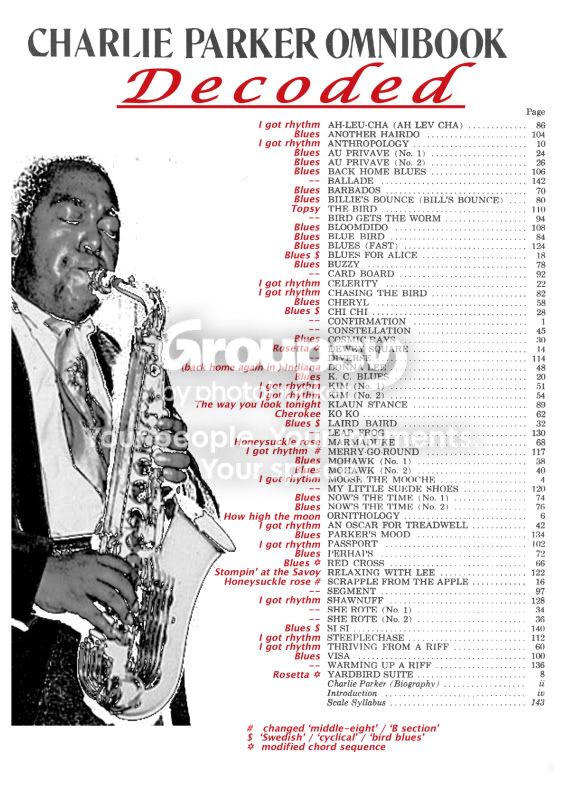
Here's my little insight into just how much of Parker's work is based on blues, and other standards.
i.e. there are 25 blues and 12 'rhythm-changes" in the Omnibook....

CPOdecoded.jpg
 
Hey guys,

Well, my primary instrument is the harmonica, mostly the diatonic/blues harmonica.

You know, I´ve learned a lot about improvisation by playing an instrument with such limited options and range.

When you have less options to express your creativity, you learn the true nature of the musical notes...There are lots of ways to play the same note giving it different emotional connotations. It´s all about feeling the note.

Personally, I don´t like thinking scales, arpeggios and chords progressions when I´m improvising. These things are useful when you´re learning but after you learn how to use them, you have to let them go. I know it sounds weird, but most of the times it´s all about forgetting the the theory and keeping just the essence. Forget the formulas and keep the logic.

One thing I like to do is to leave the instrument alone and just sing...When you sing, you use other parts of your brain, you think freely and don´t get limited by eventual melodic addictions that most of the times are associated to mechanical addictions regarding your instrument.

So, if you have some play along tracks, start singing over them and record your melody. Then, try to reproduce it with your sax. I´m sure you´ll be surprised with the results.

Personally, I really like a more minimalist approach to improvisation. Every note should be there for a reason, not just to fill the gaps. Learn to assign meaning to each note you play and your improvisation will sound much better than playing scales and arpeggios like a robot.

Cheers,

Raf.
 
Last edited by a moderator:
Very interesting thread.

i look at scales kinda the same way I think of the alphabet. Short licks are the equivalent of words and so on.

the more "words" one has fluency with, the easier it is to say something meaningful. Pete's thoughts around voice leading and harmony are like learning grammar. Matter not it get o words order right in the ..... Some things are easier to understand than others.... A reasonable understanding of grammar helps to get ones point across so that others relate. Whether it be by formal education or by having a great ear like Django Reinhardt (who steadfastly refused to have any discussion on harmony and couldn't even read or write let alone music.

S I think that the advice to learn lots of phrases and licks and even memorizing the odd complete solo all helps to develop one's musical "literacy". Blues, swing jazz rock and such all have a number of cliches that everyone has to,learn and then by subtle variation of timing and note use as a foundation to build on.
 
No: "Parker's Mood" is a 12 bar blues, with a couple of related minor chords as a intro & coda.
And the image I posted earlier in this thread is the list you're looking for, I guess.
Thanks that list is useful. I just noticed the first two bars of Parker's Mood sound a bit like summer time and somewhere I thought I read that many of Parker's tunes were inspired by standards. That is the list I was asking for.
 

Social

New! Social Feeds

Look out for the navigation icon:

Follow CafeSaxophone

Latest Song of the Month

Trending

Forum statistics

Topics
32,082
Messages
578,824
Members
8,139
Latest member
Gary Boudreau2
Back
Top Bottom