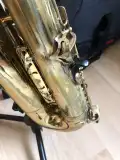
Tech/maintenance Side F# key guard for Selmer Mark VI tenor required

Could you find a photo showing the guard and highlight or crop it to illustrate the part?

All 3 of these purport to be MkVI tenors...

H0045-L44573773.webp

15.-Brecker-Mark-VI-RH-Thumb-Rest-2.webp

79886-body.webp


Dawkes have a similar SA80II (out of stock): Key Guard - Side F# - Selmer Series II Tenor Saxophone

Or try Steve Crow, as I noticed he'd bought parts from Selmer (direct?):

Screenshot 2021-09-10 at 15.27.58.webp

From: Selmer Mark VI | Steve Crow

Otherwise, @Stephen Howard should be able to point you in the right direction?
 
Last edited:
@stitch are you saying you have a spare one?
The one above came from my box of bits. Said box contains a couple of sets of silver-plated MkVI keys + guards (minus soldered ones), along with that lacquer F#. In fact I can't guarantee that it's from a MkVI, or even from Selmer ... nor indeed for a tenor.
So on balance the OP might be better off getting the one from Dawkes.
 
Last edited:
Hi all and thanks for the interest - I wasn't able to respond as I was away until now.

Both stitch and DavidUK have identified the guard in question, and yes, I'm aware Dawkes have one from a SA80III.

Thanks all.
 
I'm not in any way protesting at your comment Colin but it was an awkward solder with only my one pair of hands. I guess if I had stripped the entire bottom half of the horn off it would have helped though time was of the essence and it's on.
What would help would be suggestions as to how I could have made a better job of it.
 
It can be tricky fitting those guards, given that there's really no way to wire them in place.
Here's how I approach it.

Clean the mating surfaces thoroughly. Draw or paint a barrier around the mounting points on the body. A plain pencil will do, or a drop of Tippex - the idea being to limit where the solder can go.
Pre-tin the middle foot and leave it with a small amount of excess solder on it...then, with the aid of a suitable pair of pliers, solder the middle foot to the body...ensuring the side feet are sitting against the body.
Let it set, then solder the side feet - and if necessary, resolder the middle foot.
When applying the solder, always do so from inside the guard.

If you're familiar with the characteristics of your solder you can pre-tin all three feet and do the job in more or less a single pass - but you do have to ensure that all three feet are a close fit to the body beforehand.

There should be no need to strip the bottom end of the horn - just removing the F# key should be enough (and the top F# lever if you feel at all nervous about it).

 
Interesting....... I did pre-tin each of the guard's feet and the mounting points (the F# key was removed prior to this) and then with pliers in one hand holding the guard, the other hand applying the heat to the centre foot. After that had set I then ensured the two remaining feet were soldered. Not easy doing it alone but it worked!
 
Interesting....... I did pre-tin each of the guard's feet and the mounting points (the F# key was removed prior to this) and then with pliers in one hand holding the guard, the other hand applying the heat to the centre foot. After that had set I then ensured the two remaining feet were soldered. Not easy doing it alone but it worked!
That's the way to do it - but maybe less is more 🙂
 
There's a knack to soldering. I had it once. The best tip I got for soft soldering was that the solder is a glue. It only needs a film between the parts and not around them so parts need to be a snug fit
A solder sucker can help with the xs but mind the flame on the plastic end and carry a spare.
I don't like taking a blow torch to my brass tubes. The heat scares me these days.
 
I consider myself pretty good at electrical and plumbing soldering, but soldering parts onto brass instruments seems to be a surprisingly different skill. I refitted a couple of braces to a schalmei a couple of years ago, thinking it would be no problem because I was "good at soldering", but I was never really happy with the look, or the strength, of it however careful I was. I ended up getting it redone properly by a tech (thanks @griff136 🙂 )

The OPs efforts haven't done any damage to anything, so as long as it is physically stuck then no harm done - it can always be tidied up later when the horn is in for a service or whatever.
 

Social

New! Social Feeds

Look out for the navigation icon:

Follow CafeSaxophone

Latest Song of the Month

Trending

Forum statistics

Topics
32,080
Messages
578,777
Members
8,137
Latest member
AdrianoHoma
Back
Top Bottom