Saxophone beginners Session Band App

Sounds like your in a great position.


Leaving the past aside,

... and when you've tried that, what problems do you encounter?
Being so used to being in a band and having a conductor to, well, conduct, I find it hard to know when to come in and out. That’s why a wondered if the TomPlay app might be a solution
 
Assuming you are looking for jazz try Index of Jazz Standards - Learn Jazz Standards which has a load of decent quality playalong backing tracks. Scroll down the page and see if anything takes your fancy.
Actually I am not looking for Jazz, that’s why I think the tutor got the wrong end of the stick so to speak. I actually told him I prefer to play ballads as the slower tempo suited my ageing fingers. Lol.
 
Yes, it's not totally clear what the objective(s) is/are... Possibly one of several miscommunications with the teacher!

I had read this in the previous thread

(Playing the tune as written, right? Not improvise?)
And have some sympathy with (as another late starter). Seems to me: There's a cavern to be crossed between just playing from notes and playing with a backing track, for some of us - and this cavern may seem like a small ditch to many people. Listening has to be good, timing solid, you can't correct errors etc. Even if you can't play entirely from memory, the dots become an aide memoir....

Anyway. Speculation. I hope BigT engages with the question.
Exactly that. Playing the tune as written, reading off the score.
 
Being so used to being in a band and having a conductor to, well, conduct, I find it hard to know when to come in and out. That’s why a wondered if the TomPlay app might be a solution
I'm pretty sure the answer is not in an app, nor is one download more of a silver bullet than another.
Seems to me, folks have a fixed amount of attention capacity and if you put a lot of attention on an app / reading/ fungering notes, one isn't left with enough brain power to pay attention to the backing. A large part of the game is to automate as much about playing, as much as possible, so that one can pay attention to the backing and play with it (not just at the same time).
Scales, arpeggios etc. are part of that - automating finger movements that crop up in tunes often. Training to memorise tunes (as mentioned above) also frees up attention for listening. Being able to "sing" along etc.

Seems to me, anyway.
 
Last edited:
The answer is simple really Karaoke Version and score from music notes..score may need ammending some songs are shorter in K.V. . I'm just doing cry me a river and it's shorter perfectly workable from the score tho..
 
Exactly that. Playing the tune as written, reading off the score.
Actually I am not looking for Jazz, that’s why I think the tutor got the wrong end of the stick so to speak.
Seems like (a) not the right tutor for you (as above) but also not a great teacher if they can't explain that a chord symbol is not an alphabetical code. Or rather they should explain what a chord symbol means before anything else.

Most saxophone teachers (unless classical) tend to teach improvising as well as teaching saxophone. But if so they should actually assess the students needs or wishes and fit in with that.
 
If @BigT wants to play ballads from sheet music with backing tracks then there are lots and lots of books that should be suitable. The sort that has written music (often for saxes in Bb and in Eb as well as concert pitch like flute) and has a CD or downloadable tracks with both the backing track and also a demonstration of how it should sound with a melody instrument playing the written music.

You can play along with the demo track which will help you learn to play in time and in tune for that particular tune. Then moving on to playing with just the backing track should be fairly straightforward.

Depending on the style of ballads you like and the standard of playing, something like these:

Guest Spot: Ballads Playalong For Alto Sax

Play Ballads With A Band By Various - Softcover Audio Online Sheet Music For Alto Saxophone - Buy Print Music HL.400653 | Sheet Music Plus

Good luck

Rhys
 
Being so used to being in a band and having a conductor to, well, conduct, I find it hard to know when to come in and out. That’s why a wondered if the TomPlay app might be a solution
Remember in the band, you had to count rests sometimes? If you can't feel where to come in or feel the ends of 4, 8 or 16 bar phrases, you have to count. So when the recording starts, listen to the bass and drums and start counting. Most jazz tunes will probably have a 4 or 8 bar intro. So count that much, and it should be obvious when to come in. If not, do more listening and sing when you think the tune starts as practice. Listen for when the harmony or melody resolves. That's the end of a section usually. With lots of listening, you'll start to hear the form of the tune and know when each part of the tune starts and ends (intro, verse, chorus, bridge, tag, etc.).

This is more alphabet stuff, but it's also helpful to think of the overall form of tunes where each section is a letter, i.e., AABA, where the A section is played twice (16 bars each, for example), then the B section (bridge), then the A section again. When you can feel where these start and end, you'll always be able to find your way back if you get lost.

If none of the above ever clicks with you, maybe cut your losses and join a band with a director if that's what you need to be able to play.
 
Being so used to being in a band and having a conductor to, well, conduct...
Remember in the band, you had to count rests sometimes?

It seems though that Big T was relying on the conductor. I'm not so sure that is a great idea and would advise anyone to count the bars rests. Partly it is useful thing to do and partly there could well be a conductor one day who either

  • Doesn't give you the luxury of always cueing you (plenty of those)
  • Need sto cue in someone on the other side of the stage at the same time
  • Is a deputy and so may be sight-reading the score and is not superhuman enough to always get the cues right at the same time as reading ahead, turning pages etc.
  • Just wants to play a prank on you
 
Last edited:
The difference between playing in a band and to a backing track is, with a backing track,
you come in at the beginning and play to the end.
You get lots of tries.
Nobody claps.
No funny looks if you're off key.
When you've got it down pat, you can call the tune at your local jam night or sit in, but the band may use a different arrangement.
 
Hi Pete, what he was saying was that at my age my brain couldn’t keep up with reading the music and playing with a backing track. which to me made no sense as I used to play in a competition winning brass band where we read music and played together albeit with a conductor. What he promoted was to take each note from the score and write it as it’s name. So C, D, F, F# etc. When I asked him what the difference was his answer was to memorise the scales and use the app to play with. Hope that explains it a bit better. PS he did say I had great rhythm and tone on the Tenor of which I have no idea if it’s so as i made the big mistake of not recording myself at the beginning.
Can you describe this brass band? In the US, such a band that would have saxophones would be heavily improvisation based with no sheet music or conductor, i.e., like a New Orleans style band. So you'd definitely would have needed the skills to follow the form by ear for your entrances.

Perhaps because of your difficulties reading and playing along, your teacher concluded that you couldn't actually read the notes and needed the letter names?

After re-reading the thread and giving this some more thought, perhaps it's your reading that needs attention first. If the reading part is taking all your attention, so much that you can't listen to others whether they be in a live band or on a recorded backing track, then your reading needs work. Once you can read with little or no thought, then you can concentrate more on playing along with others/recordings. So I suggest getting a fake book or two and reading a lot along with a metronome. Then when that seems effortless, add the backing tracks.
 
What he promoted was to take each note from the score and write it as it’s name. So C, D, F, F# etc. When I asked him what the difference was his answer was to memorise the scales and use the app to play with. Hope that explains it a bit better.
To me that sounds like he doesn't really know what he's talking about, or a very bad teacher. Sorry.

Can you describe this brass band? In the US, such a band that would have saxophones would be heavily improvisation based with no sheet music or conductor,
In the UK a brass band is not like a NOLA band. It is historically a works band like a coal mine, railway or factory might have started off in the industrial revolution, kind of more like a military band (without the clarinets and piccolos) so it would involve reading.

Here you go, I'm sure this sounds familiar

View: https://www.youtube.com/watch?v=eijiQIUcMus


But the term brass band in this case didn't have saxophones, just brass such as cornets, euphoniums, tubas and suchlike.
 
Last edited:
Theres also Karaoke version which is good enough for me. I buy a score in the same key from music notes..and off you go. The good thing with karaoke version is that for £1.99 you can download the MP3 with and without lyrics..I start with the lyrics to try to keep time and move onto the unlyriced backing track..Theres room for improv over the instrumental assuming you want to play the whole song..
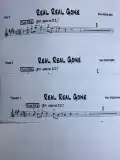
I also use KV. There are other sources as well but KV helped us. The last song I/we did was "Real, Real Gone" (Van Morrison). We had a 3-horn arrangment made as it was heard on KV version. Easy stuff ..... Most of the songs we did were easy.
real.JPG
 
Actually I am not looking for Jazz, that’s why I think the tutor got the wrong end of the stick so to speak. I actually told him I prefer to play ballads as the slower tempo suited my ageing fingers. Lol.
Today, I'm 66, I also play more ballads. When I started to play I just played what I heard. Later I heard things that I didn't heard earlier. I was so concentrated to play the melody. Different scales, chord symbols ..... is important. I often use the pentatonic scale. You can do a lot with just five tones but maybe you want to throw in more tones to make it a little bit more interesting. And you get the other tones from the chord or tones that are not in the chord. When I started to play I wanted to play the music I heard on the radio or Hi-Fi. Back then the sheet music was limited. I had to listen-play-listen-play ...... . If possible, I would probably learned a song as it was written. Reading speed up the learning. And that goes for music theory as well.
 
Remember in the band, you had to count rests sometimes? If you can't feel where to come in or feel the ends of 4, 8 or 16 bar phrases, you have to count. So when the recording starts, listen to the bass and drums and start counting. Most jazz tunes will probably have a 4 or 8 bar intro. So count that much, and it should be obvious when to come in. If not, do more listening and sing when you think the tune starts as practice. Listen for when the harmony or melody resolves. That's the end of a section usually. With lots of listening, you'll start to hear the form of the tune and know when each part of the tune starts and ends (intro, verse, chorus, bridge, tag, etc.).

This is more alphabet stuff, but it's also helpful to think of the overall form of tunes where each section is a letter, i.e., AABA, where the A section is played twice (16 bars each, for example), then the B section (bridge), then the A section again. When you can feel where these start and end, you'll always be able to find your way back if you get lost.

If none of the above ever clicks with you, maybe cut your losses and join a band with a director if that's what you need to be able to play.
Excellent advice. Unfortunately there are no bands like that anywhere near me.
 
To me that sounds like he doesn't really know what he's talking about, or a very bad teacher. Sorry.


In the UK a brass band is not like a NOLA band. It is historically a works band like a coal mine, railway or factory might have started off in the industrial revolution, kind of more like a military band (without the clarinets and piccolos) so it would involve reading.

Here you go, I'm sure this sounds familiar

View: https://www.youtube.com/watch?v=eijiQIUcMus


But the term brass band in this case didn't have saxophones, just brass such as cornets, euphoniums, tubas and suchlike.
Haha, excellent. That brings back happy memories. We used to play that, the monty python signature tune.
Where are all the saxophones?
You don’t get saxophones in traditional uk brass bands. You do get them in military bands though
 

Social

New! Social Feeds

Look out for the navigation icon:

Follow CafeSaxophone

Latest Song of the Month

Trending

Forum statistics

Topics
32,062
Messages
578,399
Members
8,129
Latest member
Bartman
Back
Top Bottom