• New!

    Try our new Social Feeds, look out for the navigation icon: . You can now set default social feed view in your account preferences.

Tech/maintenance Mouthpiece and saxophone tuning mismatch

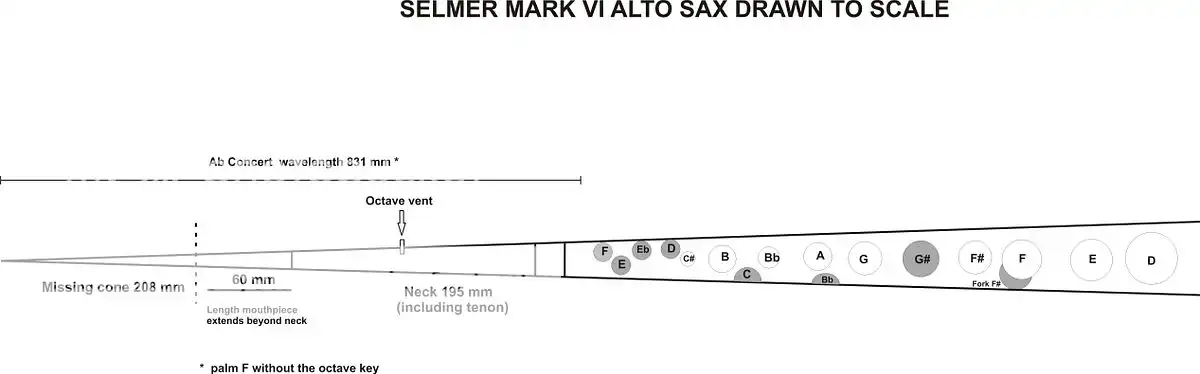
Also given that it's a very acoustically imperfect instrument to the missing cone:

Very true. Bb to C# seem kind of in line with 2-3 overtones. But sound the 3rd overtone of d - my tenors can’t decide between d and e, and there are more funky drifts in there (that partly explain sound and flavour of certain notes).
 
I think it was joke, at least it thought it’s really funny…
Of course Marcel Mule would disagree, but there may be a little truth in there, looking at the inventions of the 20er-50ies. Selmer nailed the layout in 40ies/50ies. Everything else was there before, and maybe more so in the American brands.
As long as we can't see the mark 1, mark 2, mark 3, mark 4 and mark 5 there are reasons to doubt if it's a joke.
 
As long as we can't see the mark 1, mark 2, mark 3, mark 4 and mark 5 there are reasons to doubt if it's a joke.
Well, kinda.

22
26/28
Super
Balanced Action
Super Action

A bit blurry in between, I agree. Still I doubt they’d have taken a competitor’s traditional code number meaning “alto” for a whole series, even if they had copied anything…
 
You’re pointing out something important. Getting your sax in tune with itself always sounds like the ultimate Jedi advice for a balanced intonation. And I also think tuning the Bs is the best way to tune a sax. But the truth is, that this may not really work out for all overtones in a sax that has been tuned in real life conditions (heat, cold, whatever) and - more importantly- it may completely fail for certain sax-mouthpiece combinations and in the hand of an inexperienced player. It doesn’t help, if an advanced beginner dials in a tuning with the sax in tune, but stands out of the section by being 30 ct sharp all the time. In that case I prefer the small tingling pain of the out-of-control middle d with everything else in the range of the others.
You make some good points. One must always adapt to the situation one is in.

That said, if the “advanced beginner” is 30 cents sharp, then that person is maybe not so advanced. Playing in tune with others is an important musical skill. Here’s a newsflash - not everyone is in tune. My experience is that trumpet sections tend to go sharp, especially as a gig wears on, so maybe I have to push in a tiny bit to keep up.

The best way to work on playing in tune is with drone tones, unless you are in a situation where you play with other musicians every day. It’s easier to adapt if your instrument is in tune with itself, in my opinion.

Regarding your Jedi remark, I strongly feel that working on fundamental concepts is important for everyone, and especially important for beginners. I came to saxophone from a clarinet background, and while I had good instruction on that instrument, had none at all on saxophone. As a result, my embouchure was too tight on saxophone. I did eventually learn how to do things correctly, but it was many years later. This in my opinion was a fundamental flaw in my education, and it did hold me back for a while. Learning to produce the best, most coherent and in-tune sound is important - especially at the beginning.

I feel that tone production and intonation are basic concepts that a beginner should work on from the start. So the “tuning to B overtones” trick is valuable even for someone with only a month or two experience. It helps them play properly (“slurring” between B2 and the first harmonic of B1 really helps people focus their air) and clues them in to the fact that listening is probably the most important skill to develop.
 
I have zero intonation issues with a Meyer on my 12M. On the other hand, a small round chamber Vandoren tuned poorly. But you don't have to play one of those dill pickle pieces that feels just like blowing into an old gym sock. Especially now that multiple makers supply MPs with a variety of baffles AND large internal chamber.

There is very considerable latitude in mouthpiece internal volume to get a good-enough saxophone scale; but whether a given horn mates well with a given mouthpiece depends on the MP internal volume that was assumed when the thing was designed.

Of course, most saxophone makers didn't make the stock mouthpieces they supplied with their instruments, and some (Conn for example) supplied three, four, or five different stock pieces over the life of a model.
Well a Meyer Rubber medium or Large chanber is the most common Rx across pretty much ALL vintage horn voicings for intonational 'problems'. There are a few others.

But not ALL pickle-barrels are somehow anachronistic, as you intimated. A lot make perfectly good baritone mouthpieces and they are usually readily available cheap on auction sites etc.

I have a Meyer, I also have a Woodwind Rubber B5 Educator (I think these were distributed by Vito/Leblanc in their final version) I think from the 90's (I believe they discontinued 'em at some point because they tend to get snatched up pretty quickly, used - and I just noticed their used prices have literally doubled since last time I checked like 5-6 years ago, so...).
Basically it is a good repro of the old-school baritone pieces, as are Fobes ones which was mentioned already. It plays really nicely, darker than a Meyer...maybe not enough "bite" in a solo/frontman situation or in a funk or pop horn section, but in a multi-horn combo or big band, it is really sweet.

I cannot say there is much of difference in response or overall tone from a 1930's Conn rubber I have, actually. It feels and plays pretty similar, a bit more brightness maybe.

I have 3 pickle-barrel ebonite/rubber or the like pieces, unlabeled. Two of them are actually killer on most of the Bighorns I refurb here. and they are not tuba-sounding either.
So, the oldies have their place even today.
 
. I came to saxophone from a clarinet background,

I also started on clarinet as a kid, with classical training and real ambitions as a teenager, adopting tenor sax as a side instrument (sounding like clarinet). In the end I took up a completely different profession, became a “hobby sax aficionado” instead and until now spent almost another 30 years learning how to form a proper sax embouchure. 😉

So I agree with everything you wrote, the proper tuning of the instrument, the training with drones to learn adopt pitch, when listening to others, the flexibility to adjust.

Except that I am not sure about the sequence or timing of this proper tuning in education

That said, if the “advanced beginner” is 30 cents sharp, then that person is maybe not so advanced.
Certainly a matter of perspective.
In my perception, a beginner starts with a honk, that maybe quite close to a correct mouthpiece pitch but is totally out of control. Then a slight amount of bite adds the first cultivation to the tone and offers a tool for pitch correction. The muscular strength to hold a “loose embouchure” without biting in contrast takes months or years to develop and comes later, if ever.

I think teachers kind of encourage this, because they encourage the transition to a more musical tone which makes the student ensemble-ready and he or she can control pitch and adopt to the ear.

In my surrounding, many amateurs never left the save haven of a balanced bite. Their instrument is not in tune, but they still learned to intonate decently (while they lack some of the resonance they could have).

I am not a teacher, so I can’t tell if it is successful to start with the best pitch and mouthpiece position from the beginning. I just don’t see it, except in advanced players.
 
Yes but I was specifically wondering about the hypothetical explanation he laid out...that actually the horn and stock mouthpiece match was, once upon a time, designed/intended to result in the best intonational combination.
Again, just an interesting thought.
Thing is, few sax makers also made the stock pieces they shipped in the box; and then one has to ask "which stock piece, anyway?".

Conns came with five or six different stock pieces through the years. I refute the idea that the Conn tenor needs to be played with the dill pickle current in 1920 or so when it's basic acoustics were laid down, with my experience playing Conn tenors with Meyer, Link, Brilhart, Dukoff, Riffault/Woodwind Co., and Selmer Soloist pieces all of which have very different acoustic designs than the "just like blowing into an old gym sock" dill pickles of 1920.
 
JBT's approach to this was what he called "mouthpiece pitch" - the note you play on the mourhpiece alone. This is a tool to help you form the proper embouchure and set your voicing up correctly, and is a common practice among certain saxophone professors. I actually find it to be useless, whereas he thought of it as an important technique, especially for beginners.
I think this may be because it's more akin to classical embouchure and playing higher in the pitch. Biting, to be disrespectful.
 

Similar threads... or are they? Maybe not but they could be worth reading anyway 😀

Trending

Latest Song of the Month

Forum statistics

Topics
32,253
Messages
575,737
Members
8,081
Latest member
DataPath
Back
Top Bottom