Tech/maintenance LH Pinky table C# glitch - is it normal?

mizmar

Eternal early intermediat
Messages
6,137
Location
Trondheim, Norway
Level
Eternal early intermediat
Hi
As mentioned in the thread linked below, i just got a Better[sic]sax.
Now, it's fine; but my previous sax wasn't so up to date so I'm not sure how some things are meant to work.

Here's the post:

But either it's not working or I don't get it.
If I touch the Bb, B or C# keys cleanly it's fine and the widget does nothing.
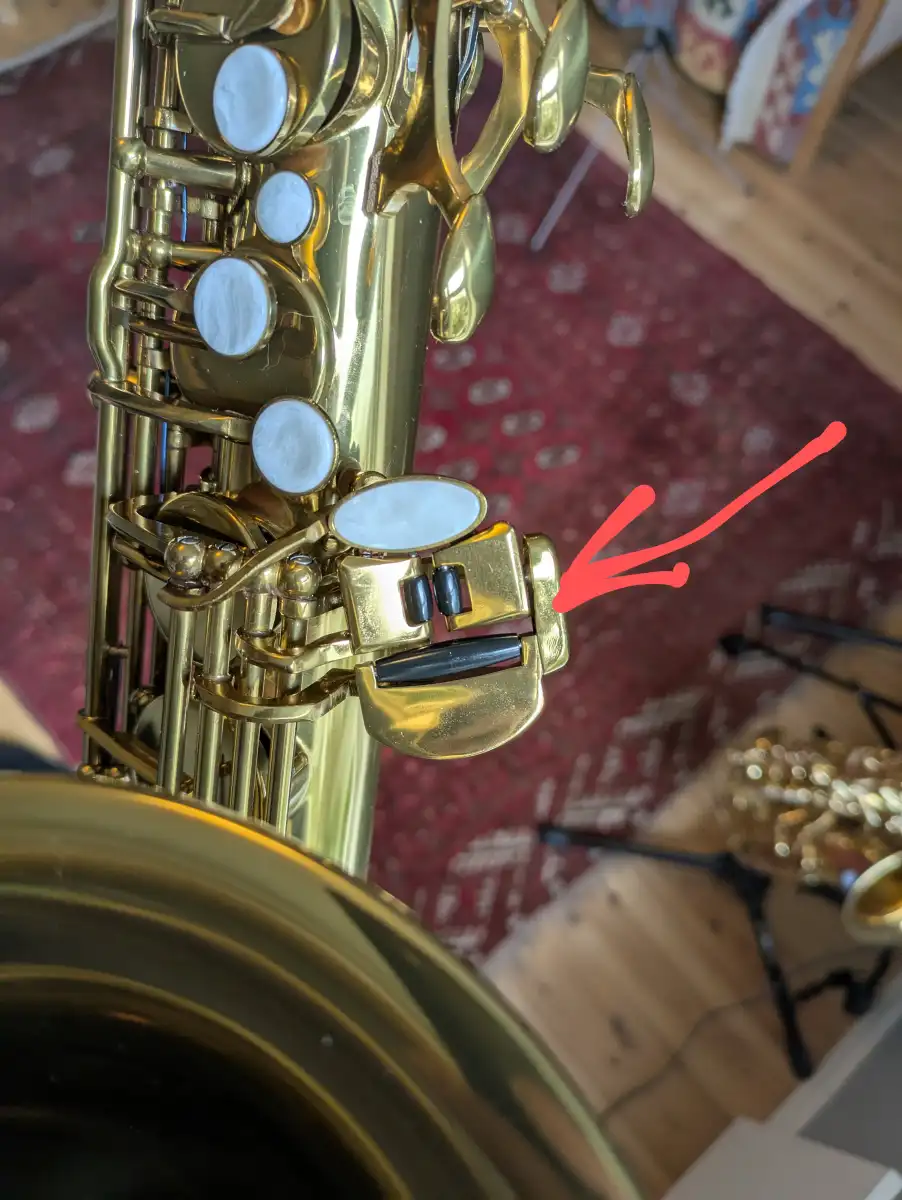
If I touch the linkage bar (red arrow Below) on the pinky table - a nice big target for low Bb - the C# opens a little before being closed by the widget. Which is no good.
I can't see how to fix that. It's got an adjustment screw but any lower and it'd hold the B key open.
Maybe it needs a tec thread when I can take some pictures.

This is the problem key press.
1000000082.webp


And here's the C# glitching (video has; keying Bb, C#, the above "everything")..


Post in thread 'Low B not completely closing with Bb' Tech/maintenance - Low B not completely closing with Bb

Basically, is that Normal?
 
In the software tech support industry we had an acronym for this kind of question. DDT Short for Don’t Do That.

Seriously, that linkage bar was not designed to be pressed directly. So it’s not a defect that you can’t regulate the keys activated by pressing it.

On a side note (Bb or C, your choice!) I have often thought that linkage is a clever solution to a nonexistent problem. I much prefer the pinky tables on my SBA and Beaugnier model 38 altos, neither of which have this linkage. But the market has decided this is the way saxophones should be made, so I deal with it. (I have similar experiences when I vote…)
 
The low B to C# link is one of the most useless gadgets ever fitted to a horn (beaten into second place by the vintage Eb trill).
The principle is fine; when the low B key cup comes down it forces the low C# key cup to close...or prevents it from opening.
Sounds great - but the mechanics of it are such that unless its meticulously designed and built it really doesn't stand much of a chance of working properly. And even a well-built mech will struggle.

There are several issues to contend with, the most major being the amount of flex in the keywork, followed by the amount of play in the keys and then the softness of the pads - which is very closely tied to the flatness of the toneholes. So that's four things (disregarding spring balancing) that have to be dead-nuts on before the mech can do a proper job. And good luck with resolving the first issue.
On some horns you can also run into issues with the bell key table due to binding or iffy geometry.

So when setting up this mech you usually have but two choices; to ensure the low B closes correctly or the low C# remains closed when the tilting table activates the C#. If you opt for the latter you can kiss goodbye to getting the full whack out of the bell notes because you're always going to be blowing through a leak.
Press harder? It's a natural reaction, but pressing harder just flexes the keys more and typically causes the low B pad to rise at the rear. Oh, it won't be by much...but 'by much' is still a leak.

When I'm setting up this mech I give it one chance. It gets sets to do the job it's supposed to do. When if fails (not if) I back the adjustement screw off until the low B closes properly - and that's it; that's the limit of that particular mech in its current condition.
It's perhaps best to think of it as more of a 'better than nothing' solution. If you fumble a low B/Bb and catch the C# touchpiece you'll get a weak bell note...but you'll still get something (unless the mech's setup is particularly bad).
The solution to the problem is, of course - don't fumble the bell notes.

There aren't many workarounds. You can't often disable the mech easily without cutting parts off and soldering others into a fixed position (like they did on the Nexus Select tenor). About the only DIY solution that half works is to remove the buffering from the Bb box or from the C# pin - which adds so much slop (and rattle) to the bell key table that it's largely an impractical solution.
The other workaround is, of course, practice your bell key fingerings until you stop fumbling around.
Or buy a horn with a non-tilting bell key table.

If you like you can think of it as an oversized G# mech, which is prone to exactly the same issues but has the advantage of its smaller scale giving it rather more room for error.
 
Many thanks for the assurance that I hadn't missed something.
Seemed to me, to work as intended it'd need gearing, a pivot point or such!

I set it for a nice B.

I don't think my problem was, especially, fumbling; more than that the point where the C# glitches was a tempting target. Like target fixation on a bike!
 
This is one of the fundamental problems with the Selmer Mark 6 style tilting low Bb mechanism.

If you have long fingers, it's fine; but those with short fingers WILL inadvertently catch that linkage bar and open the C# pad. Thus the helper bar that forces closed the C# pad when the B pad is closed. Of course as Stephen indicates, it all has to be PERFECTLY aligned to work properly and not hold-off the B pad from closing. And with the long skinny gooshy rods used, especially on tenor and baritone, it's basically an impossible adjustment. So B to Bb is always at risk of maving a brief opening of the C# pad which will cause a bobble.

The only real solution is to cut off the C# to Bb tilter link and solder the tilting Bb key into position so it won't tilt. LIke the Balanced Action had.

It's all worse if you're unfortunate enough to have the Mark 7 Selmer, designed for the near 7 foot tall Fred Hemke. I knew one guy - great big guy - who played a Mark 7 tenor - had hands like bunches of bananas - and even he had to have the tilting low Bb disabled.

I think this tilting low Bb key is the single worst feature of Selmer and Selmer-copy horns.
 
Hu!

I've found a scenario where this B-C# thing does something useful!

If I open C# with the joint of my pinky, then close B with rolling the tip - it works, C# closes.... Indeed, like the G# mechanism. So that's an quick C#<->B.

Sliding along that bar does C#<->Bb.
Probably the mechanism makes that a little cleaner.


I'm sure this is obvious to people with grown-up horns, but my old pinky table was both old-fashioned and somewhat "badly regulated".
 
Sure would be easier to play a Conn.

Logical LH table, laid out in accordance with the actual anatomy of the human hand not a theory, short stiff positive action, and all note combinations are available while requiring the minimum amount of little finger action in its weakest directions - instead making use of the limited strength of the little finger as efficiently as possible.

Of if you've just got to have a Selmer, consider the Super.
 
Sorry, yes, I see now what the horn in question is.

That, like pretty much every saxophone made today, is a copy of the Selmer Super Action 80, which is itself a copy of the Mark 6 Selmer.
 

Social

New! Social Feeds

Look out for the navigation icon:

Follow CafeSaxophone

Latest Song of the Month

Trending

Forum statistics

Topics
32,060
Messages
578,362
Members
8,128
Latest member
Roger Atlas
Back
Top Bottom