Tech/maintenance How Feasible Is It To Add A Front F To A Sax Without One

Jazz Is All

Member
Messages
861
Location
Barcelona, Spain
I see earlier Martin Handcrafts for sale that look great, are in tip-top shape, and cheaper because they go begging due to the lack of a Front F. I certainly steer clear of them as well, but now I've read that it's possible for a good tech to add a Front F. How feasible is that really and how much work is involved in it, and more importantly much would it run in monetary terms? Is it a cost-effective thing to do to get a HC with a front F or is it always better to get one that has one that was factory installed?
 
I’m guessing it would be less expensive to buy one already equipped. I just took some pictures for the thread. This is not a $100 fix. But then again I think too much.
0D6A8E5E-2D27-4B6E-893F-7923FF83D2B7.webp
C3798F61-55B2-4896-8FAD-08EDBBF54ED7.webp
49C0504D-99DC-48C1-82FA-A37261520681.webp
 
I don't think you'd need to go down the route of adding a touchpiece key with an intermediary lever - it would be a lot cheaper to add a standalone key such as that seen on many modern horns (such as the Yamaha 62).
I think JBT posted some shots recently of just such mods he'd done.
 
How feasible is that really and how much work is involved in it, and more importantly much would it run in monetary terms?
My Martin baritone had such a mod. It was obviously cannibalised from some other horn and was quite ugly, but I’m sure could have been done in an hour maybe. But as Stephen said to make it look like is part of the original would be a whole different kettle of fish.
 
I’m guessing it would be less expensive to buy one already equipped. I just took some pictures for the thread. This is not a $100 fix. But then again I think too much.
View attachment 17573View attachment 17574View attachment 17575
That looks excellent and not something an ordinary player buying it would know was not original unless they were hip to the details available on the Martin Story regarding the SNs and which did and didn't have one.

Then the question is how much that ran you to have done, eh? Wink wink nod nod, know what I mean?
 
My Martin baritone had such a mod. It was obviously cannibalised from some other horn and was quite ugly, but I’m sure could have been done in an hour maybe. But as Stephen said to make it look like is part of the original would be a whole different kettle of fish.
Well I like a good bouillabaisse, but one with all the bones and scales left on the fish is a dogfish of a different collar.
 
Okay, tell me the approximate damages for doing that, if you can please. Is it equal to the difference in price between a HC without one and one with to make doing it moot?
I have no idea, to be honest. Just going off the top of my head I'm sure it would cost more than the difference between a model with and one without.
The price for Rhys's bari job (should he wish to reveal it) would probably be a good starting point.
 
The price for Rhys's bari job (should he wish to reveal it) would probably be a good starting point.

The work was done back in 2012 and I had three separate modifications done:
  • Bis Bb moved £65
  • Selmer-style large plastic left thumb button (to replace small pearl) £45
  • Construct and fit new front F £150
  • Plus cost to silver plate the modified Bis and front F £70
Hope that helps.

Rhys
 
There are two ways to do it, as has already been illustrated here. One is to use a "Yamaha-style" see-saw rocker, which is the simpler mechanism that consists solely of the F keytouch/arm and it's saddle. This is what Pete's shows.

(BTW Yamaha hardly 'invented' this detail, I have come across it on some very old saxes, as in '30's horns - so they resuscitated the mechanism).

Providing there is space to do it, this would be a cheap mod. $100-125 or so. (With due respect to Pete's Baritone...ummmm....more often than not such a mod will end up looking a bit...sexier.... than his photo, there).

The other option would be to do the mod where the touch and rocker are 2 separate pieces, as your initial OP photo shows. So 3 pieces involved here: touch, rocker, and the posts (oops, that's 4, probably). The touch needs to be 'cut in' to the upper stack (IOW a piece of barrel of ONE stack key needs to be cut away. THIS means the stack keys of the C and B have to be designed/arranged in such a way that this can be DONE while maintaining the integrity of the existing two keys (NOT always possible, but oftentimes possible).

I have done this method as well, using cadaver parts. Very possible (again if the existing mechanism allows for it), but more time-consuming as one would imagine.
... so that one might be around $200, perhaps a bit more depending on the tech.

Is that the difference between a model with or without one ?
It may or may not be, depending.

If, for example, the model sans the Front F was a really NICE specimen...aside from the absence of that alt key....then I would say $120-200 would NOT exceed the difference...because you have found a really NICE specimen of the model sans the key.

Finding an equally cherry specimen with the alt key?
Might not be so easy, and if you did ...nobody can say it would be offered for under the $200.

 
Some techs like the challenge of fabricating a key for a sax that doesn't have one, myself included. A big part of which design to choose is how much space is available. This photo shows a front F I installed on a curved Buescher soprano. If I remember correctly, I salvaged the "saddle" for the key to pivot on from a scrap neck. This was a bit of a challenge since the front F key required an additional arm extended from the pearl to close the B.

1615141460813.jpeg


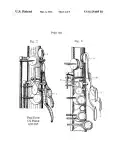
Some may think the front F to be a more recent addition to the saxophone. This patent by Paul Evette was approved in 1899. Interestingly, he conceive of both designs that are commonly used today.
1615142375700.jpeg
 

Attachments

  • 1615142355951.webp
    1615142355951.webp
    61.3 KB · : 324
Last edited:
Some may think the front F to be a more recent addition to the saxophone. This patent by Paul Evette was approved in 1899. Interestingly, he conceive of both designs that are commonly used today.
Nice work, JBT.

Yes that IS interesting, both that the patent is so old AND that he worked out BOTH styles of mechanism.
Equally curious: the dotted line in figure 1, which appears to show a sub-option of having the front F touch connect directly to its own keycup, as opposed to linking to the palm F.
 
If memory serves the Conn baritone has the entire front F mechanism separate from the top stack, so it's easy to add. I think it would be very difficult to shoehorn the keytouch key into the top stack of a horn that didn't have it, so in that case the up and down key might be the thing to do.
 

Social

New! Social Feeds

Look out for the navigation icon:

Follow CafeSaxophone

Latest Song of the Month

Trending

Forum statistics

Topics
32,081
Messages
578,808
Members
8,139
Latest member
Gary Boudreau2
Back
Top Bottom