Theory & Impro Harmonics, partials, overtones & fundamentals

Last edited by a moderator:
Look at post #43. The string whether it is vibrating in 2, 3, or 4 segments creating harmonics is still the same length. The frequency of the note C1 is still present when one of the upper harmonics becomes the predominant sound that we hear in the same way all of the harmonics are present when C1 sounds even though our ear can't pick out each frequency independently. The relative strengths of those "unheard" harmonics give color or "timbre" to the sound.
I'm not a great player, but I can play G2 with or without the octave key and they sound quite similar. You seem to be suggesting that in the latter case, G2 is not the fundamental but a harmonic of an unheard, but still present G1. I respectfully disagree.

In both cases G2 is the strongest, and therefore fundamental frequency. A harmonic created by a fundamental cannot be stronger (possess more energy) than the fundamental itself. If it could, it would be possible to violate the laws of thermodynamics and build a perpetual motion machine.

Similarly, I can also play G1 with or without the octave key, and in both cases G1 is the fundamental.

When you play G2 on a saxophone then it is an overtone, not the fundamental.
Whether or not you press the octave key makes no difference.
 
When you play G2 on a saxophone then it is an overtone, not the fundamental.
Why?

I'm sure many on this list can voice a mouthpiece up/down over an octave. Which one of the notes is the fundamental?

I suggest that the fundamental is the predominate frequency at which the reed is vibrating. All others are multiples of that frequency and can be no stronger than the fundamental. So if the predominate frequency of the reed sounding a sax is G2 then, then G2 is the fundamental.
 
I'm not a great player, but I can play G2 with or without the octave key and they sound quite similar. You seem to be suggesting that in the latter case, G2 is not the fundamental but a harmonic of an unheard, but still present G1. I respectfully disagree.

In both cases G2 is the strongest, and therefore fundamental frequency. A harmonic created by a fundamental cannot be stronger (possess more energy) than the fundamental itself. If it could, it would be possible to violate the laws of thermodynamics and build a perpetual motion machine.

Similarly, I can also play G1 with or without the octave key, and in both cases G1 is the fundamental.
There is no point in discussing this topic any further. I have tried my best to share what I have learned about musical instrument acoustics from many years of reading and research. If anyone has any interest in learning more about the subject, Benade's "Horns Strings and Harmony" and "Fundamentals of Musical Acoustics" are good places to start.
 
Last edited:
Why?

I'm sure many on this list can voice a mouthpiece up/down over an octave. Which one of the notes is the fundamental?

I suggest that the fundamental is the predominate frequency at which the reed is vibrating. All others are multiples of that frequency and can be no stronger than the fundamental. So if the predominate frequency of the reed sounding a sax is G2 then, then G2 is the fundamental.
It is the acoustic length of the instrument that determines the fundamental. The octave vents are just “helpers” to make it easier to sound the 1st overtone. (On more traditional instruments like the baroque oboe or hautboy, this innovation is absent, and it is completely up to the player to play G1 or G2 with the same fingering.)
 
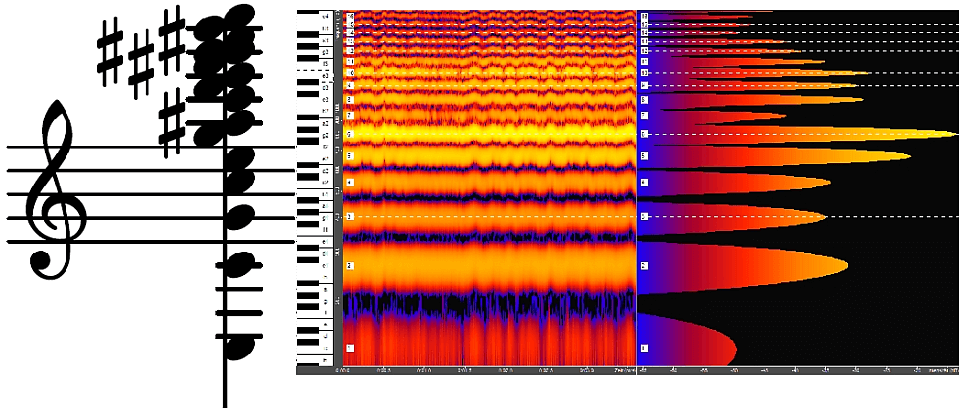
So... since 'a little picture is worth more than a 1000 words', I took my alto sax and the first frequency analyzer I could find (Sonic Visualiser), and played a few notes.

First I fingered and played C1 (Low C alto sax, so Eb concert), then with no change in fingering I sounded G2 (Alto Sax) and C2 (Alto Sax).
In the following picture, you have the spectrum (laid vertically) of these 3 notes in that order (C1, G2 - harmonic, C2-harmonic respectively from left to right).
harmonics_C1G2C2.png

In the left column (C1 as fundamental), all harmonics of C1 are visible, in particular C2 and G2.

In the right column, where I tried to sound the first harmonic (C2) corresponding to the C1 fingering, C2 is there, but not G2.
So, I didn't just 'filter out' the low frequency of C1 from the left column, I actually filtered all the odd numbered harmonics from the harmonic series of the C1 note !
In other words : I moved the fundamental from C1, to C2. (**)

After that, I also tried the analysis of C2 and G2 with their correct respective fingering, only to find similar spectra as the ones on the image.

Which means the sax works as @Admitone was saying... (and I am the first to be surprised by this result !)

Edit: (**) However in the right column, C2 is the fundamental but is not the strongest component of the note (blue is 'weaker' than yellow), so the fundamental is not always the strongest contribution to a note...

 
Last edited:
A fascinating statement that is found on p.442 of Benade's FMA describes when the (saxophone) is played pianissimo there are virtually no harmonics present in the tone beyond the fundamental (similar to a "sine wave"). Then for every doubling in the amplitude of the fundamental harmonic 2 increases by a factor of 2² , similarly harmonic 3 will grow by a factor of 23 and so on.
Once the blowing pressure has raised to the point that the reed is blown entirely closed for a portion of each cycle of its oscillation [called "beating"] the player notices a change of "feel", the listener notices a change of tone, and the higher partials tend to grow in a way that parallels the growth of the fundamental.
 
As this thread is now 4 pages long, I feel it's time I sacrificed myself by standing up and stating

'If there is anyone else out there reading this thread who understands absolutely nothing about what is being discussed and how it might affect your Sax playing, please know you are not alone...'

Please carry on.. just needed to get that off my chest 😵
 
A fascinating statement that is found on p.442 of Benade's FMA describes when the (saxophone) is played pianissimo there are virtually no harmonics present in the tone beyond the fundamental (similar to a "sine wave"). Then for every doubling in the amplitude of the fundamental harmonic 2 increases by a factor of 2² , similarly harmonic 3 will grow by a factor of 23 and so on.
Once the blowing pressure has raised to the point that the reed is blown entirely closed for a portion of each cycle of its oscillation [called "beating"] the player notices a change of "feel", the listener notices a change of tone, and the higher partials tend to grow in a way that parallels the growth of the fundamental.
So that would explain why increasing volume corresponds to an increase of brightness in sound, right ? (to the point where it could actually be used to define those terms: 'dark' and 'bright' ?)

As this thread is now 4 pages long, I feel it's time I sacrificed myself by standing up and stating

'If there is anyone else out there reading this thread who understands absolutely nothing about what is being discussed and how it might affect your Sax playing, please know you are not alone...'

Please carry on.. just needed to get that off my chest 😵
That will probably not change anything about how people play the sax, but that was a fun question. Or maybe I'm just weird...
 
As this thread is now 4 pages long, I feel it's time I sacrificed myself by standing up and stating

'If there is anyone else out there reading this thread who understands absolutely nothing about what is being discussed and how it might affect your Sax playing, please know you are not alone...'

Please carry on.. just needed to get that off my chest 😵
With ya brother.
 
That will probably not change anything about how people play the sax, but that was a fun question. Or maybe I'm just weird...

I would not want to ruin anyone else's enjoyment of the subject. However, I'm getting flashbacks of all those times at School I sat there thinking "I have no idea what the hell is going on here. Is it just me?!"
😛
 
would not want to ruin anyone else's enjoyment of the subject. However, I'm getting flashbacks of all those times at School I sat there thinking "I have no idea what the hell is going on here. Is it just me?!"
As I see it, you have two options in that situation:
  1. You don't care that you have no idea. Stop reading.
  2. You do care. Look it up and learn something about it. Easy to do these days, especially if you're already in front of a computer.
In my experience, option 2 is usually more fun, if you have the time.

There are actually more options, one of which was to do what I did 😉 I've read through the thread a few times and no, can't grasp it at all. I just wanted to state that for the benefit of anyone else who was entirely bewildered. 🙂
 
So... since 'a little picture is worth more than a 1000 words', I took my alto sax and the first frequency analyzer I could find (Sonic Visualiser), and played a few notes.

First I fingered and played C1 (Low C alto sax, so Eb concert), then with no change in fingering I sounded G2 (Alto Sax) and C2 (Alto Sax).
In the following picture, you have the spectrum (laid vertically) of these 3 notes in that order (C1, G2 - harmonic, C2-harmonic respectively from left to right).
View attachment 14107
In the left column (C1 as fundamental), all harmonics of C1 are visible, in particular C2 and G2.

In the right column, where I tried to sound the first harmonic (C2) corresponding to the C1 fingering, C2 is there, but not G2.
So, I didn't just 'filter out' the low frequency of C1 from the left column, I actually filtered all the odd numbered harmonics from the harmonic series of the C1 note !
In other words : I moved the fundamental from C1, to C2. (**)

After that, I also tried the analysis of C2 and G2 with their correct respective fingering, only to find similar spectra as the ones on the image.

Which means the sax works as @Admitone was saying... (and I am the first to be surprised by this result !)

Edit: (**) However in the right column, C2 is the fundamental but is not the strongest component of the note (blue is 'weaker' than yellow), so the fundamental is not always the strongest contribution to a note...


I was surprised by this, so I just did the same experiment using a different spectrum analyser (Overtone Analyser on Mac)
It gives the same result as @Hipparion
I fingered bottom C1 and then played the first two overtones (C2 and G2) without moving my fingers.
when I played C1, all the harmonics were present,
when I played C2, only the even harmonics of C1 were present
when I played G2, only every 3rd harmonic of C1 was present.

Wikipedia defines "fundamental" as follows:
The fundamental frequency, often referred to simply as the fundamental, is defined as the lowest frequency of a periodic waveform. In music, the fundamental is the musical pitch of a note that is perceived as the lowest partial present. In terms of a superposition of sinusoids, the fundamental frequency is the lowest frequency sinusoidal in the sum.

So I have changed my mind - when we blow an "overtone", the "fundamental" note does change.
 
Last edited:

Similar threads... or are they? Maybe not but they could be worth reading anyway 😀

Social

New! Social Feeds

Look out for the navigation icon:

Follow CafeSaxophone

Latest Song of the Month

Trending

Forum statistics

Topics
32,085
Messages
579,000
Members
8,140
Latest member
Alisanna
Back
Top Bottom