Theory & Impro Harmonics, partials, overtones & fundamentals

The fundamental is the lowest note that a given length of tube will support, regardless of what note your actually playing. If I'm fingering a C1 then that is the fundamental no matter what screamingly high harmonic is coming out.

That’s what I thought too, but it’s not how Wikipedia defines fundamental.
Maybe the word fundamental is used in two ways:
1. The lowest note that a tube will support
2. The lowest frequency in a tone
 
From following information presented in this discussion I now accept the following statements to be true:
1. The harmonics present in the note C2 played with C1's fingering are whole number multiples of C2's frequency which suggests that C2 has become its own "fundamental".​
​
2. When C2 played with C1's fingering is "overblown" to the next higher overtone it is not the next overtone in C2's harmonic series C3, but instead it is the next overtone in C1's harmonic series G2. Herein lies the conundrum.​
​
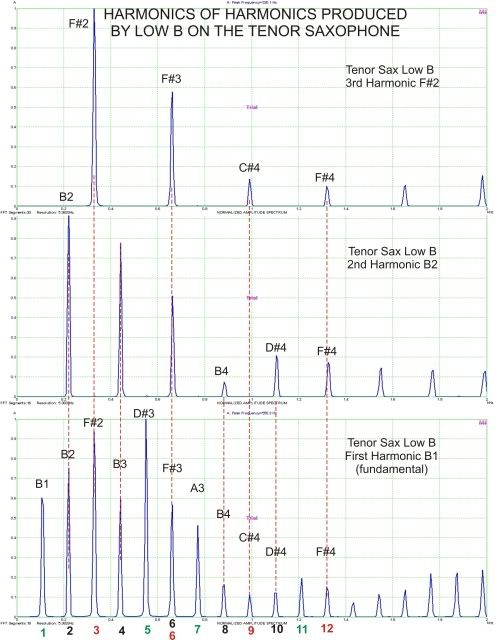
To confuse matters even further I have found a spectrograph I produced as part of the earlier discussion on SOTW that seems to reinforce the view I have been arguing against.

B1test.jpg
 
Last edited by a moderator:
What I find interesting is that the 2, 3, 4, 5 multiples of the frequency of C2 in its harmonic series are identical to the even numbered harmonics of the frequency of C1. There may be a mathematical explanation for this that is beyond my mathematical abilities. Perhaps one of our members who are mathematicians can offer an explanation.
 
The most interesting thing about the harmonic series, a phenomenon of physics, waves and math, is that the human acceptance of what is consonance follows it, and has done since music has existed. If you think about it, Octaves and fifths are most common in early western music. Thirds came in later and then upper ones like 7, 9, +11, 13. The more consonant, the less notes from upper harmonics. This is also true of rhythm. The relation between the harmonics,
1:1, 2:1, 3:2, 4:3 etc are paralleled in rhythms which are more complex when the ratio is more complex. We easily hear 2:1, 3:2, and 4:3 rhythms. With work you can hear and play 5:3, 5:4, and 7:4. (Note the ratios create the interference patterns we call rhythmic figures. 5:5 is 5 beats on 4, NOT 5/4 time. You can work out the rhythmic patterns on graph paper, then write out the drum pattern.

Long story short, humans perceive and enjoy simple ratios. Perhaps the most popular music is that which makes the relationships obvious to the subconscious.

The evolution of this discussion (roadmap with links):

What are the exact names of notes on all saxophones?

What are fundamentals and harmonics?

How are harmonics, rhythm and math and physics related to art?
 
What I find interesting is that the 2, 3, 4, 5 multiples of the frequency of C2 in its harmonic series are identical to the even numbered harmonics of the frequency of C1. There may be a mathematical explanation for this that is beyond my mathematical abilities. Perhaps one of our members who are mathematicians can offer an explanation.
Pretty simple, really. They're just multiples of twice the original frequency. Same thing as even multiples of the original.
 
Wow! Accord seems to have broken out. That's not like us! >:)

Looking at how the word "fundamental" is used in tutorials about acoustics on the net, there does seem to be a confusion about whether it is a property of a tone generator (pipe or string) or of the tone itself. There are lots of references to the fundamental frequency of a pipe (i.e. of a tone generator) whereas the Wikipedia definition of "fundamental" applies to the tone, not the device that produces it. Hence our own confusion I think.
I’m over it. Whatever it is.
 
I'm very happy to disagree. Just let me know what it is I'm disagreeing with. 😛
Yeah. Me too. I became Homer Simpson on several posts that I tried to read:

The fundamental is fundamental to the fundamental note even when the fundamental fundamental might not be present - it is. Blah Blah Blah....
 
The "fundamental" has not changed. The length of the tube stays the same with the same fingering. When you change the "voicing" to make C1 vibrate in its second mode, C2 is the 2nd harmonic.

If C2 became the "new" fundamental, voicing it to a higher overtone (with the same fingering) would produce C3 which it does not. Instead it produces G2 the third harmonic of C1. Years ago I asked a related question on SOTW which was "do harmonics have harmonics"? The answer is no. 😉


You are confusing sounds with modes of vibration of the air column. The sound of C2 has a fundamental of C2 but the air column is vibrating in mode 2.

A fourier transform of the C2 note will show a harmonic series starting at C2 i.e it will not contain G2 or E3 etc. like the C1 note does. If it did it would sound like C1 due to the missing fundamental effect.
 
What I find interesting is that the 2, 3, 4, 5 multiples of the frequency of C2 in its harmonic series are identical to the even numbered harmonics of the frequency of C1. There may be a mathematical explanation for this that is beyond my mathematical abilities. Perhaps one of our members who are mathematicians can offer an explanation.
The harmonics of C2 are:
harmonic_C2 = C2 x n, where n is an integer.

But:
C2 = C1 x 2.

Therefore:
harmonic_C2 = (C1 x 2) x n.

C2 harmonics are simply a subset of and fully contained by those of C1.
You are confusing sounds with modes of vibration of the air column. The sound of C2 has a fundamental of C2 but the air column is vibrating in mode 2.

A fourier transform of the C2 note will show a harmonic series starting at C2 i.e it will not contain G2 or E3 etc. like the C1 note does. If it did it would sound like C1 due to the missing fundamental effect.
And yet there are subharmonics, or are there?
 
I said I would report back with Joe Wolf's response so here it is:

Gday John,

I don’t want to get involved in what is already a long thread, but I note that someone has quoted Art Benade’s excellent and authoritative text, which is pretty clear.

The issue has complications, however, and I also have some notes at

How harmonic are harmonics?

which might be helpful.

Best

Joe
 

Similar threads... or are they? Maybe not but they could be worth reading anyway 😀

Social

New! Social Feeds

Look out for the navigation icon:

Follow CafeSaxophone

Latest Song of the Month

Trending

Forum statistics

Topics
32,085
Messages
578,988
Members
8,140
Latest member
Alisanna
Back
Top Bottom