



 (bottom of page)


JayeNM
Well-Known Member
- Messages
- 3,871
- Location
- New Mexico, US
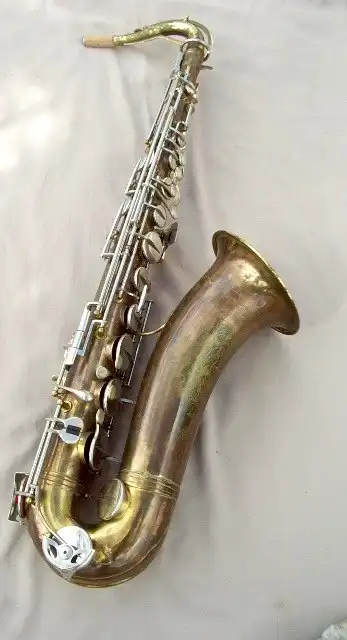
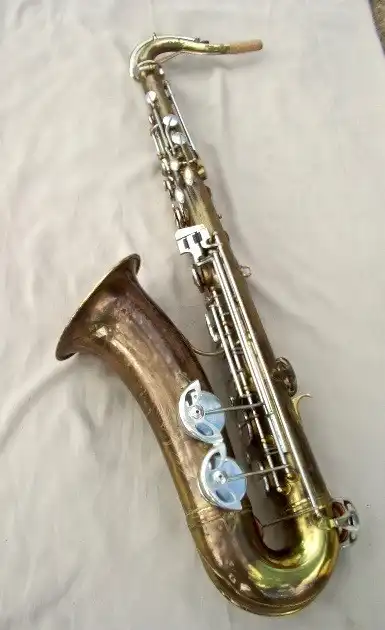
Just finished up a full refurb on this instrument, and am posting more for posterity than anything else (although if anyone has ever come across one, please chime in).
This is a horn made by Desidera, Verona Italy....a company which, per this article, was active from the 1940's, almost shut down in the late 60's, but then was purchased and survived into the 70's: http://woodwindshelp.weebly.com/uploads/2/3/7/9/23791000/italy_sax.pdf
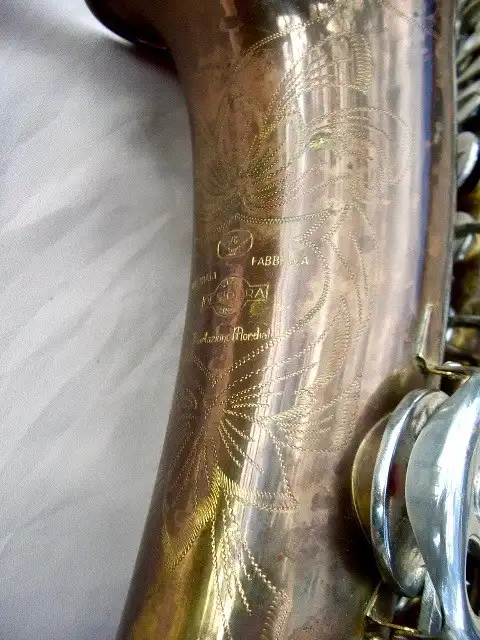
These are horns which I have seen from time to time, most of them being equipped with stencil names, thus making their identification rather difficult since a) there are few to begin with and b) the only real graphic clue is their logo, which is a very small stamped triangle with a D inside of it, usually found in the serial number area.
I have seen some Gretsch stenciled horns were actually made by Desidera. These are sometimes mistaken, visually, for Beaugniers...which upon close inspection, they only bear a superficial resemblance to in some details. This one, interestingly, is actually engraved Desidera on the bell.
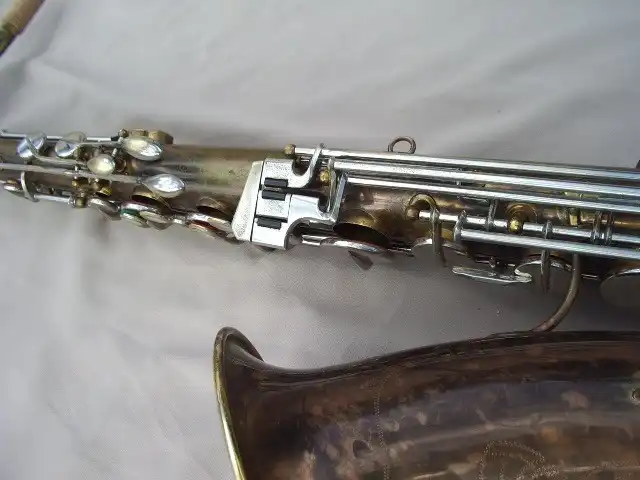
Anyways, a pictorial for y'all.
My impressions: Good, solidly built horn. Body metal gauge is substantial. Typical vintage mechanisms but ergonomically well-done. Key action is fairly responsive, no strange reaches. Body has drawn toneholes. Keywork is well-cast and relatively heavy. Standard keywork compliment, keyed up to high F. Includes a G# trill key, no other auxiliary keys which are sometimes found on old Italians.
Pretty free-blowing, just a hint of some resistance which is something many players prefer. Intonation is pretty good, nothing gets wonky up or down the registers; like many a vintage horn , it does have some 'flex' in this dept but is really relatively straight-arrow.
Not particularly mouthpiece-picky. I used a Yama 5C, a Selmer , France scroll shank, a Link Rubber, and a Meyer 6 to playtest...and intonation was quite decent on all.
Only two things which I would consider unusual is the octave key itself is hella heavy, and in order to get the octave mechanisms working in sync it takes a bit of attention on the spring and regulation material adjustments. Also, the bell key springs/spring holes were a bit undersized (too light, too small a spring needle diameter given the weight of the keys).
In a nutshell, a pretty good vintage horn.
My surprise here was that the horn is brighter than I expected; old Orsi, Santoni, Borgani, Rampone horns tend to be more focused than their American or German counterparts while also retaining a slightly 'mellow' and smooth tonality. This Desi shares the focus, but actually blows 'edgier' and 'reedier'...certainly not to the degree of a contemporary asian horn, but notably so for a vintage horn of at least 50 years old.
This is a horn made by Desidera, Verona Italy....a company which, per this article, was active from the 1940's, almost shut down in the late 60's, but then was purchased and survived into the 70's: http://woodwindshelp.weebly.com/uploads/2/3/7/9/23791000/italy_sax.pdf
These are horns which I have seen from time to time, most of them being equipped with stencil names, thus making their identification rather difficult since a) there are few to begin with and b) the only real graphic clue is their logo, which is a very small stamped triangle with a D inside of it, usually found in the serial number area.
I have seen some Gretsch stenciled horns were actually made by Desidera. These are sometimes mistaken, visually, for Beaugniers...which upon close inspection, they only bear a superficial resemblance to in some details. This one, interestingly, is actually engraved Desidera on the bell.
Anyways, a pictorial for y'all.
My impressions: Good, solidly built horn. Body metal gauge is substantial. Typical vintage mechanisms but ergonomically well-done. Key action is fairly responsive, no strange reaches. Body has drawn toneholes. Keywork is well-cast and relatively heavy. Standard keywork compliment, keyed up to high F. Includes a G# trill key, no other auxiliary keys which are sometimes found on old Italians.
Pretty free-blowing, just a hint of some resistance which is something many players prefer. Intonation is pretty good, nothing gets wonky up or down the registers; like many a vintage horn , it does have some 'flex' in this dept but is really relatively straight-arrow.
Not particularly mouthpiece-picky. I used a Yama 5C, a Selmer , France scroll shank, a Link Rubber, and a Meyer 6 to playtest...and intonation was quite decent on all.
Only two things which I would consider unusual is the octave key itself is hella heavy, and in order to get the octave mechanisms working in sync it takes a bit of attention on the spring and regulation material adjustments. Also, the bell key springs/spring holes were a bit undersized (too light, too small a spring needle diameter given the weight of the keys).
In a nutshell, a pretty good vintage horn.
My surprise here was that the horn is brighter than I expected; old Orsi, Santoni, Borgani, Rampone horns tend to be more focused than their American or German counterparts while also retaining a slightly 'mellow' and smooth tonality. This Desi shares the focus, but actually blows 'edgier' and 'reedier'...certainly not to the degree of a contemporary asian horn, but notably so for a vintage horn of at least 50 years old.
Last edited:


 Glad you are still enjoying her....


