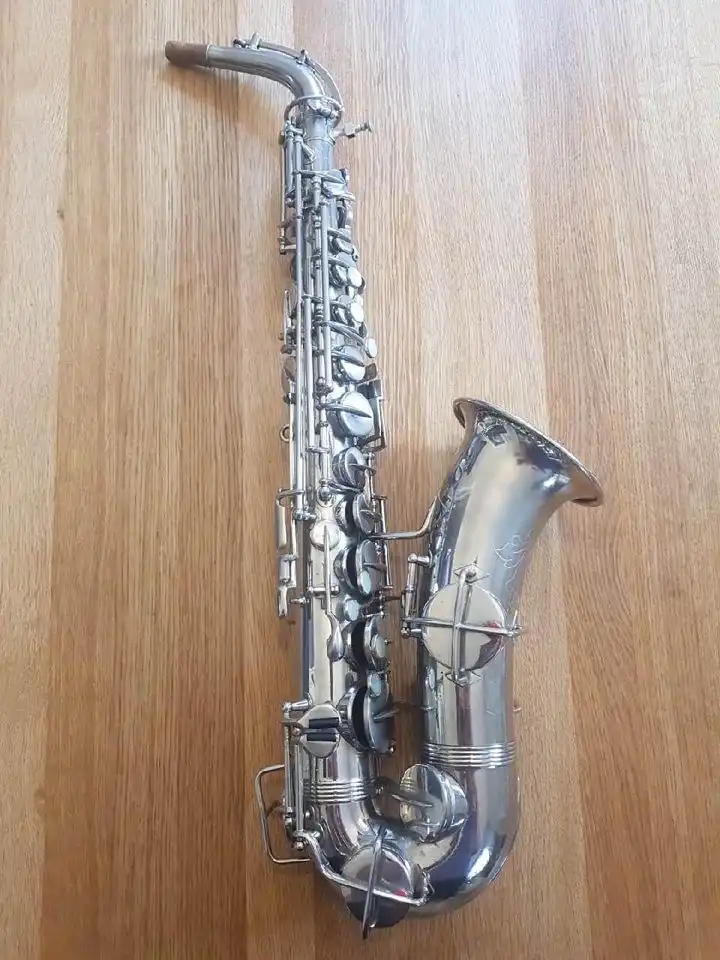
Saxophones David's interesting finds - a real Loud Martin Handcraft

DavidUK

Well-Known Member
Messages
8,133
Location
Near Evesham, Worcestershire
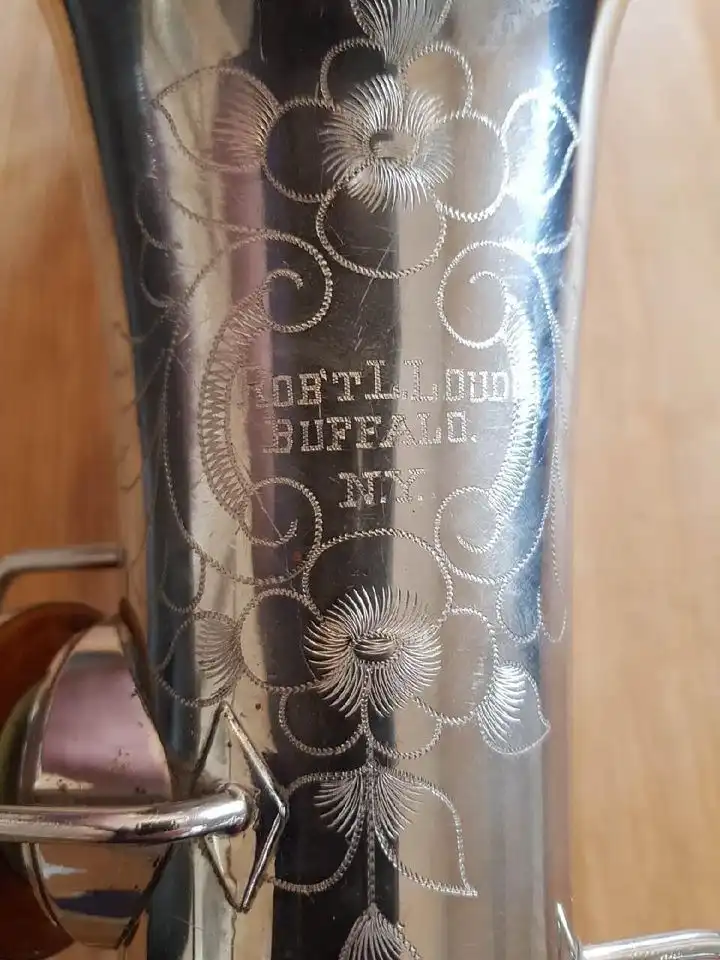
Not seen one of these before. A Martin Handcraft stencilled for Rob't L Loud of Buffalo N.Y.

Seems he was more into pianos: Loud, Robert - Antique Piano Shop
218763594_4334696236586605_1237292729215852634_n.webp

221863829_4179705445448910_7432582235636059444_n.webp

218839455_4524030610955022_5266009827693095433_n.webp


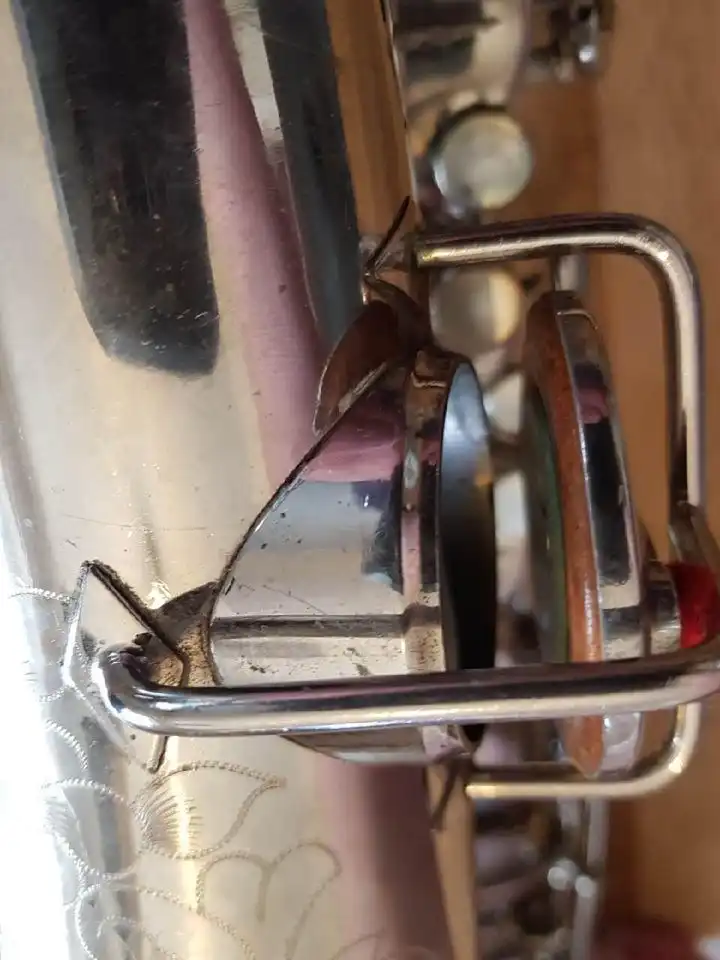
Checking it is a Handcraft via The Martin Story - Martin Handcraft saxophones I was led to Steve Howard's review Martin Handcraft Orginal alto sax review and within that perhaps an explanation as to why the key on the left in the photo below is glued shut...
218472801_4284733778275788_5253851053105991986_n.webp


Looks rather nice, although the shiny pads make me think it needs more work than the seemingly knowledgeable seller is admitting to. Always tempted by something unusual, I have to remember each time that in our world "rare" often means unsaleable and so it's one for the collectors. Priced at £450 I think that would be fair if it was in tip-top playing condition as a Martin badged Handcraft would perhaps sell for £600+. However, it could be some time until such a collector spots it.

If you're interested, the ad is here: Log in or sign up to view

NB. I have no connection with the seller whatsoever.
 
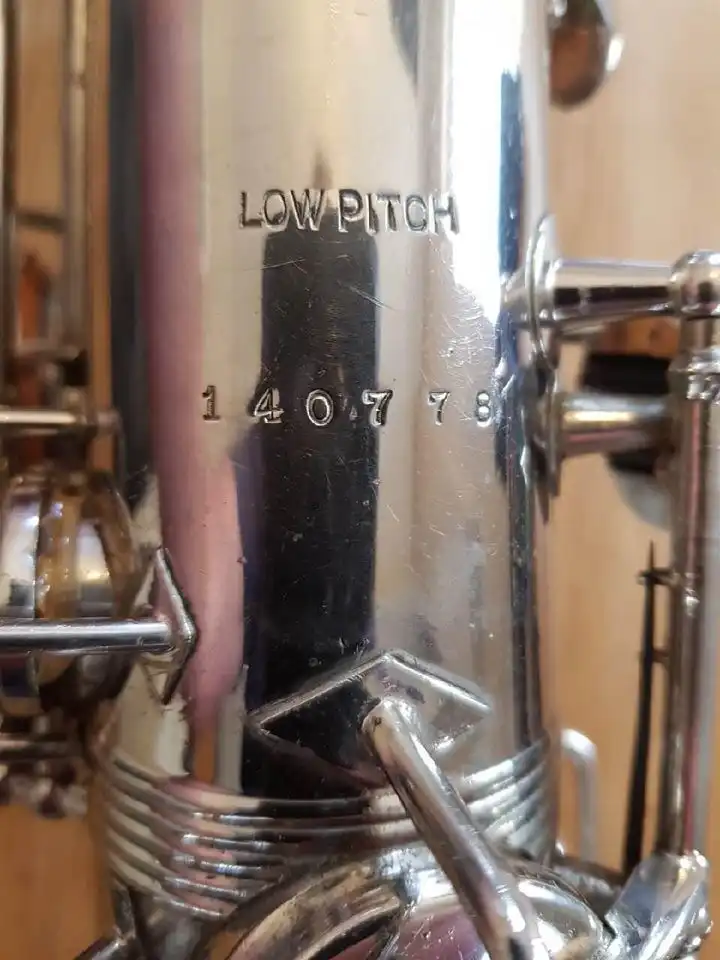
Thank you for posting. That's a late Martin Handcraft. A sax made in 1941. Martin made Comm II and the Handcraft Special, Martin dropped the Eb trill or Eb in the mid 30's. But lots stencils were made with with this key. Trill och vent key? When i got my fists issue of Saxophone Journal the was a NYC tech writng about how he did an extra tonehole and key on Selmer MK VI (early) so the D would sing better????
 
Well, right off the bat there's no front high F. I don't think that's a 1941 horn, Martin was well into the Committee series by then, all of which have left side bell keys. Looks more like mid to late 20s to me.

The key glued shut is the fork Eb. Ignorant technicians have been trying to do away with that key when they find it, for generations. Hopefully the only thing that's been done is to glue it shut with hot melt so it's easily restorable.

Without being able to assess playing condition, I'd say a nickel plated split bell Martin stencil without front F, not badly dented up, probably needing a bunch of pads corks and felts and a regulation, ought to fetch around $300 in the US.
 
The key glued shut is the fork Eb. Ignorant technicians have been trying to do away with that key when they find it, for generations. Hopefully the only thing that's been done is to glue it shut with hot melt so it's easily restorable.

Likewise not-so-ignorant repairers.
Hardly any of the owners of horns fitted with this mech profess to even want to use it - and the design of the actuating mech usually means it's the first key to wear on a horn, which knocks down the response of the bell notes.
When restoring an action with one of these fitted I bring it up back up to spec...then set the spring in reverse (to keep the pad down). If the client wants it enabled it's ready to go, but I can't remember when someone last said "Yeah, I want to use that key".
 
"Yeah, I want to use that key."

Now you can remember the last time someone said it.

Every one of my instruments that has it, has it properly working and properly adjusted. I have seen photos and in person of horns with the mechanism removed and thrown away, with pennies soldered over the tone hole, with the tone hole ground down and a patch soldered over. Compared to that, just gluing it shut is pretty small beer.

But I've also heard it called the "bastard key", the "vent key", and have been told numerous times by "professional" repairers, that it's unneeded, unwanted, gives bad intonation, can't be kept in adjustment, is a mistake, etc., etc.

One of the reasons I declined to buy a particular Conn bass sax was that the fork Eb had been disabled and because it's on the main stack, they had cut key arms off and soldered things together. On low saxophones the fork Eb is extremely handy for things like C minor or Eb arpeggios. I use it all the time on my Conn 12M.
 
I don't think that's a 1941 horn, Martin was well into the Committee series by then, all of which have left side bell keys. Looks more like mid to late 20s to me.
Wasn't it usual practice to use older designs and tooling for stencils, so that a 20s model could in theory persist into the 40s? But of course you're right: it's not a 'proper' 40s Martin.
 
Martins serial charts are not easy to read. A 140 XXX sax is made around 1940. It's sax that was constructed in the 20's. I wouldn't buy it. I think a late Indiana is a better sax.
 
But I've also heard it called the "bastard key", the "vent key", and have been told numerous times by "professional" repairers, that it's unneeded, unwanted, gives bad intonation, can't be kept in adjustment, is a mistake, etc., etc.
Oh, it can be kept in adjustment - no problem there...it all depends on how much money you want to throw at it.
For a cheapskate job you can have the lever key's barrels swedged...assuming there's enough meat to get tooling around. Failing that you can peen the barrels (or rather the holes drilled through the key arms)...but that's a shonky fix and won't last very long.
You could oversize the rod and spruce up the whole stack at the same time, but the lever key sees a lot of use and will still wear quite quickly.
A more long-term solution is to adapt the stack key barrel to allow for extended barrels on the lever key - but that's not always possible, and there's perhaps the issue of originality.
For a real belt-and-braces job you can bush the key with a hard nickel silver alloy - or, if you want to go the full Monty, a stainless steel bush will sort it for decades.
The bigger the horn, the more meat there is to play with usually - though key flex often becomes an issue.
 
Martin had two serialnubers charts. One for stencils and second line saxes. One for the "Martin". Stencil and Indiana serial numbers with 6 digits ends around 108XXX-109XXX (around 1934).
 
I'm lost. What is this fork Eb key?
Here's one:

shwwimg_King_C_Melody_Eb_trill.webp


And here's a detailed view of a typical mechanism:

Eb trill mech.webp


It's called a fork Eb because that touchpiece sits above the low E key and serves as the touch for the same. To play the side Eb you lift your E finger...leaving your F and D fingers in play. A forked fingering....hence forked Eb. Bring the E finger down and the side Eb closes and the horn plays a D.
There were quite a few variations on this theme, including some horns which used 'stacked cups'. This features a low D key with a hole through the middle. The D is fitted with a 'doughnut' pad and another, smaller key sits atop it.

The key above is a good illustration of why such mechs can be problematical. The barrels on the lever key are barely more than holes drilled through the key arms - so they'll wear pretty quickly. Chuck in the flex of the key and any play in the pillars, and it all passes along to the point where the lever key meets the cup key.
So you go for a low D, the side Eb key closes...and then the tension from the springs pushes back against all the closed keys. At this point anything that can move or flex will do so...and that's when the side Eb key will crack a leak.
 
So the fork Eb, trill and Eb vent key are the same? On a Martin Handcraft it's a closed key. On a Martin HC Imperial from the -34 the Eb fork, trill and Eb vent key is open. Still the same function? I don't own a a Martin from the 20's.
Handcraft Imperial-106771-alto-9-rpinky.webp
 
Fork, trill and vent are all the same things in this instance. It's normally open - and only closes when the E comes into play.

If you want to see a true venting mech, take a peek at an Eppelsheim bass - it has a feature that keeps the low C# slightly open to improve response from the lower stack, and a link to close it when low C is in play.
 
That's an Eb trill. So if you pressed F and D down, you'd play Eb. You'd only get the D when you pressed the E key touch down (the E key cup will already by down because the D key closes it).
 
Likewise not-so-ignorant repairers.
Hardly any of the owners of horns fitted with this mech profess to even want to use it - and the design of the actuating mech usually means it's the first key to wear on a horn, which knocks down the response of the bell notes.
When restoring an action with one of these fitted I bring it up back up to spec...then set the spring in reverse (to keep the pad down). If the client wants it enabled it's ready to go, but I can't remember when someone last said "Yeah, I want to use that key".
Agreed. I have a Buescher Truetone with one of these. It works and doesn't leak, as it happens. But I've only used it once, just to see how it works. That ws fifteen years ago. Never used it since.
 
So the fork Eb, trill and Eb vent key are the same? On a Martin Handcraft it's a closed key. On a Martin HC Imperial from the -34 the Eb fork, trill and Eb vent key is open. Still the same function? I don't own a a Martin from the 20's.
View attachment 18676
Several models have the tone hole for the fork Eb on the lower stack (Conn 12M, some Martins, King Zephyr baritone, some Holtons I think) and it's actually a better implementation. However, fitting it in there gets to be a challenge with the smaller horns. Now on the larger horns, the fork Eb with the tone hole round the back can be stuffy as it's a small hole higher up than the regular Eb tone hole. On soprano or alto the fork Eb tone hole's close enough to the regular Eb in size that it can sound almost the same as the regular fingering.
 

Social

New! Social Feeds

Look out for the navigation icon:

Follow CafeSaxophone

Latest Song of the Month

Trending

Forum statistics

Topics
32,080
Messages
578,785
Members
8,137
Latest member
AdrianoHoma
Back
Top Bottom