Tech/maintenance Damage matters?

wooster

Member
Messages
167
Location
Kent
Ladies and Gentlemen,

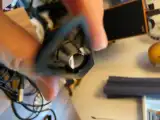
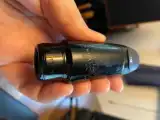
I dropped my mp and there's a small chip taken out of the edge. I have enclosed some pictures of the damage.

It seems to play all right with my Legere 1.5 and 1.75 reeds, my Rico 2, my Vandoren 2.5. Can I just ignore it or will it make my progress harder? Also is it possible that my playing is not at a level for this damage to be audible?

I'm happy to use it but wanted to make sure there weren't any hidden disadvantages.

Thank you
 

Attachments

  • IMG_4615.webp
    IMG_4615.webp
    29.5 KB · : 525
  • IMG_4616.webp
    IMG_4616.webp
    36.6 KB · : 124
Hi folks, it's a plastic Yamaha 4C. I bought it for my sax (new from Amazon ) and haven't done anything to it. ) It's still a bit wet from my gob I'm afraid and I wonder if the refections this caused is making the picture give a distorted view? ) I'm a novice but it looks pretty smooth to me in real life.

Mind you as it's a bit iffy with the damage I'm wondering if I could try a "baking soda and superglue repair". I mean if I boge it, I won't have lost much. Or if I was going to replace with a budget model, would the same one be best or is is there another one that might do the trick but better? I will try and resist the temptation to juggle it this time, of course! 😎
 
Thank you. I gave it a quick blow and it seemed all right, no rough feel or anything unpleasant so as long as I'm not worrying against it I'll keep going with it 😀
 
Are 4C's worth a repair? They aren't generally an expensive mpc.
That's right, and I wouldn't get a pro to look. I just thought if it was just me taking 5 mins with some superglue and soda then I'd give it a go. As it is, it works fine and so I'm not going to do anything either repair or replace so zero cost and all is good
 
That's right, and I wouldn't get a pro to look. I just thought if it was just me taking 5 mins with some superglue and soda then I'd give it a go. As it is, it works fine and so I'm not going to do anything either repair or replace so zero cost and all is good
I haven't seen that solution in a long time. I stopped using CA with balsa wood model aircraft framework years ago. The modern carpenter's water based glues do a much better job, plus are gap filling.

Recently I broke down and bought a small 4 pack of small thin CA tubes. I used it on a clarinet tenon cork. It was on a low mileage Chinese clarinet I purchased dirt cheap. Someone apparently attempted assembly without cork grease. It was torn and lifted on about one half of the diameter but still intact. If this doesn't hold up, then I will replace the cork with new.

If all else is well, plan to donate to our community band. We have people who want to join but lack an instrument. Last Monday nightt, we had a new alto saxist show up. He hadn't played in 25 years, said he was a decent player in high school. Leads worship in a church. Was concerned about playing the music.

About half way through the rehearsal, I started hearing the alto sax play the part. It's just like riding a bicycle. He was using a used Glarry budget sax, but it sounded OK.

But back to the mouthpiece, glad it wasn' damaged to the point where it would not play without further work. Regarding repair versus buy new, that is a personal matter. If one has the skills and the time, I see why not. May buy time until they want to buy another maybe better one.
 
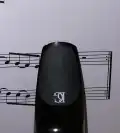
On the subject of mouthpieces I have one that came with my tenor. It seems to say "Brillhart" and the guy who sold me it thought it was a 7* but otherwise I know nothing about it. It sounds pretty good ( as far as I can judge ). Pics attached. Does anyone know what it might be? I have found a post which refers to one similar but I'm not sure if this is the same one. Also it says on that thread that they were usually no 2 for students. I'm not sure this is. It is harder to blow than my 4C for sure and also harder than another 7* my old teacher sold me a while back so I'd appreciate anyone else's opinion on this one.

It seems to be something like this though it doesn't have the "ebolin" written on the bottom front. Maybe more like this but it doesn't have the white at the tip so I don't know.
 

Attachments

  • IMG_4676.webp
    IMG_4676.webp
    30.2 KB · : 96
  • IMG_4679.webp
    IMG_4679.webp
    35.2 KB · : 89
On the subject of mouthpieces I have one that came with my tenor. It seems to say "Brillhart" and the guy who sold me it thought it was a 7* but otherwise I know nothing about it. It sounds pretty good ( as far as I can judge ). Pics attached. Does anyone know what it might be? I have found a post which refers to one similar but I'm not sure if this is the same one. Also it says on that thread that they were usually no 2 for students. I'm not sure this is. It is harder to blow than my 4C for sure and also harder than another 7* my old teacher sold me a while back so I'd appreciate anyone else's opinion on this one.

It seems to be something like this though it doesn't have the "ebolin" written on the bottom front. Maybe more like this but it doesn't have the white at the tip so I don't know.
They are being sold on Amazon US site for between $90 - $100 US. The Brilhart Carlsbad Ebolin Special 7* has a tip gap of 0.081 inch (2.06 mm). Your Yam. 4C has a tip gap of 1.70 mm (0.067 inch). You'll have better luck with a softer reed on the 7* to play it due to its wider gap.

This link gives a better rundown on it:

Consider yourself fortunate IMO, now you have a mouthpiece to move you into jazz sax territory. (Although personally, one can do jazz on a 4C.) 😉
 
Thank you. That is encouraging. I don't have any number written on the mp so I can't be sure of its tip opening although it is a harder play than the other one I have. It's pretty old an has been used and bitten a lot by the looks of it but I'll work my way towards it 😀
 
They are being sold on Amazon US site for between $90 - $100 US. The Brilhart Carlsbad Ebolin Special 7* has a tip gap of 0.081 inch (2.06 mm). Your Yam. 4C has a tip gap of 1.70 mm (0.067 inch). You'll have better luck with a softer reed on the 7* to play it due to its wider gap.
There is more to a mouthpiece than its tip opening. If one is already using a soft reed on the 4C, using an even softer reed could be a mistake.

The length of the facing also matters - a larger tip opening may have a longer facing that is equally happy with same reed. On the other hand, a mouthpiece may be more challenging to play just because it has a bad facing - regardless of tip opening. The best way to determine what strength reed one needs is to play it.
 

Social

New! Social Feeds

Look out for the navigation icon:

Follow CafeSaxophone

Latest Song of the Month

Trending

Forum statistics

Topics
32,051
Messages
577,974
Members
8,120
Latest member
lundalux
Back
Top Bottom