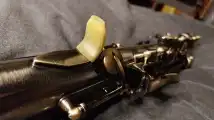
Tech/maintenance cork for mouthpieces - no alternatives yet?

OK, so that’s one more reason that the horns of the ‘20s sound as they do. It is literally compromised from the start.
Crooks from 1800’s to mid-late’20s changed from year to year. The conical bore wasn’t patented until 1913. All new tech at the time.
1769545614544.webp

1769545032123.webp
 
Do you hear a difference in character when they have a full taper?
Warburton did some taper experiments with a no cork mouthpiece system for saxophones. They had three flavors for the first length of the crook. cylindrical, conical and reversed conical. The conical one enhanced high frequencies. The sound of the cylindrical was most liked. No fans for the reversed one. At the moment Warburton doesn't sell this system anymore.

There are some saxophones which start conical such as the gebr. Moennig diamant. But they are rare. But the point at which the taper starts being conical is an important part of the sound. Bariton saxophones often start pretty fast with the conical part as it makes the sound more haunting. Soprano saxophones often have a relatively long cylindrical part to make the sound less sharp. This also affects the ease of notes above high F#.
It may be a matter of degree - literally. On all of my modern saxophones, I have to sand the cork to get it to form a cylinder. Otherwise a sheet of cork applied to the bare tube forms a cone such that the mouthpiece cannot slide the entire length of the cork without applying undue force.
 
It may be a matter of degree - literally. On all of my modern saxophones, I have to sand the cork to get it to form a cylinder. Otherwise a sheet of cork applied to the bare tube forms a cone such that the mouthpiece cannot slide the entire length of the cork without applying undue force.
The cork is always longer than technically necessary. A 1 cm cork is enough but changing this will expose the visual difference of the material formerly covered by cork.
 
The cork is always longer than technically necessary. A 1 cm cork is enough but changing this will expose the visual difference of the material formerly covered by cork.
The length is entirely arbitrary and just doesn't matter. I often trim mine to length.

Regardless, the OD of the un-sanded sheet cork forms a cone on my modern horns until I sand them. The phenomenon is all too common - go to your local store and take a look at the horns on display. Try to slide on a mouthpiece with a machined ID. Does it slide on for the length of the mouthpiece bore or does it come to a stop because the cork OD gets too large?

If you are playing old horns with a straight section at the tip of the neck, then you are having a different experience. It's really that simple.
 
Do you hear a difference in character when they have a full taper?
Sound, tone or resistance/ free blowing NO. I think that’s all bore-bow-bell related?
Stability or control yes. A taper crook is more forgiving. Playing style such as vibrato or staccato is more obtainable IMHO. I’m thinking sharp transition Vs gradual transition is reason? Less abrupt edege = more give / cushion?
‘20s equal to say a 1950’s horn? No way. That’s like a 25-30 year spread in technology.
A ‘29 Ford model A lined up to a ‘52 Mercedes Gullwing ? Heck, a double decker in ‘52 could outrun a ‘29 A.
 
It may be a matter of degree - literally. On all of my modern saxophones, I have to sand the cork to get it to form a cylinder. Otherwise a sheet of cork applied to the bare tube forms a cone such that the mouthpiece cannot slide the entire length of the cork without applying undue force.
So you have 2 or 3 experiments to base this conclusion?
 
At times when I forgot my stick of cork grease, I wetted my artificial mouthpiece cork (the stuff made of real ground cork bits with a flexible binder) on my tenor with saliva, which got me through a rehearsal. It is better than nothing.

I think the answer is obvious. The neck's entrance is cylindrical for about the first 60 mm, then goes conical. As I recall, my Jupiter Vito tenor's neck is like that. (I replaced the bad cork with synthetic cork sheet mentioned above.)

I am all for newer materials being substituted for cork. As manufacturers find suitable replacements, it can only improve things. There appeared to be some resistance to synthetic pads, but IMO now they seem to have found their place.

My gut level feeling is that perhaps a better lubricant for an artificial cork replacement is silicon grease?

Silicon grease would be rather hard and brittle. Just sayin'.
 
@PigSquealer, Thanks for taking the time to do that and post the results. Looks can be deceiving. Turns out even the ones that look straight are conical, with York being the oldest and least conical. Glad I'm not losing my marbles. I know for sure that every cork I've replace on every sax I've had in the past 50 years has been conical because one end wraps around farther than the other. Granted, my one and only hundred year old horn has a microtuner, so all bets are off there.
 
The measurements of the diameters' sections can be affected by tolerances (maybe there are differences which cannot be measured by the instrument being used? (a caliper, I suspect) Not to mention human errors are lurking around (we often see what we want to see..).
Then, we can assume there are plenty of saxes (mostly vintage) which were designed with a cylindrical start without affecting the sound (much). Then, a cylindrical instrument is the clarinet (and that's not a perfect cylinder too), and that explain the enphasis on the odd harmonics...while the conical shape of the sax produces both even and odd harmonics for a brighter sound. So, compromises are possible either way.

Interestingly, I believe (no measurements yet) there are many vintage MPs with a conical bore - that's the opposite answer to the solution.
 
In my past message I mentioned about the lack of plasticity in silicone - but the surgical type bought very cheaply is contraddicting my statemet - just look at this pic:
20260128_181348.webp

I didn't noticed initially but the stuff is keeping its shape and works well with all 4 mouthpieces (sopranino's are rare and expensive...I'm happy with them 4). I did install this a while ago and I don't even remember if I used glue.

Then, here what happen with the spare surgical silicone...nothing wasted. Maybe it's worth trying with the alto too...
 

Attachments

  • 20260128_181550.webp
    20260128_181550.webp
    40.7 KB · : 86

Social

New! Social Feeds

Look out for the navigation icon:

Follow CafeSaxophone

Latest Song of the Month

Trending

Forum statistics

Topics
32,045
Messages
577,854
Members
8,111
Latest member
Simonob
Back
Top Bottom