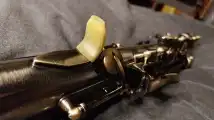
It’s a straight cylinder for entire length of cork.@PigSquealer , what exactly am I looking at? If it's cone vs cylinder, show how the diameter changes (or doesn't).
Mind sharing some measurements with your calipers?It’s a straight cylinder for entire length of cork.
Crooks from 1800’s to mid-late’20s changed from year to year. The conical bore wasn’t patented until 1913. All new tech at the time.OK, so that’s one more reason that the horns of the ‘20s sound as they do. It is literally compromised from the start.
Let me see what I can do. It’s put away and has a cork on it now.Mind sharing some measurements with your calipers?
Do you hear a difference in character when they have a full taper?
Warburton did some taper experiments with a no cork mouthpiece system for saxophones. They had three flavors for the first length of the crook. cylindrical, conical and reversed conical. The conical one enhanced high frequencies. The sound of the cylindrical was most liked. No fans for the reversed one. At the moment Warburton doesn't sell this system anymore.Do you hear a difference in character when they have a full taper?
It may be a matter of degree - literally. On all of my modern saxophones, I have to sand the cork to get it to form a cylinder. Otherwise a sheet of cork applied to the bare tube forms a cone such that the mouthpiece cannot slide the entire length of the cork without applying undue force.Warburton did some taper experiments with a no cork mouthpiece system for saxophones. They had three flavors for the first length of the crook. cylindrical, conical and reversed conical. The conical one enhanced high frequencies. The sound of the cylindrical was most liked. No fans for the reversed one. At the moment Warburton doesn't sell this system anymore.
There are some saxophones which start conical such as the gebr. Moennig diamant. But they are rare. But the point at which the taper starts being conical is an important part of the sound. Bariton saxophones often start pretty fast with the conical part as it makes the sound more haunting. Soprano saxophones often have a relatively long cylindrical part to make the sound less sharp. This also affects the ease of notes above high F#.
This one looks like a continuous conical bore (except for the tenon).
The cork is always longer than technically necessary. A 1 cm cork is enough but changing this will expose the visual difference of the material formerly covered by cork.It may be a matter of degree - literally. On all of my modern saxophones, I have to sand the cork to get it to form a cylinder. Otherwise a sheet of cork applied to the bare tube forms a cone such that the mouthpiece cannot slide the entire length of the cork without applying undue force.
The length is entirely arbitrary and just doesn't matter. I often trim mine to length.The cork is always longer than technically necessary. A 1 cm cork is enough but changing this will expose the visual difference of the material formerly covered by cork.
Sound, tone or resistance/ free blowing NO. I think that’s all bore-bow-bell related?Do you hear a difference in character when they have a full taper?
So you have 2 or 3 experiments to base this conclusion?It may be a matter of degree - literally. On all of my modern saxophones, I have to sand the cork to get it to form a cylinder. Otherwise a sheet of cork applied to the bare tube forms a cone such that the mouthpiece cannot slide the entire length of the cork without applying undue force.
None have been cleaned or reconditioned.Mind sharing some measurements with your calipers?
Silicon grease would be rather hard and brittle. Just sayin'.At times when I forgot my stick of cork grease, I wetted my artificial mouthpiece cork (the stuff made of real ground cork bits with a flexible binder) on my tenor with saliva, which got me through a rehearsal. It is better than nothing.
I think the answer is obvious. The neck's entrance is cylindrical for about the first 60 mm, then goes conical. As I recall, my Jupiter Vito tenor's neck is like that. (I replaced the bad cork with synthetic cork sheet mentioned above.)
I am all for newer materials being substituted for cork. As manufacturers find suitable replacements, it can only improve things. There appeared to be some resistance to synthetic pads, but IMO now they seem to have found their place.
My gut level feeling is that perhaps a better lubricant for an artificial cork replacement is silicon grease?

Stuff I have comes in a large tube available at swimming pool supplies places. It is anything but hard and brittle.Silicon grease would be rather hard and brittle. Just sayin'.
The E makes all the difference.Stuff I have comes in a large tube available at swimming pool supplies places. It is anything but hard and brittle.