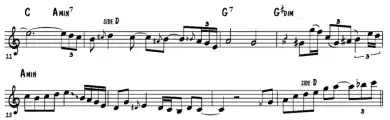
Jazz Common Ground Brecker brothers.. Best ever?

Out of interest, why is 'side D' notated on bars 12 & 18?
Does it mean play palm key D without octave key rather than 8ve|123|123?
Is this for tonal reasons, speed or convenience? Screenshot 2026-04-30 at 15.08.32.webp
'Side D' was mentioned in the discussion Tech/maintenance - C#2 Very Flat and it seems to be a non-standard fingering?
Thank you.
 
Some people find alt (side) D quicker in limited context, others like it for a particular tone. Given the context (notes before and after) of measure 18, I would not use side D. I am actually more curious about what fingerings are used for C and B, but I would just use the standard (vs alternate) fingerings since I have no issues with getting a smooth flow in that sequence.

FWIW, I have seen some Stan Getz transcriptions over the years with similar annotations. I find it interesting but not necessary.
 
On tenor, side D (palm D but no octave key) is usually a very nice note, unlike alto.

Getz used it lots. It does have possibly a more open sound, and is possibly more easy to manipulate tonally. It also has worth as it extends the low register in a way that has the same sound as the notes immediately below it. “Normal” D can be stuffy as we know, and with lots of fingers down and a long tube, doesn’t sound like the C# or C next to it. It’s also, imo, easier to bend or scoop into.
 
FWIW, I have seen some Stan Getz transcriptions over the years with similar annotations. I find it interesting but not necessary.
You can hear the difference in tonal quality when he , and others use it. It’s necessary if you want the difference in colour.
 
I'm, equally, curious as to how he glisses over the break - E to B in the above snippet and F to C in the next video page. I've tried using overtone B or C but then there are 16th immediately so it'd be clumsy... Maybe start on the palm keys?
No doubt the answer is "practice"
 
Last edited:
I'm, equally, curious as to how he glisses over the break - E to B in the above snippet and F to C in the next video page. I've tried using overtone B or C but then there are 16th immediately so it'd be clumsy... Maybe start on the palm keys?
No doubt the answer is "practice"
Do you mean the fast diatonic / chromatics (annotated as a glissando - as per usual, but not a true “slide” of course) ?

Yes, it’s the regular fingerings - often used with a crescendo or diminuendo to enhance.

Alternative fingerings are legit if

1. They enable greater fluidity
2. They don’t sound different

This past week or so I’ve been recording some modern classical chamber music on clarinet. Not something I’ve done before - only recitals.

It has been a complete shock to me how some of the stock alternative fingerings (I’m talking altissimo) sound really different to the other notes around them. I’d not noticed that so much, or rather, to any degree in a normal, live acoustic setting. With non-classical it’s fine, a note here and there with some extra sauce or whatever - great. I seek it out.

But not classical music. I consider my task to be to deliver a completely uniform tone across the complete compass of the instrument, until that becomes virtually impossible - usually from A4 - or the note sat atop of 4 ledger lines, which will want to be shouty and shrill unless you can tame a pretty hard reed everywhere else too - even then it’ll probably just be louder..

Because of the difference in sound with the alternatives you mentioned it makes them a poor choice, unless you want the sound connected with them.

At some point all the difficult transition areas on an instrument need to be ironed out and become as smooth as the easiest transition fingerings - and it’s the time-honoured slow practice and repeat etc

 

Social

New! Social Feeds

Look out for the navigation icon:

Follow CafeSaxophone

Latest Song of the Month

Trending

Forum statistics

Topics
32,064
Messages
578,438
Members
8,130
Latest member
tommyliehe
Back
Top Bottom