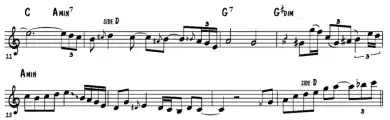
I'm, equally, curious as to how he glisses over the break - E to B in the above snippet and F to C in the next video page. I've tried using overtone B or C but then there are 16th immediately so it'd be clumsy... Maybe start on the palm keys?
No doubt the answer is "practice"
Do you mean the fast diatonic / chromatics (annotated as a glissando - as per usual, but not a true “slide” of course) ?
Yes, it’s the regular fingerings - often used with a crescendo or diminuendo to enhance.
Alternative fingerings are legit if
1. They enable greater fluidity
2. They don’t sound different
This past week or so I’ve been recording some modern classical chamber music on clarinet. Not something I’ve done before - only recitals.
It has been a complete shock to me how some of the stock alternative fingerings (I’m talking altissimo) sound really different to the other notes around them. I’d not noticed that so much, or rather, to any degree in a normal, live acoustic setting. With non-classical it’s fine, a note here and there with some extra sauce or whatever - great. I seek it out.
But not classical music. I consider my task to be to deliver a completely uniform tone across the complete compass of the instrument, until that becomes virtually impossible - usually from A4 - or the note sat atop of 4 ledger lines, which will want to be shouty and shrill unless you can tame a pretty hard reed everywhere else too - even then it’ll probably just be louder..
Because of the difference in sound with the alternatives you mentioned it makes them a poor choice, unless you want the sound connected with them.
At some point all the difficult transition areas on an instrument need to be ironed out and become as smooth as the easiest transition fingerings - and it’s the time-honoured slow practice and repeat etc




 acebook
 (bottom of page)