Beginner impro Are any of these books good/useful for a beginner trying to learn improvisation?

Perhaps that's why I now avoid "most musical situations". Not that anyone has ever complained about my lack of vibrato. I am perfectly happy not being a member of that "incredibly massive majority". :rofl:
Yep, it probably fits very well with what/where you play and has all validity. But conformity, albeit a word and practice that makes some people rather green at the gills, is very much a part of virtually every musician to a (large) degree, and vibrato is a stock technique/sound for virtually every instrument/voice in existence. I think leaving it off any list is incorrect. Discussion yes, but to ignore?
 
You need to spend time - a lot of time - playing along with records and the radio. Not carefully selected cuts, but whatever comes up. What sounds good, try to do more of that. What doesn't sound good, try to do less.
 
First of all, thanks for all the replies so far. Appreciate the effort.

So maybe I'll just do an info dump here to let you all know what my attempts and progress has been, and maybe someone can identify the problem and suggest a course of action that I am capable of following.

So I've been trying a couple of things - basically throwing stuff at the wall to see what sticks.

The "start with single notes, then add a second note, then add a third, etc" as I have described in an earlier post above is one such attempt. I get to a point where I can play some random licks with the pentatonic scale... but I get stuck thinking what I'm doing is great for one genre - the blues - and I don't know how to apply any of that to any other genre. What if I want to play a jazzy ballad, or do a screaming rock/pop solo?

Another method I've been testing is to play chord tones along with the chord chart (or lead sheet) of a song. I start with the root note, then add the third, then add the fifth... and so far, I've gotten to being able to play arpeggios. Basically, playing patterns like 1-3-5-8va or 1-3-5-3 (I haven't gotten to 7ths yet), but then the gist of the problem again is, how do I go from arpeggios to actual solos/improv (and that are appropriate to the style/genre/song)?

One method that I feel I've gotten the most progress out of, is to embellish melodies. I've gotten to the point where I can be just sight-reading a song, but able to insert random embellishments like grace notes, turns and passing notes on-the-fly. But in the end, it still sounds like the original melody and I haven't been able to deviate far from it. This video, for example, I'm amazed at how much he's able to embellish this song while I'm still stuck with simple grace notes, turns and short passing notes. That little embellishment at 0:26, for example, is something I'd love to be able to do to any song.

I've also tried to learn some short solos from songs/genres that I am interested in; in pop/rock songs, often that's learning the lead guitar part during the instrumental of a song. But again I hit the wall when I realize, the solos I learn are only appropriate for the song I'm playing along to. How do I take licks from them and apply them to other songs (and sounding appropriate to them)?

This led me to thinking maybe instead of learning the hows, maybe I should try to tackle things from a different angle and study the whys (hence, the books in question). That would, at least in theory, help with being able to learn solos from one song and try to learn the licks to apply them to another song.

But after a long, retrospective deep think, I think one of my main issues is that I am too rigid with patterns/formulas and not imaginative enough to be able to improvise. In all four methods that I have tried, I've been strictly following a pattern and unable to deviate out of the formula, which is probably why I get stuck after a while, with roughly the same line of thinking -- "what I'm doing now is cool, but how do I get from this to that other genre I'm interested in?"

Hi @atwl77,

First of all I really, truly admire your high level of motivation to learn to improvise on sax!

I'm just an amateur (tenor) sax player who first - playing in Big Bands - learned to improvise on solo's just by ear and 'musicality'. In my Big Band scores there are usually written-out solo's which I quickly learned not to play. Partly because the written-out solos were often too difficult for me to (comfortably) play. But mainly because the written-out solos did not match either my usual playing style or my intuitive sense of 'musicality'. So I quickly learned to just ignore the written-out solos and started to improvise with my own (less complicated and for me much more natural) solos instead. To my delight, other Big Band members complimented me on my (by ear) improvised solos.

During the past couple of years, I've participated in number of 10-weekly series of 'jazz improvisation workshops'. m From which I've learned a lot. Including (just as a few examples): 'how to tell a story' with improvs on maj/min scales including Major/Minor/Pentatonic and Blues scales. Whatever the scales, the emphasis is always 'telling a story' Through various techniques such as 'intro/build up/crescendo/ build down/outro' through 'repetitions' (melody + rhyme).

IHMO, trying to copy 'transcriptions' of famous sax players won't get you far in your development In fact, I believe that it could hinder it.

My well-meant (amateur) advice is to:
- continue learning and practicing playing in different keys and modes (pentatonic, maj/min blues, etc.)
- find books and videos that can help you develop your own improvisation style and musicality rather than trying to copy someone else's

As always Cafe Sax members (including me) are always happy to advise you on the best way forward to achieve your goals!

Best wishes,

Mik
 
"The blues is a feeling, you can't get it out of no book. You can't write the blues on a piece of paper, you just feel the blues."

- John Lee Hooker

This is a blues story. The blues are a simple music, and I'm a simple man. But the blues aren't a science; the blues can't be broken down like mathematics. The blues are a mystery, and mysteries are never as simple as they look.”

- B.B. King
 
One thing that I've been doing in practice, recently, is..... I'm not sure what the correct term is, but it's where there's a singer, and the saxophonist is adding some background lines that complement what the singer is singing. Usually they play a short riff after the singer finishes one phrase, but sometimes they will come in in the middle of a phrase.

So, I'll have some music playing and try to complement the melody this way. Most of it comes out as crap, of course, but sometimes I get some lines I think sound "ok". And I guess the ratio between ok-to-crap is getting a little better, so hopefully that leads somewhere.

One thing I've had some decent amount of success on though, are song endings. I'm finding that as long as I play a bunch of notes in the scale of the song, and end on the root note (some songs I could end on the 5th), I can get a decent ending that sounds ok. But sometimes I flub it by playing too many notes though! 😅
 
As you may realize... and others have hinted at, imprtovisation is composition on the fly... real time. However there are a lot of fundamentals, some of which have been already covered. IMHO to become a creative improvisor one should avoid the trap of relying on licks, riffs and arpeggios. That makes for a "cut and paste" player where one learns to fit, but not be creative. Some of those players can become technically very proficient, which I guess is a point of pride, yet thier trajectry is towards trying to impress via technique rather than fit with the music.

Your attempts to play with singers or other instruments is a good exercise. A couple others are to try and sing harmonies, counter melodies (counterpoint is similar yet leans towards the rhythmic). A simple execise to start getting your ear synced to the instrument is to play a simple melody (Mary had a little lamb, twinkle twinkle little star, etc.) but use a random start note without trying to see notes, or think of anything except how that melody goes starting from the first note. This will frustrate the heck out of you for quite a while, yet improvement will come.

Developing your ear to hear what you would play is a very big part of becomming a creative improvisor. That is why singing what you would play is extremely important. Exposing yourself to all sorts of music in this process will expand your ear's vocabulary.

Unfortunately being able to play what you would sing will take a long time, but is worth the effort. The suggestion of playing along with the radio is excellent, but will just be a frustration until you master some of the easier stuff.

Analysis is an "after the fact" exercise. Knowing chords, keys, and what jazzers call theory is a good thing, but doesn't make one a creative improvisor. If you play based on theory, or picturing notes on a page, then you're forever translating, which doesn't work for being "invested" in what you're playing. Thus most jazz theory players have thier "finger memory" cut and paste routines to fit the tune's "changes". It works and gives players satisfaction, yet is not generally creative.

If you can't hear the music you're playing until it comes out of the horn, you're never going to be convincing.

It's a long journey. Learning basic theory (melody, harmony, counterpoint, rhythmic ideas, etc,) which is NOT the same as what jazzers call theory, is very worthwhile. Expose yourself to every sort of music and find first the rhythm, then the logic of the notes and how they fit (composition). It doesn't take analysis, it's far better to internalize the feel such that you can repeat it with your voice... that means it's part of you and eventually, when one with your instrument, you will be able to play it!
 
Analysis is an "after the fact" exercise. Knowing chords, keys, and what jazzers call theory is a good thing, but doesn't make one a creative improvisor.
This is a very good point. I know a lot of quite complex theory. But do I use it when improvising or, as above, more after the fact?

The best improvising I do I am not thinking about or applying much of that theory. Rather ironic when you think I used to teach it to to undergrad and postgrad.

But the truly creative impro, what you do without thinking theory, is not directly teachable.

More to the point it’s very difficult to objectively assess. That is probably the reason that the academic system embraces the theory based impro (e.g. chord/scale or patterns) because it is easier to give it a mark out of 100 and justify that mark to irate students (or worse, irate parents).

It’s funny though that art and architectural academia seem to cope with the creative and even innovative.
To Wade’s point, you could also argue that an architect might design something of real beauty, but without any practical trade skills the application is not of worth.

I also think that if you asked 10 top improvisers how they learned, where / why pennies dropped, you’d get 10 different answers with some crossover. Moreover, what one might say to avoid might be what another says was their “go to”.
 
you could also argue that an architect might design something of real beauty, but without any practical trade skills the application is not of worth.
Absolutely true. The 7 years training is a lot more than drawing buildings. And still the big firms also employ engineers, the smaller firms consult with engineers.
also think that if you asked 10 top improvisers how they learned, where / why pennies dropped, you’d get 10 different answers with some crossover
Ah but yes. This ties in totally with types of improvisers as being discussed. There is the more "technical" for want of a better word, ie use of theory in the actual process rather than as an analytical tool (as Wade mentioned above) or a freer more melodic approach where the improviser isn't think so much about the theory but more about melodic invention (or other types of invention such as rhythmic, textural etc.) So of course you have a gamut of types of improvers from Peter Brotzmann and Jan Garbarek, to Ornette Colman to Chris Potter, Sidney Bechet, Django Rheinhart, Albert Ayler, Charlie Parker- sorry didn't get up to ten, but they are all so very different.
 
Back to the question. Those books are not particularly going to help you learn how to improvise, but they will help you get some nice licks under your fingers. How you use those licks is a different matter of course.

I might be able to use to analyze and learn something for myself?
This is something that I think is crucial along with learning to play the licks in that style.
 
Any music that you hear or read, that you like, learn it, and memorize.
Hard to take a solo, out of the library,
if the shelves are empty.
Modern electronics, makes it easy to slow it down, and even change keys. 🎶🏴‍☠️🎶
 
One thing that I've been doing in practice, recently, is..... I'm not sure what the correct term is, but it's where there's a singer, and the saxophonist is adding some background lines that complement what the singer is singing. Usually they play a short riff after the singer finishes one phrase, but sometimes they will come in in the middle of a phrase.

So, I'll have some music playing and try to complement the melody this way. Most of it comes out as crap, of course, but sometimes I get some lines I think sound "ok". And I guess the ratio between ok-to-crap is getting a little better, so hopefully that leads somewhere.

One thing I've had some decent amount of success on though, are song endings. I'm finding that as long as I play a bunch of notes in the scale of the song, and end on the root note (some songs I could end on the 5th), I can get a decent ending that sounds ok. But sometimes I flub it by playing too many notes though! 😅
Great tips given so far.

A book (via amazon) you might want to look at is John O'Neills' method for saxophone. There are versions for both alt and tenor sax. Both with accompanying 'play along' CDs. It's a very old book (first published in 1992). Of course, many more (probably much better) books have been published since then. But that it's still published today, indicates to me that it still has value for beginning (and intermediate) sax players.

It was the very first 'sax book' that I bought maybe a couple of years into 'sax playing' (then aged 40+). To be honest, I didn't use it well. I was much too impatient to 'play the tunes'. I still remember the thrill - as beginner - of being able to play tunes written by 'famous jazz musicians' such as Ted Gioia, Sonny Rollins, Thelonious Monk and Charlie Parker. So I skipped over all the sections on 'theory' and the 'recommended listening'. It's only recently (almost 30 years later and after following multiple 'jazz improvisation' workshops) that I realized:
- how valuable this book would have been if I'd not been so impatient to 'skip over' the learning sections, and
- that I can still learn a lot from this book

This 100-page book is not focused on 'improv' (though there are exercises on this) but more on learning chord/scales and learning to play jazz sax. The intro sections you probably already know. Looking the book again now, I think it would be a great way of 'analysing' (and learning from) quite short tunes. Such as (for example):
- Blue Monk, Straight, No Chaser (Thelonious Monk)
- Doxy (Sonny Rollins)
- My little Suede Shoes, Yardbird Suite (Charlie Parker)

Yes, being able to play these 'jazz standards' felt wonderful! But - something that I've never done - 'analysing' these tunes against the backing tracks (CD) - might give some you more insight into why some great jazz composers/performers deliberately chose some note sequences. And also into their choice of phrasing, timing, etc. IHMO 'analysing' (and learning from) a tune of 12 -16 bars is much easier and much more productive (in terms of learning) than trying to 'analyse' and learn from much longer (and freer) transcription.

You obviously have a good understand of chord/scale intervals. Looking back through the thread, I wonder whether your enthusiasm for learning to improvise sometimes leads you to 'overthink' it. It's certainly good idea to pick up new concepts/examples/ideas along the way. But IMHO, I also believe that that the best way to do this is to integrate anything new that you find with what you already want to and can play (without too much difficulty). So my tip is to 'take your time'

I believe that you can 'facilitate' the process of 'learning to improvise' (by experimentation and learning). But I personally (still) believe that the best sax improvisations are based on the sax player's musicality. And at deeper level, on his/her personal response to the music.

Personally, listening to technically accomplished sax players playing licks and runs all over the the sax quickly bores me. I don't feel any sense of 'musicality' or 'personal expression'. I would much rather listen to a sax player who shows 'feeling for music', 'personal expression' and a true sense of who she/he musically is.

Read, learn, copy and practice anything that helps you but please don't lose sight of the goal: finding and developing your own 'voice' on sax.

Best wishes,

Mike
 
Some really great discussion here. 🍻

Just to add my .02 to what's already been said, I want to reinforce to OP the importance of learning from records before anything else and always strengthening the relationship between your ears and playing the instrument. Books can be useful for many things, particularly learning new ideas you wouldn't have thought of otherwise, and of course they're important for strengthening your sight-reading if that's a need. But jazz improvisation can really only be learned aurally, and without a strong aural foundation to provide context for all the other concepts, books won't help much.

Consider great records to be your primary source material, and for books to be secondary. Everything you do that involves playing your instrument will help, yes! But for this music in particular, it's primarily an aural tradition, and developing the heck out of your ears first is the only way you have a fighting chance.
 
I never got anywhere with books. The written word describing sounds in Italian and jargon did me no good. I don't like Sonny Rollins and trying to copy Stan Getz is impossibly ambitious imo.

I am learning by playing (was going to put learned but it's never ending)

All that's needed is a variation on the melody or follow the harmony with extensions. A few licks and tricks for when you get lost or are ambushed by a middle eight key change.

It's not all about the notes. Sticking to the written harmony with interesting rhythmic phrasing can produce pleasing results.

This all assumes a pleasing tone and good intonation. Many soloists lose their intonation when stepping away from the melody.
 
As a beginner of about eight months, for me - I think everyone has their own path - joining a band or at least playing with others better than me, really pushed me and helped me develop my musicality more than any theory books I have read. I have now played four gigs and done one live solo plus several band rehearsals.

I play safe and stick to a few notes from an appropriate pentatonic or blues scale and aim to include a play on the melody or harmony, and I'm beginning to feel when to add an accidental or approach note for interest or how to go with a chord change.

When I'm improvising I have no thoughts about theory, chords, arpeggios, inversions or anything. I hear the rhythm, pulse, melody of the tune and my fingers seem to press the 'right' keys, my articulation is subconscious and it's like I'm listening to it more than playing it. There's an almost simultaneous hearing it in my head and hearing it from the sax, most weird?!

I have listened seriously to music most of my life and I think that has given me a 'vocabulary' to draw on so I recognise melodic phrases and patterns, intervals and so on. It is quite possible that the theory I have read and got rather confused by at first is sinking in and working at a deeper level?

TL,DR Read up on basic theory, put the books away and just practice, practice, practice. Play anything, put on some music, a drone, backing track and just play. Listen, hear, feel, experiment, don't think, don't try, just play. It may sound like weird, dissonant, non-melodic free experimental jazz but don't judge, it's your music and your ears and fingers will learn what sounds 'right'.
 
Improvising has driven me (and the wife and neighbours) insane. I've felt like I have made little progress, it's been painfully slow, I posted here about it. There doesn't seem to be anything you can measure progress against, I've still a long way to go!
Well,

That's the way it goes

You've put into words my
crawl through the improvisation mud

On the plus side... When you improvise you play in the moment
 
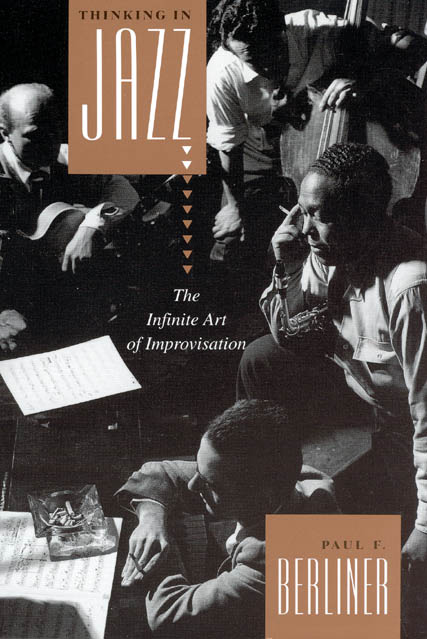
At the risk of putting an emphasis on "book learnin" (IMO learning from ensemble playing and records is a better idea overall) I'll link a book I got out of the library recently,


The product of more than fifteen years of immersion in the jazz world, Thinking in Jazz combines participant observation with detailed musicological analysis, the author’s experience as a jazz trumpeter, interpretations of published material by scholars and performers, and, above all, original data from interviews with more than fifty professional musicians: bassists George Duvivier and Rufus Reid; drummers Max Roach, Ronald Shannon Jackson, and Akira Tana; guitarist Emily Remler; pianists Tommy Flanagan and Barry Harris; saxophonists Lou Donaldson, Lee Konitz, and James Moody; trombonist Curtis Fuller; trumpeters Doc Cheatham, Art Farmer, Wynton Marsalis, and Red Rodney; vocalists Carmen Lundy and Vea Williams; and others. Together, the interviews provide insight into the production of jazz by great artists like Betty Carter, Miles Davis, Dizzy Gillespie, Coleman Hawkins, and Charlie Parker.

It's kind of an ethnographic approach and maybe the kind of information you wouldn't really be able to get otherwise (unless you were a jazz musician in NYC in the 50s and 60s).

Of course improvisation is not exclusive to jazz! Another interesting book in that respect would be Derek Bailey's Improvisation.

This probably is not exactly the kind of information you're looking for @atwl77 but again maybe what books are best suited for.
 
helped me develop my musicality more than any theory books I have read.
But, with respect, this is like trying to read say, French literature when you’re less than a year into speaking the language.

It’s impossible to say which type of information will make a profound difference to your musicality or playing ability.

Suffice to say that the subject is enormous and the longer you study, and broaden your areas of study you will gain significantly from most avenues - from a few chosen wise words from a fellow musician (which could be written down in a book), to all the things mentioned above, including our own “fiddling around “ - which can be blind but can lead to stumbling upon a recognised sound - “ah, that’s what that is!”
 
But, with respect, this is like trying to read say, French literature when you’re less than a year into speaking the language.
There's an adage that the quickest and best way to learn a language is to go and live where it is spoken natively (or better still get a lover who speaks it!).

All I know, confirmed by my teacher and others, is that my playing has improved more in the three months I've been in the band than in the first five months of more traditional learning.

My reading, timing and general musicality is now much better than before and for the first time I am beginning to feel competent and part of the band. Not saying I am good by any means but getting better all the time.

I tend to do best when challenged, thrown in the deep end as it were. It works for me but others may need a different approach.
 

Social

New! Social Feeds

Look out for the navigation icon:

Follow CafeSaxophone

Latest Song of the Month

Trending

Forum statistics

Topics
32,041
Messages
577,729
Members
8,117
Latest member
H3nri
Back
Top Bottom