

Tech/maintenance A question for the math experts

jbtsax

R.I.P. in memoriam 1947 - 2023
Messages
8,986
Location
Beautiful Springville, Utah USA
Marten Postma has complied and posted a great amount of data accumulated over many years concerning saxophones he has taken measurements of. The portion of his work that pertains to this post is located here: M. Postma Saxophones Go to "measurements", "holes, keys"

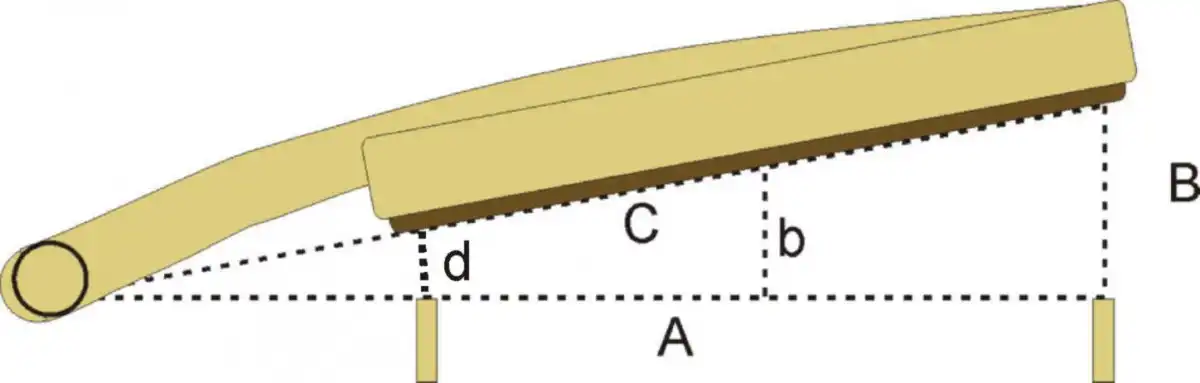
There is a lot of useful and interesting data compiled by the author, but for some unknown reason he chose to list key heights as the average of the distance from the top of the tonehole to the pad measured at both the front and back of the key. Repair techs always refer to key heights or key openings at the front of the key where the opening is the widest. This is where I could use some help. I have created the following illustration to clarify the issue. M. Postma has measured the distance from the top of the tonehole to the pad at locations (B) and (d) and then averaged them to find (b). In the data the value of "A" -- the tonehole diameter and "b" the average of the openings are known.

My question then: Is there a way mathematically to find the value of "B" with the known values of "A" and "b". Thanks
key_height_edited..webp
 
A and b aren't sufficient information, as @h4yn0nnym0u5e saidb, because they convey no information about the angle of the pad compred to the tonehole. I expect you coulod work it out if the knew the length of the key arm (ie ie how far is the pad form the pivot point.
 
Marten Postma has complied and posted a great amount of data accumulated over many years concerning saxophones he has taken measurements of. The portion of his work that pertains to this post is located here: M. Postma Saxophones Go to "measurements", "holes, keys"

There is a lot of useful and interesting data compiled by the author, but for some unknown reason he chose to list key heights as the average of the distance from the top of the tonehole to the pad measured at both the front and back of the key. Repair techs always refer to key heights or key openings at the front of the key where the opening is the widest. This is where I could use some help. I have created the following illustration to clarify the issue. M. Postma has measured the distance from the top of the tonehole to the pad at locations (B) and (d) and then averaged them to find (b). In the data the value of "A" -- the tonehole diameter and "b" the average of the openings are known.

My question then: Is there a way mathematically to find the value of "B" with the known values of "A" and "b". Thanks

View attachment 15054
My contribution only extends as far as - it’s wonderfully drawn..
 
A and b aren't sufficient information, as @h4yn0nnym0u5e saidb, because they convey no information about the angle of the pad compred to the tonehole. I expect you coulod work it out if the knew the length of the key arm (ie ie how far is the pad form the pivot point.
Thanks BigMartin. I was afraid of that. I can measure the distance of the "hinge" to the outer edge of the tonehole of the Mark VI I currently have on my bench and on a "parts" YAS-23 on the shelf. Perhaps this might provide enough "data" to sort of extrapolate the figures for other makes and models, at least enough to come close to the "B" measurements.
 
Bizarrely @jbtsax I was watching a maths video on a very similar subject the other evening... (I lead an exciting life...) and without knowing the angle or the length of the other side you are kind of stuffed. For this sort of problem you need 3 pieces of information, the length of the two sides and the included angle... or what you have plus both angles
 
I can measure the distance of the "hinge" to the outer edge of the tonehole
Can you also measure the distance from the hinge to the inner edge of the tonehole?

If so, you can calculate B.

Tan of the hinge angle = ratio of opposite to adjacent
B/A = b/a where "a" is distance from hinge to middle of tonehole
Therefore B = (A x b)/a

and a = (D + A)/2 where D is distance to inner edge of tonehole.

E&OE
 
Can you also measure...
@jbtsax's original question was to do with working from the known / published data. The trouble is that the published information is insufficient, and relates to a large number of different instruments. Measuring a couple of examples (Mk VI and YAS-23), as he says, may allow exact result for those (within build variations), and reasonably good extrapolations for others.

Another approach might be simply to email Mr Postma and ask if he could also publish the extra measurements he must have made at the time...
 
Last edited:
As all the others have said I believe the answer is no...at least I currently can't see a way!

For right angle triangles there are generally two approach to find unknown angles and sides:

1) Pythagoras' theorem: If you have two known sides
2) Trigonometry: if you have one known side and one known angle.

So you need two bits of information about the triangle.

Another fact which may be useful is that the smaller right angle triangle (with "b" as the side), is mathematically similar (i.e. A scaled down version of) to the bigger right angle triangle (with "B" as the side)
 
@jbtsax's original question was to do with working from the known / published data. The trouble is that the published information is insufficient, and relates to a large number of different instruments. Measuring a couple of examples (Mk VI and YAS-23), as he says, may allow exact result for those (within build variations), and reasonably good extrapolations for others.

Another approach might be simply to email Mr Postma and ask if he could also publish the extra measurements he must have made at the time...
No, @jbtsax was not only working with the published data, he was also making an adfitional measurement A. If he makes one more measurement to the inner edge of the tonehole he can calculate what he needs using basic trigonometry as I showed above.
 
Marten Postma has complied and posted a great amount of data accumulated over many years concerning saxophones he has taken measurements of. ... [he] has measured the distance from the top of the tonehole to the pad at locations (B) and (d) and then averaged them to find (b). In the data the value of "A" -- the tonehole diameter and "b" the average of the openings are known.
....
My question then: Is there a way mathematically to find the value of "B" with the known values of "A" and "b". Thanks
View attachment 15054
We are all agreed there's insufficient data given to compute B...
No, @jbtsax was not only working with the published data, he was also making an adfitional measurement A. If he makes one more measurement to the inner edge of the tonehole he can calculate what he needs using basic trigonometry as I showed above.
...which he can only do for the two instruments he mentions having to hand, not the full range measured by Marten Postma (link provided in the original post: a total of 44). As you rightly state, one additional measurement from the pivot point to (either) tonehole edge will suffice to do the calculation, either using trigonometry or similar triangles. As highlighted above, A is known from the published data, but as it's the tonehole diameter it doesn't help. It's not totally clear from the diagram what A is measuring, but it is from the text: I note you've taken it to be the distance from the pivot to the outer edge of the tonehole, but it doesn't matter - still not enough data!

I'm not familiar enough with the variations in sax construction to know if cup arms tend to have a length that's related to the corresponding tonehole diameter - it's certainly not the case for the palm keys - but I'm assuming here that @jbtsax would like something better than an estimate, and for more than two instruments, if at all possible.

Cheers

Jonathan
 
Last edited:

Social

New! Social Feeds

Look out for the navigation icon:

Follow CafeSaxophone

Latest Song of the Month

Trending

Forum statistics

Topics
32,056
Messages
578,145
Members
8,127
Latest member
PJ2116
Back
Top Bottom