Saxophones 10M ergos

I have never read, nor experienced that on a 10M, but granted I cannot say I have played one regularly for an extended period of time. I just refurbed them, played them for a few days, then sold 'em.

IMHO, I never felt anything peculiar or uncomfy about 10M ergos other than the Conn Cobra placement of the strap eyelet.

Have you played other vintage horns regularly and not had a problem ? I know you say your contemporary one is fine....

Tendonitis in lower arm, upper arm, wrist ? Where...?
 
Nope. Been playing Conn tenors since 1978.

I suggest rather than trying to blame the horn (which has, really, rather unremarkable keywork positions), you should look at your overall posture. Are you one of those that play with arched back, right elbow drawn way back, etc.? If I were to look at a photo of you holding your horn and playing, would it look uncomfortable, or would it look like you were standing, or sitting, comfortably, relaxed yet alert, with your arms and hands ready for use?

The truth is that from one saxophone to the next, the positions of keys and how they place your hands isn't a gnat's fart's difference. The biggest differences, and they're still small, are in the little finger keys of the left hand.

Watch the whole video, which will show you what can be done with a 10M: but particularly, start at 23:30 to watch two guys playing a 10M and a Selmer: watch their posture. They're both playing intently, but their bodies and arms and hands are relaxed, using only as much muscle tension as needed to operate the keys. If you're not looking at least this relaxed when you play intently on something high speed and demanding, it's your posture and the way you're addressing the horn, not the few mm one way or the other that the keys are located, that's causing you difficulty.

View: https://www.youtube.com/watch?v=R8Ycbrwqh5w&list=RDR8Ycbrwqh5w&start_radio=1
 
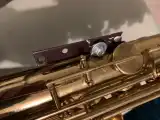
Bothers my forearm. Playing over 40 years, Gigging several times a week every week…..acquired the 10M several years ago, great horn, bit awkward tho… the strap ring position high, let it hang and the mouthpiece will swing up and bash your teeth🥴…I sure this contributes to things. Anyway, I had a think a done a spot of diy engineering to lower strap ring position….see if this helps
 

Attachments

  • 90658773-254E-4C6E-B8B3-B051253727F2.webp
    90658773-254E-4C6E-B8B3-B051253727F2.webp
    53.3 KB · : 109
  • BDF79222-B1C7-48BB-A54D-03B0CEAA8B09.webp
    BDF79222-B1C7-48BB-A54D-03B0CEAA8B09.webp
    73.9 KB · : 118
I'm not knocking you at all. I wish I'd thought of that - it goes with my 'can it be fixed with a bit of Dexion?' aesthetic 🙂

(I'm sure you thought of this already - but the upper part of the lever you created which will want to rotate around the original strap ring, will try to dig into the sax body - even if the nut is tight. Make sure the pad under it is wide and spreads any load out as wide as you can to avoid dinking the tube. Several layers of cut-up plastic bottle of approx the right diameter for the body tube, one on top of the other, would make me feel a bit safer if it were mine. Having looked again - at least it is close to a tone hole which adds a bit of local stiffness).
 
Any horn can trigger tendonitis - if you're prone to it. If it happens when you play a 10M it's called Tenemdonitis...
For example, I have some arthritis in my hands - and the penny whistle really gives the base of my right thumb some proper gyp. Of course, it rarely affects many other other penny whistle players...so it must just be me. My solution was to work out that pinching my fingers to the diameter of the whistle was the culprit, so I made up some clip-on 'buttons' that bring the diameter of the whistle out to around that of a clarinet...which gives me no problems. Job done.

A very common issue with the 10M is the placement of the sling ring. It was most likely positioned for playing in a sitting position. I probably do half a dozen sling ring moves a year on 10Ms - but the problem also crops up on other horns.
You can get a rough idea of what position suits you best by playing about with a bunch of cable zip ties. Wrap one around the body using a tonehole and/or a pillar to limit its position. Snug it up loosely then pop a smaller one under it and form it into a sling ring. Tighten the body tie to suit. Assemble the horn, pop the sling on and adopt your playing position and see how it feels. You might need the assistance of another person to move the horn around to help you find the right balance - and you'll probably go through a good few ties before you get close to a sweet spot. Once you do you can lock things in place with a bit of gaffa tape - and this should last long enough for a proper test blow. And that'll be where you need to have the ring moved to.
This is the procedure I carry out with clients who want the ring moved.

Might not solve the problem as there are other factors that may be more critical to your tendonitis - but improving the static balance of the horn is a good bet in any case. It may also be the case that moving the thumb hook is called for.
 
I had the problem when I first got a Conn curved soprano that was made with an incredibly awkward fixed neck position. Having that shifted solved the problem.

Since you're not having the problem on your other horn (another tenor?), it may just be something as simple as the neck position. Try shifting it a bit to one side or the other and see if it's more comfortable.
 
OP, you may find that rotating the strap ring is what's needed. On my latest Conn tenor, the height of the ring was not a problem (it never has been on any Conn, but that's another story), but the angular position of it caused the body to be somewhat strangely rotated when standing. I didn't have trouble with my hands and arms, but it meant that I had to readjust the neck angle between standing and sitting. A few minutes with the torch and I moved it some distance to the right (I think) as you'd look at it from behind the hron - maybe 3/8" lateral shift was plenty enough. This may be the source of the problem if you're having to flex your wrist more or less than you're used to.
 
OP, you may find that rotating the strap ring is what's needed. On my latest Conn tenor, the height of the ring was not a problem (it never has been on any Conn, but that's another story), but the angular position of it caused the body to be somewhat strangely rotated when standing. I didn't have trouble with my hands and arms, but it meant that I had to readjust the neck angle between standing and sitting. A few minutes with the torch and I moved it some distance to the right (I think) as you'd look at it from behind the hron - maybe 3/8" lateral shift was plenty enough. This may be the source of the problem if you're having to flex your wrist more or less than you're used to.

View attachment 31579
Some quick observations here.

1) a member decided to stir the pot by belittling another member, in a rather shallow manner....for 'going there'.
The option was available to not do that, just let it slide. Or simply say "well, that wasn't really an appropriate comment to make here". Such options were available. It would not have taken much effort to do either.But when the member then decides to conflagrate the discussion, rather than letting it be...it's pretty hard to claim any 'high road' there.

2) Here's something I learned quite a while ago...when a POC comments about racism they have experienced, if you are not a POC...but rather a white person in a majority white country who really doesn't have any past experiences that can begin to understand/relate to what that feels like. None at all....it's probably better to just not reply with something along the lines of "then you are the problem, not the existence of racism".
Isn't it better to maintain a bit of understanding and dignity and remind yourself "well I don't really understand that but then again I have never actually experienced it, myself, so..."
Denying the existence of what someone states is a regular experience for them due to their being of a particular race or socioeconomic background other than yours...there's no way you (or we) really have the footing to criticize or retort to that.

3) The point of my prior post is this: 2025 is the time for critical thinking...to believe that the sociopolitical reality cannot and should not permeate all aspects of our existence at this point, Nov. 2025, is pure fantasy.
And those who continue to believe (or pretend) that things are OK, when literally daily life around us illustrates the opposite....are doing themselves and their loved ones, acquaintances, etc... no favors. To the next point:

Yup, when people ask me to reposition the eyelet that is what I usually do, not just a north-south repositioning, but it should move a bit laterally as well.
 
Bothers my forearm. Playing over 40 years, Gigging several times a week every week…..acquired the 10M several years ago, great horn, bit awkward tho…
I would doubt the eyelet location is causing the tendonitis in your forearm.

Back in the good ol' days, I'd suggest maybe asking a physician or osteopath, even bringing in the horn to demonstrate. But that was when you could get an appointment which wasn't 3-6 months out.

It may just be that the 10M doesn't work for you. Am wondering if it is perhaps the weight as well ?

If you have been playing since the 80's, again I am curious - all your other horns from the past..were any also 'vintage' ones ?

My other thought is could it be the weight ? Compared to your modern axe ?
 
Nope. Been playing Conn tenors since 1978.

I suggest rather than trying to blame the horn (which has, really, rather unremarkable keywork positions), you should look at your overall posture. Are you one of those that play with arched back, right elbow drawn way back, etc.? If I were to look at a photo of you holding your horn and playing, would it look uncomfortable, or would it look like you were standing, or sitting, comfortably, relaxed yet alert, with your arms and hands ready for use?

The truth is that from one saxophone to the next, the positions of keys and how they place your hands isn't a gnat's fart's difference. The biggest differences, and they're still small, are in the little finger keys of the left hand.

Watch the whole video, which will show you what can be done with a 10M: but particularly, start at 23:30 to watch two guys playing a 10M and a Selmer: watch their posture. They're both playing intently, but their bodies and arms and hands are relaxed, using only as much muscle tension as needed to operate the keys. If you're not looking at least this relaxed when you play intently on something high speed and demanding, it's your posture and the way you're addressing the horn, not the few mm one way or the other that the keys are located, that's causing you difficulty.

View: https://www.youtube.com/watch?v=R8Ycbrwqh5w&list=RDR8Ycbrwqh5w&start_radio=1
That’s an insanely great video. I hadn’t seen this before. Seeing how each player plays is great information to me. The sax condition and fingering action says tons. The opening of neck/ crook key octave and other “small stuff”. Bent / dented parts…these guys played the snot out of those tenors. Thanks for sharing !!
 

Similar threads... or are they? Maybe not but they could be worth reading anyway 😀

Social

New! Social Feeds

Look out for the navigation icon:

Follow CafeSaxophone

Latest Song of the Month

Trending

Forum statistics

Topics
32,057
Messages
578,194
Members
8,127
Latest member
PJ2116
Back
Top Bottom