Playing the saxophone What Differences Can People Hear Between...

I can imagine that the internal bore of a wooden clarinet may have a roughish surface compared to a plastic one?
For a more polished sound?

I think a plastic clarinet does sound different actually. I’m remembering stuff from 2010 and how it sounded less rounded, even with same mouthpiece etc.
 
Can someone explain or point to something that explains the difference in acoustic effect between this and what material the horn is made of?
Yes.

The surface finish has a minor effect, as roughness will tend to slightly disturb the standing waves, which are predicated on complete reflection of pressure pulsations off the walls. Any losses due to imperfect reflections will affect sound quality in a minor way.

The material the horn is made of has zero effect, as long as the stiffness is sufficient that the walls maintain their shape.
 
Your eyes and your brain make far more difference to how a saxophone sounds than any change in kit. When I bought the Shadow tenor that I've now been playing for 17 years I thought I'd treat myself the best tenor that sax.co had in stock at the time. The fact that I thought it also looked the best had absolutely nothing to do with it. No, not a bit. Honest guv.
 
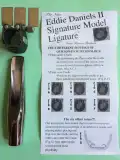
No question about that. Is often like that. But a ligature can clamp the reed in more than one way. Have you tried an Ed Daniels lig on a mouthpiece with big window?
If you have two ligatures, and you put them both on the same mouthpiece at the same point on the reed, they should sound and feel the same. If they do not, then at least one of the ligatures is defective.

I have an Eddie Daniels ligature for soprano. It is defective, in the way that Rovner ligatures often are. They do not hold the reed in place, but allow the reed to lift slightly away from the table while playing. How do I know? By inspecting the reed after playing, and finding it wet below the window area. Also by listening and experiencing the response of my setup. A Bonade two screw, tightened lightly, solves these problems.
 
It's the nut on the end (the player) that seems to make most of the the difference. A few months ago I was trying to decide between setups for some sax/guitar duo stuff I've been up to, and so recorded myself with a variety of different mouthpieces (metal HR, and plastic) and reeds, which I thought made a significant difference to my sound. That was until I listened to the playback. I seem to sound depressingly similar on all of them!
 
I think my ligature makes a difference. For many years ago the general opinion was that a 2-screw standard ligature was the right thing. I can't use a 2-screw standard ligature on my mouthpiece.

Here is a picture of my mouthpiece and the ligature. Less table for the flat side of the reed to rest on. It's less than 10 mm of a tenor reed that is against the table (a little bit more for baritone reed). The ligature is "clamping" on the rails of the reed. They are some options to color the tone/sound with different inserts and flaps. Not so important for me.

I think my mouthpiece/ligature makes a difference. And so do the guys I use to play with.

IMG_4941.JPG
 
Last edited:
I'll summarize what I believe, and what every qualified scientist who's studied this subject believes, based on data and the understanding of how single reed woodwinds create sound.

<SNIP>

The function of ligatures is to clamp the reed, period. A reed with a flat back, clamped to a mouthpiece with a flat table, cares not what kind of clamp is used. If the reed is convex on the back, the position and type of clamping can matter to tone and response, but it's highly unrepeatable and unreproducible; the solution is not more ligatures, but a better joint between the reed and mouthpiece table.

I agree with just about everything that you said, I suppose that as far as ligatures go, you are probably right as well.

But I have noticed a difference between my Rovner Star-ligature and a standard metal (1 screw) ligature. The metal ligature gives a noticeably brighter sound. My wife also heard that difference, so it's not just the player that hears it.

My theory is that the leather (or is it synthetic?) band will hold the reed less rigidly than the metal ligature (leather will allow a bit of movement).

Disclaimer: I am just an "experienced beginner" (have been at it more than 10 years, but I still have a lot to learn). Certainly my embouchure and breath support are not solid yet, work in progress ......
 
Clarinet -

Don't know, I would hope so given the price difference but I suspect high quality plastic job could sound just as good as wood.

Sax -

I play an old King and an even older King. They feel different to play and I think the Zephyr Special sounds richer than the Super 20 but to the listener I think they might sound similar. I also have a Keilwerth SXR90 that needs a service so I haven't played it in a long while but I remember it sounding brighter and maybe a bit brasher. My wife says she always knew which one I was playing when I played the Keilwerth. All of them are either American or American influenced and I'm sure they sound different to Selmer based horns. All the Yannis, Yamis and Selmers I hear all sound near enough alike to me but I haven't played one in years.

General -

Mouthpiece material

I doubt the material makes much difference, maybe at the loud end, but the design does.

Ligature -

The sound differs to me but it still sounds like a saxophone being played by me. The feel and response is different between the ones I use.

Reeds -

filed vs unfiled; doesn't matter.
different cut; maybe but they all sound different anyway.
manufacturer; I like the ones that Rigotti knocks out, Rico sound a bit soapy to me and Vandoren are so variable that I don't bother.

Klangbogen - I really don't think so.
 
My theory is that the leather (or is it synthetic?) band will hold the reed less rigidly than the metal ligature (leather will allow a bit of movement).
Maybe the issue is that the Rovner isn’t tight enough or needs oiling.
 
My theory is that the leather (or is it synthetic?) band will hold the reed less rigidly than the metal ligature (leather will allow a bit of movement).
Your theory is correct. Use the metal ligature, it is repeatable. The flexible leather or synthetic material lig is not. If your sound is too bright, then change reeds or mouthpiece. Using a ligature to adjust the tonal spectrum of your sound is, in my opinion, a bad idea (TM). I want my equipment to work the same way every time.
Maybe the issue is that the Rovner isn’t tight enough or needs oiling.
This, fo me, is another reason to avoid flexible ligatures. They need to be tight to work properly. A metal two screw requires only a firm tightness, similar to the neck receiver screw.
 

Social

New! Social Feeds

Look out for the navigation icon:

Follow CafeSaxophone

Latest Song of the Month

Trending

Forum statistics

Topics
32,064
Messages
578,449
Members
8,130
Latest member
tommyliehe
Back
Top Bottom