Saxophones What brand is this Saxophone

Jinx2886

Member
Messages
5
Location
Enschede, Overijssel, Nederland
Hello everyone,

My band has disbanded, and they're selling their old instruments.

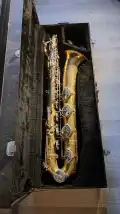
I bought this baritone saxophone, but I don't recognize the brand.

The bell says: Silversound
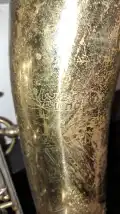
and in some places the initials HSC (see photos).

Can anyone give me more information about this saxophone?
 

Attachments

  • 20240519_204443.webp
    20240519_204443.webp
    95.9 KB · : 225
  • 20240519_205151.webp
    20240519_205151.webp
    32.5 KB · : 168
Hello everyone,

My band has disbanded, and they're selling their old instruments.

I bought this baritone saxophone, but I don't recognize the brand.

The bell says: Silversound
and in some places the initials HSC (see photos).

Can anyone give me more information about this saxophone?
A overall picture from right, left and LH pinky table would be helpful. The name and brace are not enough to go with.
 
Vote:
Upvote 0
The bell says: Silversound
Probably made for the south Korean Samick music corporation who bought the name silersound from Sears.
My father had a 5 valve (tube) AM radio that used the older octal socket valves from the 1950's, a Sears Silver Tone. He loved that radio, kept it working even after I graduated from high school in early 1970's.

Back then, I remembered music teachers warning us not to buy catalogue woodwinds. The large Sears catalogue the size of the old phone books had them, cheaper than music store woodwinds. The same thing teachers say now of cheap Internet listed Chinese woodwinds, said the same back then. "The metallurgy is softer, easier to dent, keys bend easily," etc.

They said the same of Yamaha woodwinds back in the late 1960's. My father bought me on clearance a Yamaha YAS-61 pro alto sax in early 1970's through my music teacher. It wasn't anything like that, played much better than the school standard brand name beginner loaner saxes.

Congratulations on your purchase of that Silver Sound bari, @Jinx2886 ! :thumb:
 
Vote:
Upvote 0
It's a beautiful bari.

How I've been able to comply with the 2 photo rule is to use photo editing software to combine two photos together, which then counts as one.

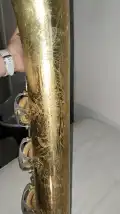
Your photo (I cropped here) shows the left pinky key table shot from the side.
2025-07-16 Sears Bari left pinky table.webp


To make more visible for sax identification, would help if you could rotate the sax 30° - 45° so that it is more visible.
 
Vote:
Upvote 0
Damn what a BEAST.

This one may be impossible to ascribe a factory to. @Woodpad may have given us the mother company, (nice contribution) but as to who they may have contrated their saxes to....or whether they had a sax factory, we dunno (?)

It is not (obviously) 'the usual suspects'...doesn't look old East Bloc, doesn't look early Japan, doesn't look Italian or French or USA....but has details both old-school and post-1970's.....

I would lean early Asian, based on the ferrules being screw-tension, but really...that's not a very terra-firma attribution...

@Jinx2886 ...does it play ? You mind my asking what you paid for it ?
 
Vote:
Upvote 0
Probably made for the south Korean Samick music corporation who bought the name silersound from Sears.
This one may be impossible to ascribe a factory to. @Woodpad may have given us the mother company, (nice contribution) but as to who they may have contrated their saxes to....or whether they had a sax factory, we dunno (?)
Going back as far as the 1950's - 1960's, there are a few mysteries with products manufactured in the Far East, which never made made any major importation to the West.

One is hobbyist model aircraft engines. Some models from makers like OS and Enya were strictly marketed in Japan and nearby Asian countries, but never made their way west except by those who purchased there, then returned home. Aside from OS and Enya, other lesser manufacturers actually copied Western and some Oriental engines, but due to their limited local market and literature in their native languages, regarding patents slipped under the radar, basically "Out of site, out of mind".

I am not saying that this particular model of Silversound sax is "illegal", but just to say that some product brands were not imported to Western markets with maybe the exception of major catalogue mail order sales like Sears, J.C. Penney, Montgomery Wards, and etc.
 
Vote:
Upvote 0
Going back as far as the 1950's - 1960's, there are a few mysteries with products manufactured in the Far East, which never made made any major importation to the West.

One is hobbyist model aircraft engines. Some models from makers like OS and Enya were strictly marketed in Japan and nearby Asian countries, but never made their way west except by those who purchased there, then returned home. Aside from OS and Enya, other lesser manufacturers actually copied Western and some Oriental engines, but due to their limited local market and literature in their native languages, slipped under the radar, basically "Out of site, out of mind".
Wasn't OS the house brand of Graupner for their model planes in the 1960s. When I read your post, I had this flash-back, I could be wrong but it really struck a memory.
 
Vote:
Upvote 0
Wasn't OS the house brand of Graupner for their model planes in the 1960s. When I read your post, I had this flash-back, I could be wrong but it really struck a memory.
From what little I have gleaned from various forum posts and magazine articles, Graupner was an importer of OS engines, who made them available to the European market. Graupner and OS had a partnership where OS / Graupner obtained the licencing from NSU to make a 0.30 cubic inch displacement Wankel Rotary Engine for modelling use. First model, the box listed both OS and Graupner with NSU credited. A later version, the model 2 was improved with OS listed on the box.

The Wankel was a delightful engine, but even new was expensive at $450 US some 20 years ago and an equivalent in power say to a .45 sport Schneurle ported engine. Those sold for around $50 US. It IMO was impractically priced, beyond most modellers' means, who opted for the less expensive alternatives.

Today on say Ebay, in low usage like new or new condition are now commanding $1,300 and higher. (But some apparently have more money than they know what to do with, as it is not unusual to hear of $20,000 US invested in a true turbine engine powered model aircraft crash and be reduced to fire wood kindling and lump of metal just like the real ones.)

 
Vote:
Upvote 0
From what little I have gleaned from various forum posts and magazine articles, Graupner was an importer of OS engines, who made them available to the European market. Graupner and OS had a partnership where OS / Graupner obtained the licencing from NSU to make a 0.30 cubic inch displacement ****el Rotary Engine for modelling use. First model, the box listed both OS and Graupner with NSU credited. A later version, the model 2 was improved with OS listed on the box.

The ****el was a delightful engine, but even new was expensive at $450 US some 20 years ago and an equivalent in power say to a .45 sport Schneurle ported engine. Those sold for around $50 US. It IMO was impractically priced, beyond most modellers' means, who opted for the less expensive alternatives.

Today on say Ebay, in low usage like new or new condition are now commanding $1,300 and higher. (But some apparently have more money than they know what to do with, as it is not unusual to hear of $20,000 US invested in a true turbine engine powered model aircraft crash and be reduced to fire wood kindling and lump of metal just like the real ones.)

Very cool, after 50 years to come across all these names, Very fond memories, I had a "Beginner" glider but no RC just a fuse to burn the rubber band that held the tail down, The rib construction of the balsa wood wings ...
 
Vote:
Upvote 0
Very cool, after 50 years to come across all these names, Very fond memories, I had a "Beginner" glider but no RC just a fuse to burn the rubber band that held the tail down, The rib construction of the balsa wood wings ...
You had a free flight soaring glider, probably tow-line that used a dethermaliser timer (length of "fuse" determined flight time prior to deployment) to prevent the classic OOS (Out Of Sight) flight. Tail pops up, ends flight and the glider sort of mushes, "parachutes" down.

Don't some saxists use a musical rest "dethermaliser" to go back to playing? When their cigarette burns down to the filter, it is time to go back on stage or rehearsal. (I'd have my 2nd hand smoke break with them.) 😉
 
Vote:
Upvote 0

Social

New! Social Feeds

Look out for the navigation icon:

Follow CafeSaxophone

Latest Song of the Month

Trending

Forum statistics

Topics
32,058
Messages
578,320
Members
8,127
Latest member
PJ2116
Back
Top Bottom