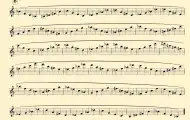
I'm not sure whether this practice tip applies to @Pete Thomas's 'surprisingly difficult' exercise. Or is useful for everyone.
At a recent Big Band 'sax section rehearsal'1, a couple of sax players (including me) struggled to play the 'String of Pearls' section above even at a lower tempo than the 'real tempo' (120 bpm). In my case due to lack of practice 🙁.
Our MD correctly observed that - while we could play the rest of the score without too much trouble - we 'panicked' when suddenly faced with this one section. So he obviously noted that at least some of us need to practice this one section more to build up 'muscle memory'. An obvious tip is start off by practicing slowly and gradually build up speed.
A second (useful) tip he gave was to start off by just playing the first note in each group of quavers. I.e. G, G♭, F, E, E♭, D. Just to get the 'beat' and the transitions right. Then add the last note of each group. Not difficult to play but which emphasise the transitions between G, G♭, F, E, E♭ and D. Then add the 3rd note of each group (the lead-up) into the practice. And finally, when we can play the section comfortably so far, add the 2nd notes of each group (which are an octave lower than the first note). He suggested that we might first want to just practice 'quickly dropping an octave'.
Skipping 'intermediate notes' in (for me) fast or complicated 'runs' is something I've learned to do over the years (with tips from MD's) in order to hit the 'main notes' on time. But this 'tip' from our MD was the first time that I'd heard of 'note skipping' as a practice method. It made sense to me.
Note 1: every 2 months or so we have 'section rehearsals' instead of full Big Band rehearsals. Our MD then focuses on specific 'sections' (rhythm, trombones, trumpets and saxes). Each 'section rehearsal' is an hour long so we fit 2 section rehearsals into our normal 'rehearsal time'. These 'section rehearsals' allow section members to propose and rehearse sections of various numbers that they find difficult to play. It also gives the MD to highlight areas in which he feels sections need to improve. And gives them tips to do this. For example at the 'sax section' rehearsal, one of his tips was to improve the 'balance' (in volume) in the section: alt saxes needed to make themselves 'heard' by playing louder, more confidently, etc.; in contrast tenor saxes needed to play less loudly so that the alt saxes (in general) have a slightly higher volume. To the tenor saxes, his tip was: if you can't hear the alt saxes, you're playing too loudly. On vocal numbers, his 'command' is: whatever the variable volume of the vocalist (soft, to loud) you always need to play with less volume.




 acebook
 (bottom of page)