

Tech/maintenance Saxophone Pad Acoustics Study

jbtsax

R.I.P. in memoriam 1947 - 2023
Messages
8,986
Location
Beautiful Springville, Utah USA
I don't know if anyone on this forum will be interested in this, but I am conducting a study to measure the "porosity" of saxophone pads made with different coverings and then have the same pads measured in a physics lab for "acoustic losses". The point of the study is to if there is a relationship between the porosity of a pad covering and its acoustic efficiency.

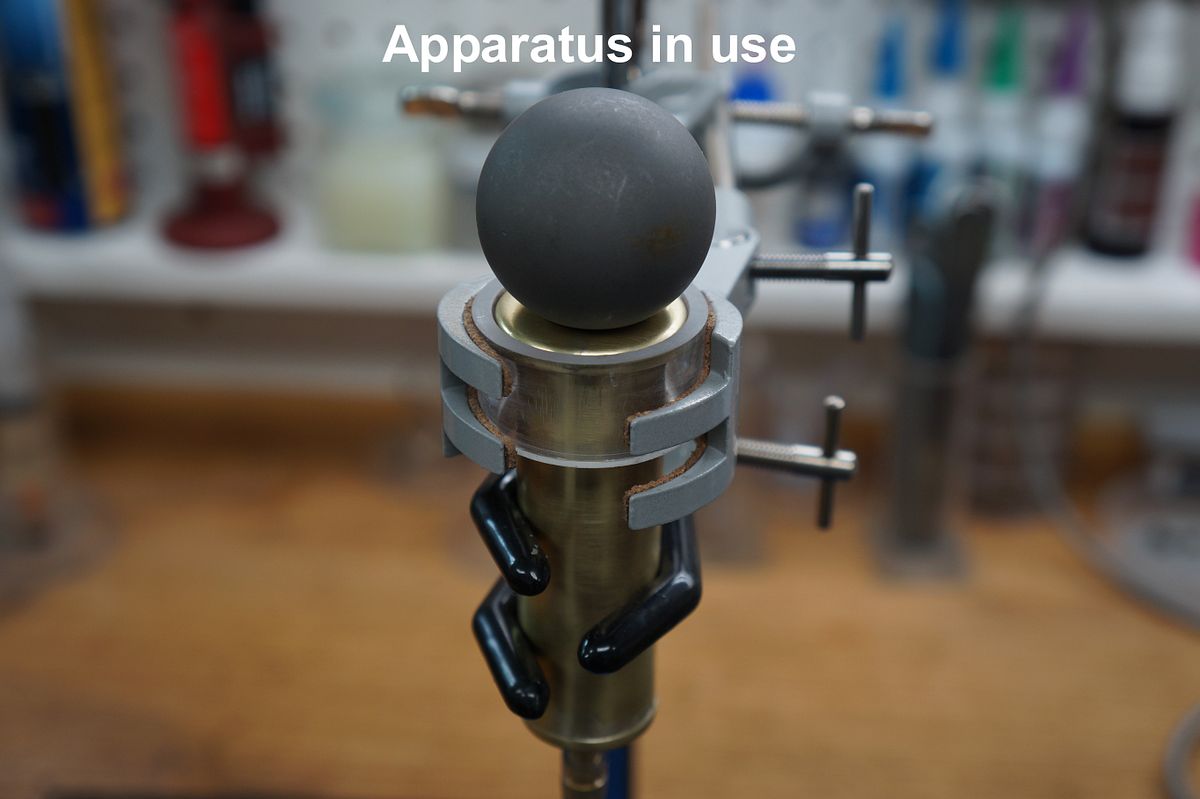
For example, it is well known that the kangaroo skin used for the no stick white roo pads tends to be more porous than pads made with traditional leathers. Some techs will not use these pads equating pad "porosity" with pad "leaks". Hopefully this study will shed some light on this topic. Shown below are some photos of the set-up used to test the "porosity" of the various pads.


 
Interesting idea. It'll probably be low, but measurable. Could be different depending on frequency as well. Both will go some way to explaining how resonators affect sound.

But will the direction of travel of the sound waves affect your results?
 
Looks interesting. How does it work? What's the scale for?
I made one of the pads out of neoprene to be the "control" pad which is perfectly airtight. I tried different weights of dent balls until I found the weight (206 grams) that gave a perfect zero reading at both pressures of 2 in H2O and 4 in H2O. The postal scale was to weigh the steel dent balls in grams.

Interesting idea. It'll probably be low, but measurable. Could be different depending on frequency as well. Both will go some way to explaining how resonators affect sound.

But will the direction of travel of the sound waves affect your results?

The acoustic scientist I am working with, Pauline Eveno has already done an excellent study of the effects of resonators by measuring the acoustic losses of pads with different types of resonators. She will use the same technique to measure and compare pads without resonators to see if the type of pad covering makes a difference as well. In the apparatus to test the acoustic losses, the direction of the sound waves is controlled by the cylindrical tube the pad sits on.
 
Have people been saying that saxes sound different with these different pad materials?
Are you joking? These are musicians we're talking about. They'd say sticking a small lump of blu-tack to the bell would make it sound different (as long as the blu-tack was special "acoustic" blu-tack and cost a small fortune).
There will, however, be absolutely no agreement about what the changes in sound are.
 
Yes, I suppose that's true. I was originally going to ask jbtsax if he has noticed any difference, that would probably have been a better question.
 
I often wonder .... The tone of a saxophone is it just the pure tone? Sound of a saxophone .... all the other sounds that we make when we are playing on our saxes?
 
Jbtsax experiment about sound will probably open the usual cans of worms, but I am really curious to know the outcome.

What kind of tube/sound producer will be used? I have some suggestions...
 
I made one of the pads out of neoprene to be the "control" pad which is perfectly airtight. I tried different weights of dent balls until I found the weight (206 grams) that gave a perfect zero reading at both pressures of 2 in H2O and 4 in H2O. The postal scale was to weigh the steel dent balls in grams.
.

So does the machine pull a steady vacuum on the cup/pad as the ball holds it down at a precise pressure? Are you then measuring a steady air stream on the meter or a leak down time?
 
So does the machine pull a steady vacuum on the cup/pad as the ball holds it down at a precise pressure? Are you then measuring a steady air stream on the meter or a leak down time?
I hope it actually increases air pressure: often pads seal well against suction but leak when blowing (pretty common on clarinets, where the suction test is easy)
 
So does the machine pull a steady vacuum on the cup/pad as the ball holds it down at a precise pressure? Are you then measuring a steady air stream on the meter or a leak down time?

Aldevis is correct in that it is positive air pressure. I wasn't going to go into this much detail, but here goes:

  1. The magnehelic (mag) machine named after the gauge it uses measures "differential" pressure or the "difference in pressure" between two enclosed areas.
  2. There are two chambers inside the gauge, one that is perfectly air tight and one that is connected by a hose to what you are trying to measure the "leakage" of.
  3. The scale of the gauge is 1 to 10 inches of water, so you set the incoming air pressure at whatever pressure you choose which becomes the air pressure in the airtight chamber of the gauge.
  4. If what you are trying to measure has no leakage at that pressure, then it gets a perfect reading of zero difference---what you are testing measures the same as the airtight chamber.
  5. Say if your initial pressure is set at 4 and your pad reads at .6, that means that the pad is losing .6 in of pressure by air seeping through the leather covering.
I hope this doesn't make it more confusing. Magnehelics are more commonly used on flutes, clarinets, and oboes with cork or bladder pads to detect leaks. They are not practical for saxophones because of the larger tone holes and types of pads used.
 

Social

New! Social Feeds

Look out for the navigation icon:

Follow CafeSaxophone

Latest Song of the Month

Trending

Forum statistics

Topics
32,056
Messages
578,154
Members
8,127
Latest member
PJ2116
Back
Top Bottom