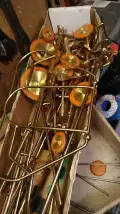
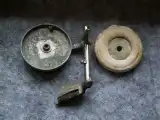
Tech/maintenance Replacing Buescher snap in pads with standard pads

I fail to understand what difference the standard metal resonator pads would make to the overall sound to this Buescher alto.
You'll get a greater dynamic range and probably a bit more volume too.
However, the payoff is likely to be that the midrange will be lifted, and that in turn comes at the cost of some of the warmth and darkness...which changes the inherent character of the horn.
It won't be by much - chances are you might not even notice it...at least until you play it side-by-side with an original spec horn. Whenever I've done that I've always preferred the sound of the original horn - it just sounds more cohesive and settled.
 
I fail to understand what difference the standard metal resonator pads would make to the overall sound to this Buescher alto.
The Snap-On botton and a standard metal reflector are roughly the same size. For me better reflectors/resonators is more a feeling. Brass or sterling silver for my saxes. Nylon, nickel plated, brass, silver plated ..... I can't hear any difference. Oversized I have a bigger tone (N.B. not louder). I don't like the idea that a pads should be kept in place with parts that can make some noise. Original, then we should use pads in the style à la Buescher (with metal back).
 
@saxmad i’m curious why you selected this instrument ? Sound? History? Collectible? Maybe it was a smart buy? Anything other than original you’ve stepped away from everything that makes this horn what it is.

@Stephen Howard @jbtsax i’ve spent a lifetime restoring things of old. Not uncommon at all for things to be serviced to “make work”. i’m sure some tech far away from the factory got creative.
Also repairs of the times and part of the historical journey. Bringing things back to original is often a challenging. The history and information is not often available.
@Stephen Howard how would you find the original reflector sizes for a Committee?

I recently had the pleasure of a COA on a 1936 6M transitional #269xxx.
100% original as it left the factory. Best I can tell the owner lost the neck early on. Placed in a garage never to be used again. A rare experience to dismantle one untouched.

The 6m original reflectors. I can only imagine how many hours the factory spent getting these sizes for desired sound dynamics.

398ED844-9A72-46CD-A5A8-0971F98EDA20.webp

It went back together with three new pads that were bug eaten. They were bagged and returned with the instrument.
 
@Stephen Howard how would you find the original reflector sizes for a Committee?
You'd have to find one in original spec and measure them...though I would imagine someone 'out there' has already done so on a web site somewhere. Unfortunately it's not something I generally keep a note of - unlike, say, the rod screw diameters and thread pitches.
 
Martin Handcraft Committee and Handcraft Comm II had more or less just a rivet. "The Martin XXXX" also had a rivet in the beginning. But in the end of the 50's they installed pads with reflectors/resonators. Martin called them oneboosters. What's really important is that a Martin Committee have thin pads (4 mm or thinner) and the factory set-up is important. I've seen Committees with too thick pads and wrong key heigts.

Martin Magna -59 original pads.
magnaputor.JPG

From 1960 sales cataloge. You can see the tone boosters.
magnaresonatore.jpg
 
You'd have to find one in original spec and measure them...though I would imagine someone 'out there' has already done so on a web site somewhere. Unfortunately it's not something I generally keep a note of - unlike, say, the rod screw diameters and thread pitches.
Funny thing is I keep a log book with everything done on each build. Sizes and specifications of everything but the physical body.
I’ve never recorded resonator sizes. I’ll get that 6m back and measure them.
 
Martin Handcraft Committee and Handcraft Comm II had more or less just a rivet. "The Martin XXXX" also had a rivet in the beginning. But in the end of the 50's they installed pads with reflectors/resonators. Martin called them oneboosters. What's really important is that a Martin Committee have thin pads (4 mm or thinner) and the factory set-up is important. I've seen Committees with too thick pads and wrong key heigts.

Martin Magna -59 original pads.
View attachment 21877
From 1960 sales cataloge. You can see the tone boosters.
View attachment 21878
Thanks for the information. Every Martin I’ve reworked I’ve used rivets. A pro player & tech friend of mine was shocked on my 28 gold plate handcraft. He had never played one on rivets. Really liked the sound. I also completely fill the back of the pad😉
Definitely 4 mm pads or less. I have this annoying habit of dry fitting. If a pad is a fuzz too thick I will iron the backside some.
 
I recently had the pleasure of a COA on a 1936 6M transitional #269xxx.
100% original as it left the factory. Best I can tell the owner lost the neck early on. Placed in a garage never to be used again. A rare experience to dismantle one untouched.

The 6m original reflectors. I can only imagine how many hours the factory spent getting these sizes for desired sound dynamics.

View attachment 21873
I am curious to learn whether Conn used those various sizes consistently. Why would they use, for instance, a larger reso on the low D than the bell keys? Was that to overcome a stuffy D issue?

When Juan Caino did up a set of custom resos for one of my Borgani tenors, I measured the diameter of every tone hole, and then he made up resos to achieve a consistent area fraction of coverage on each pad. The horn has a wonderful consistency of response and tone throughout its range (fully rebuilt by Matt Stohrer).
 
In the beginning the pads were thick and no rivets, washers, Snap-On bottons, ....later the started to install pads with a small rivet to make pads flat. With tinner pads and bigger washers the tone sound changed. Today pads with differnt types resonsators/reflectors are standard.

I installed oversized brass resonators/reflectors. I just wanted my bari to have these resonators. No saxtech her in Sweden or Denmark wanted to install the Resotechs. And to send my bari to USA was too risky and also connected with more money for the freight. A friend ( precision mechanic in the automotive indystry) helped me. We both share the interest for saxes and Rock & Roll Saxophone. I'm glad I did it. Not just because of the pads and resos. Also that we made it. It shows that two "blind" guys can lead each other ...!

Bari keys pads with ovesized resos.
barytonklaffar.jpg

Here is a very thick pad with screw and washer that was aimed to hold in/ make the pad flat. Not for the tone/sound Kohlert model 1927 soparano.

kohlertwasherscrew.jpg
 
I am curious to learn whether Conn used those various sizes consistently. Why would they use, for instance, a larger reso on the low D than the bell keys? Was that to overcome a stuffy D issue?

When Juan Caino did up a set of custom resos for one of my Borgani tenors, I measured the diameter of every tone hole, and then he made up resos to achieve a consistent area fraction of coverage on each pad. The horn has a wonderful consistency of response and tone throughout its range (fully rebuilt by Matt Stohrer).
Good question! I have absolutely no clue whatsoever. It’s my understanding reflectors are the diameter of the tone hole -5 mm. I wonder what Buesher snap-on sizes are ?
 
Good question! I have absolutely no clue whatsoever. It’s my understanding reflectors are the diameter of the tone hole -5 mm. I wonder what Buesher snap-on sizes are ?

Do other Conns use that rule of thumb more consistently than the horn you show? Those resos on the bell keys are substantially smaller than the D. Is it like that on other 6Ms?

We so often take one horn as representative of lot, and sometimes that can be misleading. For instance, there may have been a tech at sometime in that horn’s life that decided to replace the pad and used a larger reso to either fix a problem, or because it’s what he had.
I guarantee you this particular Horn is 100% original. All of the pivot points showed absolutely zero ware. The hinge rods showed no signs of use either. This was a very unusual find. I have no idea what the standard is ongoing on Conn reflectors. These kinds of things often changed frequently. This particular instrument still has a transitional era pivoting thumb hook. Yeah, I was surprised myself about those bell keys reflectors being much smaller. It’s more than just a little bit.
The 5mm sizing applies to more modern horns. I think…
According to the ad at this link Buescher Snap Ons In their catalog they listed the sizes in inches as:
7/32
9/32
7/16
9/16
3/4
7/8
Great link & information! Thanks :thumb:
 

Social

New! Social Feeds

Look out for the navigation icon:

Follow CafeSaxophone

Latest Song of the Month

Trending

Forum statistics

Topics
32,076
Messages
578,675
Members
8,134
Latest member
banjo
Back
Top Bottom